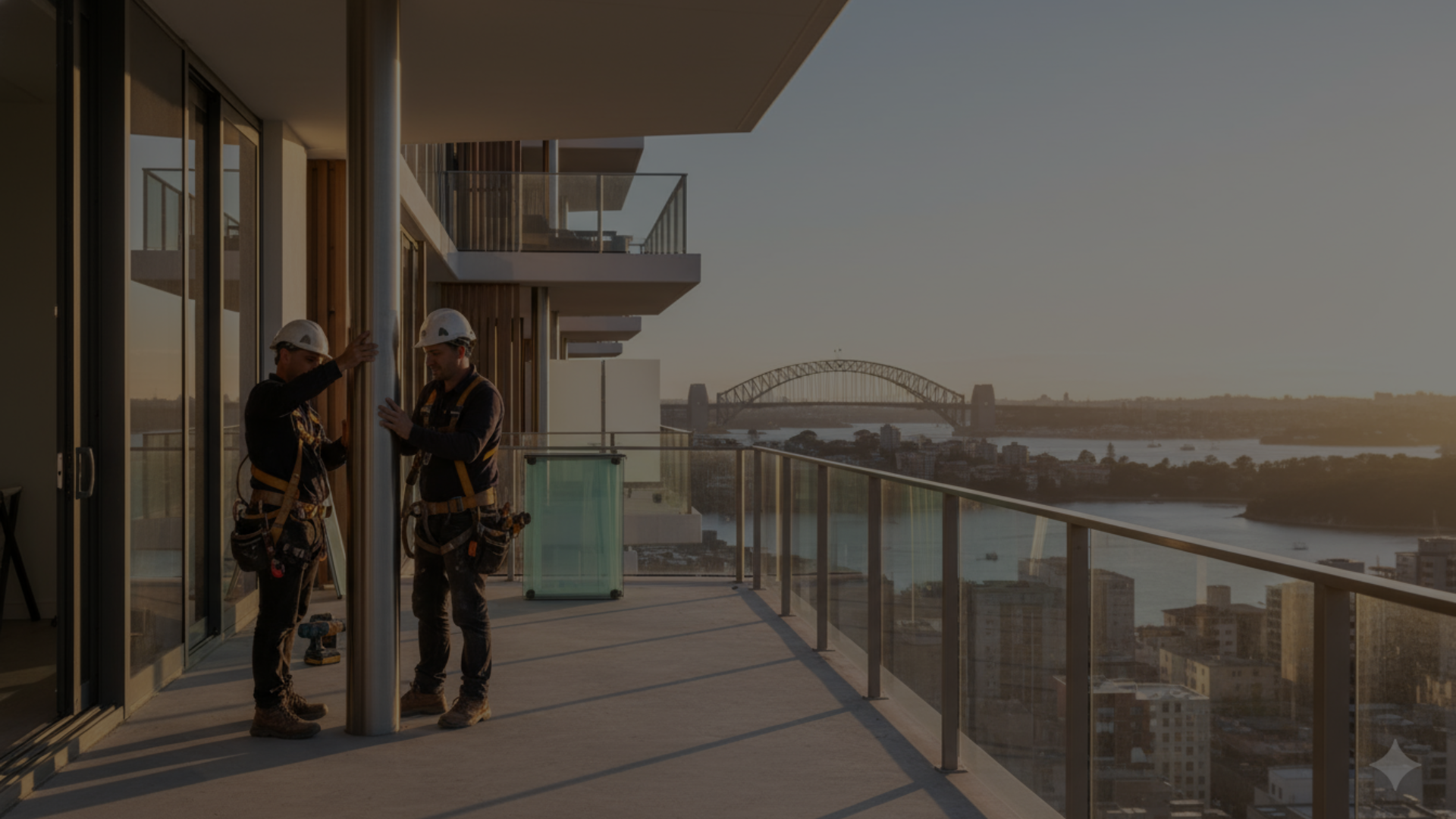
Balustrades are essential safety elements — but also a common source of façade deterioration and compliance risk. Older balustrades often feature corroding steel fixings embedded in concrete, leading to spalling, cracking, and potential failure. Glass balustrades may not meet modern loading or impact standards. Loose fixings or unstable handrails present direct safety hazards to occupants and the public below.
Our balustrade remediation service ensures that aesthetics, safety, and compliance all align.
Our Process
- Condition Assessment
- We assess balustrades for stability, corrosion, and compliance with NCC and Australian Standards (AS 1170, AS 1288, AS 1657).
- Demolition & Safe Removal
- Where required, old balustrades are carefully removed, ensuring surrounding concrete or brickwork is not damaged.
- Structural Repairs
- Any damaged substrates are repaired (concrete patching, brick reinforcement) before new systems are installed.
- New Balustrade Installation
- Options include stainless steel, aluminium, or glass systems, each designed for durability, minimal maintenance, and compliance with modern safety codes.
- Fixings & Waterproofing
- All penetrations are sealed with high-performance membranes and sealants to prevent water ingress at anchor points.
- Final QA & Certification
- Independent structural certification confirms that installations meet strength and safety requirements.
Key Considerations
- Compliance – Balustrade height, spacing, and loading must meet strict standards.
- Durability – Materials must resist corrosion in Sydney's coastal climate.
- Safety – Failures can be catastrophic; quality control is paramount.
Value to the Client
- Eliminates safety hazards and compliance risks.
- Modernises appearance with sleek, low-maintenance systems.
- Protects surrounding façade elements from water ingress.
- Provides peace of mind with independent certification.
- Enhances property value with updated, compliant systems.
Frequently Asked Questions
How do I know if my building's balustrades are compliant?
Balustrade compliance is assessed against the National Construction Code (NCC) and relevant Australian Standards including AS 1170 (loading), AS 1288 (glass in buildings), and AS 1657 (fixed platforms and access). Common non-compliance issues include insufficient height (NCC requires a minimum of 1 metre in most residential applications), inadequate load resistance, glass that doesn't meet safety glazing requirements, and anchor fixings that have corroded or pulled free from the substrate. A compliance inspection will confirm whether remediation or full replacement is required.
What is the most durable balustrade material for a coastal Sydney building?
For buildings within 100 metres of marine environments, marine-grade 316 stainless steel is the standard recommendation for metal components. Aluminium with anodised or powder-coated finishes also performs well. Glass panels should be toughened or laminated and mounted in marine-grade framing systems. Avoid standard 304 stainless or uncoated mild steel — these corrode rapidly in salt-laden air.
Do corroded balustrade fixings indicate a broader structural problem?
Yes — corroding fixings embedded in concrete are often a sign that the protective concrete cover is insufficient or carbonated, allowing moisture and chlorides to reach the steel. This can indicate wider concrete spalling and reinforcement corrosion issues on the balcony or balustrade zone. We always assess the surrounding concrete when remediating balustrade fixings to avoid addressing the symptom while missing the cause.
Will balustrade replacement require a development application (DA)?
In most cases, like-for-like balustrade replacement is classified as exempt development in NSW and does not require a DA. However, changes to design, height, materials, or heritage-listed buildings may trigger council approval requirements. We advise on this case by case and can assist with the relevant applications where needed.
What does independent structural certification involve?
Following balustrade installation, a RPEQ- or CPEng-certified structural engineer inspects the installation and issues a certificate of compliance confirming that fixings, loading capacity, and installation methods meet the relevant Australian Standards and NCC requirements. This certificate is an important document for the building's strata records and is often required for insurance and liability purposes.
Related Services