


Balcony waterproofing in Sydney costs $8,000–$25,000+ per balcony. The strata guide to the process, membranes, who pays, timelines and DBP compliance.
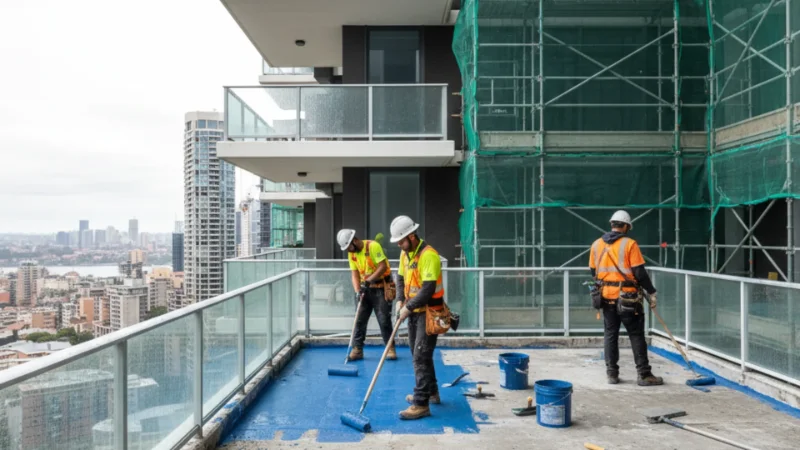
If your building is between 8 and 20 years old, its balconies are the most likely place for water to get in — and the most expensive place to ignore it. Waterproofing failure is the single most common serious defect in NSW strata buildings, accounting for around 42% of all documented defects in a 2023 NSW Building Commission and Strata Community Association assessment. On a balcony, that failure stays hidden under the tiles until it reaches the ceiling of the unit below.
This guide is for strata managers and owners corporation committees who know their balconies need waterproofing and want to understand the process, the cost, and the NSW compliance rules before they call a contractor. It covers how balcony waterproofing is actually done, what drives the price, which membrane suits Sydney conditions, who pays, and what the Design and Building Practitioners Act now requires.
Balcony waterproofing in Sydney ranges from around $1,500 for a minor patch to $8,000–$25,000 per balcony for a full strip-out and re-membrane, and $15,000–$40,000+ where concrete repair is also needed. A building-wide programme across 20–40 balconies typically runs $250,000–$800,000, depending on the mix of defects and access.
The price depends almost entirely on how far the damage has spread and how much of the balcony has to come apart. A full strip-and-seal — removing the tiles, screed and failed membrane, correcting the falls, then re-waterproofing and re-tiling — is the most common strata scope, and generally costs $150–$250 per square metre.
| Scope | What's involved | Typical cost (per balcony) |
| Minor / localised repair | Crack sealing, regrouting, drain clearing, small membrane patch | $1,500–$3,500 |
| Partial membrane repair | Re-waterproofing a defined failed area, sound substrate elsewhere | $3,500–$8,000 |
| Full strip-out & re-waterproof | Remove tiles, screed & membrane; correct falls; new membrane + tiles | $8,000–$25,000 |
| Structural repair + waterproofing | Concrete spalling repair to the slab before re-waterproofing | $15,000–$40,000+ |
| Building-wide programme (20–40 balconies) | Staged access, shared scaffold and mobilisation | $250,000–$800,000 |
Two costs committees routinely underestimate are access and concrete repair. For anything above ground level, scaffolding, swing stages or rope access can add 15–25% to the total — on a high-rise, the access can cost as much as the repair itself. And if water has already reached the steel, concrete spalling repair is a separate scope that has to be finished before any membrane goes back down. For a full cost breakdown by defect type, see our guide to what balcony repairs cost in Sydney. For a scoped price on your building, we quote balcony waterproofing in Sydney after a site assessment, not off a photo.
A proper balcony re-waterproof follows a fixed sequence: strip back the tiles and screed, repair the concrete substrate, re-establish correct falls to the drain, apply a membrane compliant with AS 4654.2, flood-test it for 24–72 hours to prove it holds, then re-tile. Skipping the flood test is the most common — and most costly — shortcut a contractor can take.
Each step exists for a reason. The strip-out is what turns guesswork into a fixed scope: until the tiles and screed are off, no one can see the true condition of the membrane or the slab. Correcting the falls matters as much as the membrane itself — if water pools instead of draining to the outlet, even a perfect membrane will be sitting in standing water for years. The membrane is then taken up the walls and around every penetration, because the threshold, the balustrade fixings and the drain are where balconies leak, not the open field in the middle.
Most strata balconies need balcony and terrace waterproofing taken back to the slab rather than a patch, because a partial repair only lasts until the next section of the original membrane fails. The waterproofing membrane replacement is only as good as the detailing around it — which is why the flood test, not the datasheet, is the real proof the balcony is watertight.
For most Sydney balconies, a liquid-applied polyurethane membrane is the best choice. It bonds seamlessly around drains, thresholds and balustrade fixings, bridges hairline cracks, and stands up to UV and foot traffic. It costs more upfront than a cementitious or sheet system, but delivers a longer service life in Sydney's exposure.
The reason comes down to movement and detail. Balconies expand and contract through Sydney's 35°C summers and cold, wet winters, so the membrane has to flex without splitting and has to seal complex shapes — internal corners, drain flanges, door thresholds — without a join. A quality liquid-applied polyurethane system installed to AS 4654.2, at the correct film thickness and with proper falls, will typically last 15–20 years. Cheaper membranes, or the right membrane installed badly, can fail in five to seven. The membrane brand matters far less than the preparation, the falls and the detailing — which is why the contractor's method, not the product name, is what you should interrogate in a quote.
In most NSW strata schemes the waterproofing membrane sits beneath the tiles and is common property, so the owners corporation is responsible for repairing and replacing it under section 106 of the Strata Schemes Management Act 2015. The surface tiles above it may be lot-owner responsibility, depending on the strata plan and by-laws.
In practice this means the OC — not the individual owner — usually carries the cost of a balcony re-waterproof, and it belongs in the capital works fund plan rather than being billed to one lot. Where the line falls between common property and lot property can be genuinely unclear on older schemes, so it's worth confirming against your strata plan before the argument starts. Our guide to who pays for remedial work in a strata scheme walks through the common scenarios. One procedural point to plan around: for any contract of $30,000 or more, your owners corporation must obtain at least two quotes before it can commit, which affects both your timeline and how you scope the work.
Yes. On Class 2 apartment buildings, balcony waterproofing is regulated building work that must be carried out by a practitioner registered under the Design and Building Practitioners Act 2020, with a regulated design and compliance declarations lodged on the NSW Planning Portal. From 1 July 2026, that practitioner must also hold professional indemnity insurance.
This is not a formality — it changes who carries the risk. If unregistered trades re-waterproof a Class 2 balcony, the work is non-compliant from day one and the exposure lands back on the owners corporation. Before you engage anyone, verify their registration on the NSW Government public register at verify.licence.nsw.gov.au, ask for their current PI certificate, and confirm they will lodge the regulated design and declarations on the Planning Portal. Registered building work also carries a statutory warranty — six years for major defects, two years for minor — which is only worth anything if the practitioner was registered in the first place.
Allow 4–12 weeks for strata approval before work starts, then about 3–4 weeks per balcony for a full strip-out and re-waterproof, including concrete cure times and the mandatory flood test. A building-wide programme of 20–40 balconies usually takes 4–8 months of site works, running several balconies at once.
The approval stage is the part committees underestimate. Between the investigation report, obtaining the required quotes, a committee resolution and — if a special levy is needed — an extraordinary general meeting and levy notice period, the paperwork can take longer than the physical repair. The site works themselves are governed by cure times that can't be rushed: the screed has to dry, the membrane has to cure, and the flood test has to run its full 24–72 hours before tiling. Residents generally stay in their units but lose balcony access for the three to four weeks their unit is being worked on, so a proper resident communication plan — with at least two weeks' notice per unit — is part of running the job well.
The clearest signs are water stains or blistering paint on the ceiling of the unit below, efflorescence or mould at the balcony-to-wall junction, and tiles that lift, crack or sound hollow underfoot. Any of these means water is already past the membrane — and the repair only gets more expensive from there.
By the time one unit reports a leak, the same failed detail has usually let go on the balconies above and below it, because they share the construction and the exposure. That's why a single balcony leak is often the trigger for a building-wide condition assessment rather than a one-off repair. If you're trying to work out whether what you're seeing is cosmetic or structural, our guide to why a balcony leaks and what the repair involves covers the diagnosis. The economics are simple: re-waterproofing a balcony early costs a fraction of rebuilding a spalled slab later.
Atomic Projects is a Class 2 DBP-registered remedial building practitioner that has delivered more than $20M of remedial work across 100+ Sydney strata buildings — from single $50k balcony repairs to $5M+ facade and waterproofing programmes, on projects from St Leonards to Alexandria. Every balcony job follows the same documented process: investigation with moisture mapping, structural engineer engagement where the slab is affected, a compliant membrane installed to AS 4654.2, a witnessed flood test, and all compliance declarations lodged on the NSW Planning Portal.
We work on occupied buildings as standard, with staged access programming and a resident communication plan built into the programme. If your building has balcony leaks or ageing membranes and you want to understand the scope, cost and timeline before you take it to the committee, get a free balcony assessment. We'll walk the building, review any existing reports, and give you a clear picture of what's involved.

Send photos, the engineer's report, or just the symptoms — whatever you've got. A registered builder reads it and calls you back. No call centre, no obligation.