


Concrete cancer in your Sydney strata building? Here's what causes it, how to identify it, what repairs cost in 2026, and what the new NSW capital works fund rules mean if you defer.
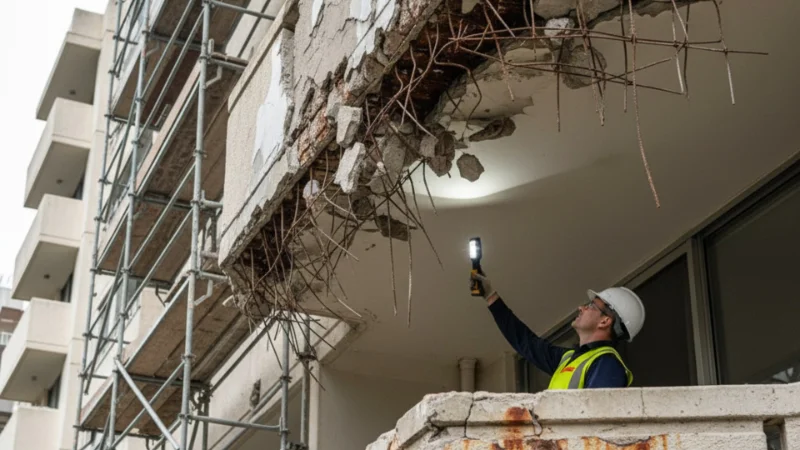
If you're seeing rust stains running down a concrete soffit, hairline cracks tracking along a balcony edge, or chunks of render falling onto common property — that's not a cosmetic problem. That's concrete cancer, and in a Sydney strata building, it compounds month after month until either the owners corporation acts or the structure forces the issue.
This guide is written for strata managers, building managers, and committee members who suspect their building has it, have been told their building has it, or have a defect report sitting on the desk recommending repairs. It covers what concrete cancer actually is, how to identify it before it becomes structural, what repair costs look like in Sydney in 2026, and what the consequences are of deferring the work.
"Concrete cancer" isn't a technical term — engineers call it reinforcement corrosion or reinforced concrete deterioration. The mechanism is straightforward, but the consequences compound.
Concrete is alkaline. The steel reinforcement bars (rebar) inside it are protected by that alkalinity — a thin passive oxide layer forms on the steel and prevents it from rusting. The concrete is doing two jobs: providing compressive strength, and protecting the steel that provides tensile strength.
That protection breaks down when one of two things happens:
Once the protection fails, the steel rusts. And here's the problem: rust occupies up to seven times the volume of the steel it replaces. The expanding rust generates internal pressure that splits the surrounding concrete from the inside. Cracks open. Concrete spalls off. More water and chloride reach the steel. The corrosion accelerates.
This is why concrete cancer is progressive — and why it doesn't fix itself.
Most strata managers identify concrete cancer by symptom, not by inspection. Here's what to look for, in roughly the order it appears:
Brown or orange streaks on soffits, balcony edges, columns, or stairwells. The rust is migrating from the rebar through micro-cracks to the surface. Sometimes the cracks aren't visible yet — but the staining tells you the chemistry has already failed.
Cracks that run in straight lines, parallel to the rebar pattern (typically every 200–300mm), are diagnostic. They form because the rust is forcing the concrete apart along the path of the steel. Random cracking is usually shrinkage or settlement. Linear cracking is corrosion.
Once the cracking advances, chunks of concrete break off and expose the rebar underneath. On balconies, soffits, and parking structures this becomes a safety hazard. In Sydney strata buildings, spalled concrete falling onto common property is one of the most common triggers for an emergency body corporate meeting.
If you can see the rebar, the corrosion is well advanced. The steel will be visibly rusted, often pitted, and sometimes reduced in cross-sectional area. At this stage the structural capacity of the element has measurably decreased.
White crystalline deposits on the concrete surface mean water is moving through it. Water carries chloride and accelerates carbonation. Where you see efflorescence, you're seeing the entry point for the chemistry that drives the corrosion.
Concrete cancer is not random. It concentrates in the parts of a building that combine three conditions: aggregated water exposure, carbonation pathway, and inadequate cover to the reinforcement. In Sydney, that means:
Concrete repair pricing depends on access, scale, and method. The figures below reflect Atomic Projects' quoting experience across Sydney strata buildings in 2025–2026.
$1,500–$5,000 per location. Suitable for isolated spalls — typically a balcony edge or a single soffit area. Includes breaking out failed concrete, treating reinforcement with a corrosion inhibitor, and reinstating with a polymer-modified repair mortar. Good for triage. Not a long-term solution if the underlying driver (membrane failure, carbonation, chloride) hasn't been addressed.
$30,000–$120,000 per building. Where a defect report has identified 8–30 separate repair locations across balconies, soffits, and common areas. Typically requires scaffolding or rope access. Most strata buildings facing this scope are dealing with deferred maintenance from a previous decade.
$25,000–$60,000 per balcony, depending on size and access. Includes removing the existing finish, repairing all corroded reinforcement, applying new waterproofing, and reinstating the tile or topping. For a typical 30-unit Sydney apartment building with widespread balcony issues, full rectification commonly runs $400,000–$1.2 million across the project.
$80–$200 per square metre of treated area. Used on heritage buildings, basements, and large facades where conventional patching isn't economic. Either galvanic anodes embedded near the reinforcement or impressed-current systems with a low-voltage DC supply. Stops corrosion at the chemistry — but requires upfront investigation, design, and ongoing monitoring.
$1.2M–$4M+ for a typical mid-rise. Where corrosion has progressed to the point that structural capacity is compromised — usually because the building has deferred remediation through multiple committee cycles. At this point engineering propping, full element replacement, and resident relocation may be required.
These figures are indicative ranges based on typical Sydney strata projects. Actual scope and pricing depend on the specific defect report, access conditions, and engineering specification for your building.
The most expensive mistake in concrete repair is patching the visible damage without addressing the cause. Here's what happens when you do:
The patched area is now harder, denser, and more alkaline than the surrounding concrete. The corrosion that was occurring at the patch location stops — but it accelerates at the boundary of the patch, where the new alkaline material meets the old carbonated material. This is called the incipient anode effect (or "halo effect"), and it means within 2–5 years a new spall typically appears immediately adjacent to the previous repair.
This is why Atomic Projects' default methodology on concrete remediation is fix the source, not the surface:
The April 2026 NSW strata reforms changed concrete cancer from a deferred maintenance item into a documented obligation. Owners corporations now have to:
If a defect report has flagged concrete deterioration in your building and the committee has not acted, that defect now needs to be in the capital works plan with a budget and a schedule. Hiding it is no longer an option. We've covered the new framework in detail in our guide to what the 2026 capital works fund changes mean for your remedial budget.
A quote tells you what a contractor will charge for what they can see. A condition assessment tells you the full extent of the corrosion, the underlying drivers, and the works program required. For a typical 6–12 storey Sydney apartment building, expect to pay $10,000–$25,000 for a comprehensive assessment with concrete testing. On a project that may exceed $500,000, that's the cheapest investment in scope accuracy you'll make.
Concrete remediation is engineering work, not bricklayer's work. Your contractor should be working to a specification prepared by a qualified structural or remedial engineer, with formal hold points and QA documentation. Without this, you have no defence if the repair fails or if a future Section 184 disclosure is challenged.
A contractor who quotes only on the visible damage without investigation is either inexperienced or planning to make a margin on variations once the work exposes more deterioration than expected. Both outcomes are bad for the owners corporation. Walk away.
Most strata buildings can't fund a full remediation program in year one. Staging works across two to five years is normal and acceptable under the new compliance framework, provided the plan is documented, costed, and prioritised by structural risk. Urgent safety items first. Progressive deterioration managed across the program.
Spalling is the visible symptom — concrete breaking off the surface. Concrete cancer (reinforcement corrosion) is the underlying cause. Not all spalling is corrosion-driven, but in Sydney strata buildings the overwhelming majority is.
It varies with the driver. A balcony with a failed membrane can move from rust staining to structural spalling in 12–24 months. A coastal facade with chloride attack typically progresses over 3–7 years before becoming critical. The point is that it accelerates, not that it follows a fixed timeline — once the rust has started, the cracks it creates expose more steel to more moisture, and the rate of corrosion increases.
Generally no. Most strata insurance policies exclude gradual deterioration, which is how concrete cancer is classified. Acute damage from a one-off event (impact, fire, storm) is usually covered. Progressive corrosion from chloride or carbonation is not. Check your policy schedule — and don't budget for insurance recovery on a remediation project.
No. Sealing the surface without addressing the corrosion accelerates the underlying damage by trapping moisture against the steel. Some elastomeric coatings designed for carbonation barrier applications are legitimate engineering interventions — but they are part of a treatment plan, not a substitute for one.
A competent condition assessment includes concrete testing (carbonation depth, chloride content, half-cell potential mapping), thermal imaging where appropriate, and physical inspection of representative areas. If your report contains only visual observations and a list of locations, it's a starting point — not a complete scope. Ask your engineer about testing.
Remedial repair preserves the existing structure by treating the corroded reinforcement, restoring the concrete profile, and addressing the corrosion driver. Full replacement removes and rebuilds the affected element. For most Sydney strata buildings, remedial repair is the right answer — replacement is usually only justified where structural capacity has been compromised or where the element cannot be cost-effectively repaired in place.
Atomic Projects is a Class 2 registered remedial builder specialising in concrete repair, waterproofing, facade remediation, and structural works for strata and commercial buildings across Sydney. If your building has concrete deterioration in the defect report or you've identified visible signs of corrosion, book a free site assessment. We'll walk the building, review your engineer's report, and give you a defensible scope before you commit to a quote.

Send photos, the engineer's report, or just the symptoms — whatever you've got. A registered builder reads it and calls you back. No call centre, no obligation.