


NSW's 10-year defect insurance covers structure, waterproofing & fire safety. Learn what that means for your building's remedial works — from a Class 2 builder.
If you're on a strata committee or managing a residential apartment building in NSW, you've probably started hearing about decennial liability insurance. The legislation is moving, the government is promoting it, and the insurance industry is positioning for it. But here's the question nobody is answering clearly: what does DLI actually cover in practical terms, and what does the remedial work look like when a claim succeeds?
As a Class 2 registered building practitioner that delivers remedial and capital works across Sydney's strata buildings, we see the defects that DLI is designed to address every week. This guide explains what 10-year defect insurance means in real construction terms — not legal theory.
Decennial liability insurance is a 10-year insurance product taken out by the developer or builder before a new apartment building is occupied. The policy attaches to the building itself, not the developer — meaning it protects successive owners for the full 10-year period, even if the original developer becomes insolvent or ceases trading.
In NSW, DLI operates as a strict liability product. That means the owners corporation doesn't need to prove who caused the defect or establish fault before making a claim. If a covered defect exists, the insurer pays for the remediation. This is a fundamental shift from the current system, where owners corporations often spend years and hundreds of thousands of dollars in legal proceedings before any repair work begins.
DLI is currently available as a voluntary alternative to the Strata Building Bond and Inspections Scheme (SBBIS) under an amendment to the Strata Schemes Management Act 2015. The Fair Trading and Building Legislation Amendment Bill 2026 signals the government's intent to transition DLI from voluntary to mandatory.
DLI covers "serious defects" in three critical building systems: structure, waterproofing, and fire safety. Those terms sound straightforward. In practice, they encompass the most expensive and technically complex remedial work we deliver on strata buildings.
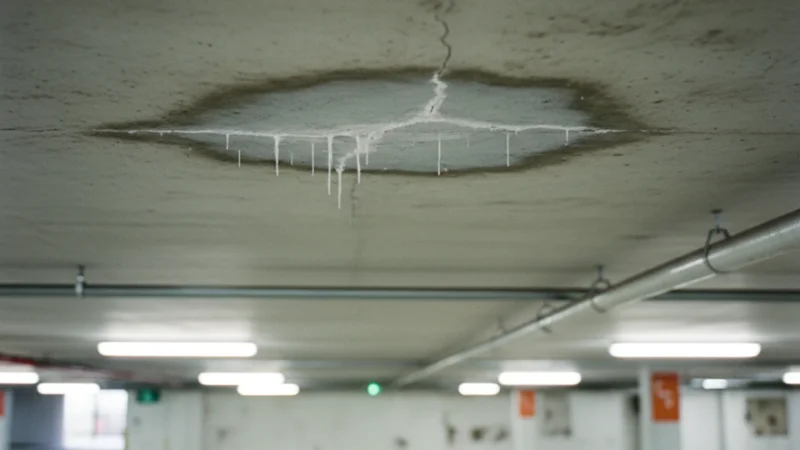
Structure means the load-bearing elements of the building — concrete slabs, columns, beams, walls, and foundations. When these fail, the defects typically present as concrete cancer (spalling caused by reinforcement corrosion), cracking in post-tensioned slabs, or settlement-related structural movement. Structural defect rectification on a mid-rise apartment building typically costs $200,000–$800,000 depending on the extent, and requires engineering design, propping, concrete removal, reinforcement treatment, and patch repair or member strengthening. This is specialist work that requires a registered Class 2 building practitioner under the Design and Building Practitioners Act 2020.
Waterproofing covers the membranes and systems that prevent water ingress through roofs, balconies, podiums, planter boxes, and wet areas. When waterproofing fails, the immediate symptom is leaking — but the secondary damage is where the real cost sits. Water ingress into concrete accelerates reinforcement corrosion, damages internal finishes, creates mould issues, and can compromise fire-rated elements. Waterproofing membrane replacement on a strata building typically involves full membrane strip and re-application, drainage remediation, and reinstatement of finishes — a scope that runs $150,000–$600,000+ depending on the area and access constraints.
Fire safety encompasses fire-rated construction, sprinkler systems, smoke detection, egress paths, and — critically — combustible cladding. Since the post-Grenfell regulatory response, fire safety defects have been among the most urgent and expensive remedial items on strata buildings. Cladding replacement alone can cost $500,000–$2 million+ on a mid-rise building, and the regulatory framework under Project Remediate and the Environmental Planning and Assessment Act adds layers of compliance complexity.
DLI is designed for serious defects in critical building systems. It does not cover cosmetic defects, wear and tear, maintenance items, or defects in elements that aren't structural, waterproofing, or fire safety related.
This distinction matters because many strata buildings have defects that fall outside DLI's scope but still require significant remedial work. Facade remediation — cracking render, failed sealant joints, corroded fixings, delaminating tiles — is one of the most common remedial scopes we deliver, and it may not be covered by DLI unless the facade failure also constitutes a structural or waterproofing defect.
The practical implication: DLI reduces risk for the most catastrophic defect categories, but owners corporations still need to maintain a properly funded strata capital works plan that accounts for all remedial and maintenance liabilities — not just those covered by insurance.
This is the question we hear most from strata committees. The short answer: DLI applies to new buildings only. If your building was completed before DLI becomes mandatory, the policy won't retrospectively cover existing defects.
But the legislative environment around DLI signals a broader regulatory shift that affects every strata building in NSW. The Building Commission is escalating enforcement against non-compliant developers. In early 2026, two developers were prosecuted in the Land and Environment Court for failing to comply with Building Work Rectification Orders, and the Commission has flagged enforcement action against 30 more.
For existing buildings with defects, the message is clear: the regulatory framework is tightening, and the expectation is that defects will be identified, reported, and rectified — whether through DLI for new buildings or through proactive remedial programs for existing ones. Owners corporations that defer investigations and remedial work are increasingly exposed to compulsory management provisions and compliance action.
This is where every other guide on DLI stops. The insurance pays out — but then what?
When a DLI claim is accepted, the insurer funds the remediation. But the owners corporation still needs to manage the remedial construction process. That means engaging a registered Class 2 building practitioner to scope the work, obtaining engineering design for structural repairs, managing access and staging in an occupied building, coordinating with residents, and ensuring the completed work meets current standards and codes.
The remedial works process for DLI-covered defects typically follows this sequence:
1. Investigation and diagnosis. A qualified building consultant or structural engineer assesses the defect, determines root cause, and defines the repair methodology. For structural defects, this includes concrete testing (carbonation depth, chloride content, half-cell potential mapping). For waterproofing failures, this includes moisture mapping and membrane condition assessment.
2. Scope of works and engineering design. The investigation produces a detailed scope of works. For structural repairs, this requires engineering design to AS 3600. For waterproofing, it requires specification of membrane systems to AS 4654 and AS 3740.
3. Builder engagement. The remedial work must be carried out by a registered building practitioner. For Class 2 buildings (residential apartments four storeys and above), this means a Class 2 registered builder under the DBP Act. Not all builders hold this registration — and using an unregistered operator creates compliance risk for the owners corporation.
4. Construction delivery. Remedial works on occupied strata buildings are logistically complex. Residents need to be notified and managed, noise and access restrictions apply, staged scaffolding may be required, and the work must be sequenced to minimise disruption. These factors add 15–25% to the cost compared to equivalent work on an unoccupied building.
5. Certification and warranty. Completed remedial work must be certified by the engineer and builder, with as-built documentation, warranty provisions, and compliance certificates lodged as required.
This entire process requires strata remedial building services delivered by a contractor experienced in occupied building work — not a residential builder or general contractor.
If your building is new (completed after DLI becomes mandatory): Confirm with your strata manager that a DLI policy is in place. Understand what's covered and what's not. Maintain a capital works fund that covers non-DLI items.
If your building is existing (pre-DLI): DLI won't protect you retrospectively. The most important step you can take is to commission an independent building investigation to understand your current defect profile. If structural, waterproofing, or fire safety defects exist, they need to be scoped, costed, and included in your 10-year capital works plan — because no insurance is coming to cover them.
Regardless of building age: The regulatory trajectory in NSW is unmistakable. The Building Commission is enforcing harder, the DBP Act is expanding to more building classes, and capital works planning requirements are tightening. Buildings that have identified and addressed their defects proactively will be in a materially stronger position than those that deferred.
Atomic Projects is a Class 2 registered building practitioner specialising in structural defect rectification, waterproofing, facade remediation, and fire safety upgrades for strata buildings across Sydney. We deliver the remedial works that DLI is designed to fund — and the remedial works that existing buildings need regardless of insurance coverage.
If your owners corporation wants to understand the true remedial condition of your building, we offer a free site assessment to identify defect types, estimate remedial costs, and help you plan the path forward.
Combustible cladding sits at the top of the typical work list — see our cladding replacement page for compliance and documentation requirements.

Send photos, the engineer's report, or just the symptoms — whatever you've got. A registered builder reads it and calls you back. No call centre, no obligation.