


What do remedial building works cost in Sydney? Concrete repair, waterproofing, facade and structural work — real cost ranges and budgeting guidance for strata.
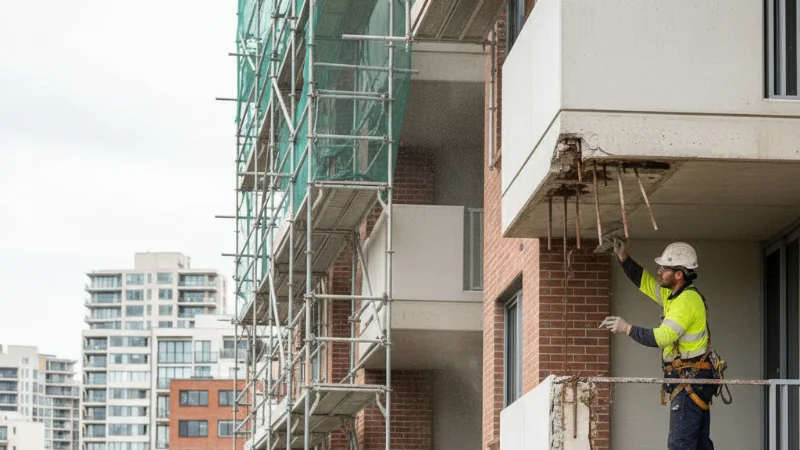
If you sit on a strata committee or manage a building in Sydney, you've probably received a defect report with a price tag that made you pause. Remedial building works aren't cheap. But the real problem isn't the cost — it's that most strata managers go into the quoting process with no idea what's reasonable.
This guide breaks down the actual cost ranges for the most common types of remedial work in Sydney, what drives those costs up or down, and how to structure your capital works fund plan so the numbers don't ambush your committee at the next AGM.
We're writing this as a remedial building contractor — not a cost estimator or quantity surveyor. These are the ranges we see across real projects in Sydney, not theoretical figures from a textbook.
Before looking at specific numbers, understand the five factors that move every remedial project's price:
1. Scope and severity of defects. A hairline crack in a ground-floor balcony slab is a different job to widespread concrete cancer across a 12-storey facade. The scope of work — how much building fabric is affected and how deep the damage goes — is the single biggest cost driver. Minor surface repairs might take a few days. Full structural remediation of a podium deck can run for months.
2. Access requirements. How your contractor reaches the work changes the price dramatically. Ground-level balcony repairs might need nothing more than basic scaffolding. Facade work on a 15-storey tower requires full scaffold systems or rope access, which can add 20–40% to the total project cost. Swing stages, mast climbers, and building management units each have different cost profiles. Access is often the most underestimated line item in remedial budgets.
3. Building age and construction type. A 1970s concrete building with original waterproofing will have different remedial needs than a 2005 rendered block. Older buildings often carry hidden defects that only emerge during investigation — which is why contingency matters (more on that below). Heritage buildings carry additional constraints: conservation management plans, council approvals, and specialised materials that cost more.
4. Investigation and design. Every remedial project starts with understanding what's wrong. A building investigation report from a specialist engineer defines the scope, identifies root causes, and specifies the repair methodology. Investigation and design typically accounts for 5–15% of the total project cost, depending on complexity. Skipping this step to save money is the most expensive mistake a committee can make — you'll pay for it in scope changes, rework, and failed repairs.
5. Market conditions and timing. Remedial construction in Sydney is capacity-constrained. Qualified remedial builders with Class 2 registration under the Design and Building Practitioners Act are a limited pool. Booking 3–6 months ahead typically gets better pricing and scheduling than emergency procurement. Sydney's construction market also sees seasonal variations — waterproofing work is best scheduled during drier months to avoid weather delays.
The ranges below reflect Sydney market pricing as of early 2026. They cover the contractor's scope (labour, materials, access, project management) but exclude separate consultant fees (structural engineer, building surveyor) unless noted.
This covers spalling concrete, concrete cancer (carbonation or chloride-induced), crack repair, structural strengthening, and carbon fibre reinforcement.
The cost per square metre for concrete and structural repairs varies widely based on depth of carbonation, reinforcement condition, and access. Surface-level patch repairs can run $150–$400/m². Deep concrete cancer treatment with reinforcement protection and structural patch repair typically runs $400–$900/m². For a detailed breakdown of concrete-specific pricing, see our guide to concrete repair costs in Sydney.
This covers balcony membrane replacement, podium waterproofing, planter box remediation, bathroom waterproofing (common property), and basement tanking.
Waterproofing remediation costs are heavily influenced by whether existing finishes (tiles, pavers, planters) need to be demolished and replaced. A balcony where the membrane has failed under tiles requires full demolition, new falls, new membrane, and new tiling — the membrane itself is a fraction of the total cost.
This covers render repairs, facade coating systems, curtain wall remediation, and combustible cladding replacement.
Facade remediation on high-rise buildings is access-intensive. Scaffold costs alone on a 12–15 storey building can run $80,000–$250,000 depending on duration and complexity. This is why facade projects have some of the widest cost ranges — the access cost is proportionally large, and it scales with building height, not just defect area.
This covers passive fire (compartmentation, penetration sealing, fire doors), active fire (detection, alarms), and wet fire (sprinkler systems).
Fire safety costs depend heavily on the existing building infrastructure. A building that was designed with sprinklers but has non-compliant penetrations is a very different project from one that needs a full sprinkler retrofit. Council fire safety orders (Fire & Rescue NSW or council) often come with deadlines that reduce your negotiating leverage on price.
The contractor's quote is only part of the picture. Budget for these as well:
Consultant fees. Structural engineer, building surveyor, waterproofing consultant, heritage consultant (if applicable). Typically 5–15% of the project cost, paid separately. For complex projects, you may also need a principal certifier and an independent superintendent.
Resident impact costs. If balcony or bathroom remediation requires residents to vacate temporarily, the OC may need to cover relocation costs or temporary accommodation. This is uncommon for most projects but can be significant for large-scale bathroom waterproofing programs.
Make-good and finishes. Remedial work often requires removing and replacing finishes — tiles, paint, render, ceiling linings. The structural repair might cost $50,000, but the make-good to restore the area to its original condition can add 30–50% on top.
Contingency. Every remedial project should carry a contingency of 10–20% of the contract value. Older buildings should sit at the higher end. Remedial work reveals hidden defects — you'll find problems behind walls, under membranes, and inside concrete that weren't visible during investigation. A 15% contingency isn't pessimism; it's planning.
Compliance and documentation. Under the NSW Design and Building Practitioners Act, registered practitioners must lodge designs and compliance declarations on the NSW Planning Portal. This adds a documentation layer that didn't exist before 2021. It's a small cost in absolute terms, but factor it into your timeline and contractor selection process.
If your building has defects — or is approaching the age where they're likely — here's a practical budgeting framework:
Step 1: Commission an independent investigation. Don't budget from guesswork. A building investigation report gives you a defect inventory, priority ranking, and indicative cost ranges. This is the foundation of your capital works plan. It typically costs $5,000–$25,000 depending on building size and complexity.
Step 2: Get a detailed scope and specification. Once the investigation is complete, your engineer produces a scope of works and specification. This document is what contractors quote against. The more detailed the scope, the more comparable the quotes — and the fewer surprises during construction.
Step 3: Obtain 2–3 quotes from registered remedial contractors. Under the DBP Act, your contractor must be registered with NSW Fair Trading and carry Professional Indemnity insurance (mandatory from July 2026). Don't compare just on price — compare on methodology, program, access strategy, and track record with similar buildings.
Step 4: Add contingency and consultant fees. Take the mid-range quote and add 10–20% contingency plus consultant fees. This is your realistic project budget. Present this to the committee and fund it through the capital works plan or a special levy.
Step 5: Plan the funding. NSW strata schemes must maintain a capital works fund plan (the new standard form applies from April 2026). For remedial works, you'll typically fund through a combination of existing capital works reserves and special levies. Your strata manager can advise on the levy structure and collection timeline.
Strata committees often face pressure to accept the lowest bid. Here's why that approach backfires with remedial work:
Remedial construction is specialised. The contractor needs to understand building pathology — why the defect occurred, not just what it looks like. A patch repair over active concrete cancer will fail within 2–5 years. A waterproofing membrane installed without correcting the falls will leak again within 12 months. The cheapest quote often reflects a superficial scope that addresses symptoms, not causes.
The cost difference between a proper repair and a patch job is typically 20–40% at the quoting stage. The cost difference after the patch job fails and you need to redo the work is 150–200% — because now you're paying for demolition, remediation of the original defect plus the damage caused by the failed repair, and new finishes. The committee that "saved" $80,000 on the first quote ends up spending $250,000 two years later.
Look for contractors who can explain their methodology, show you similar completed projects, and provide a maintenance plan for the repaired areas. The right contractor for a $300,000 remedial project is not the one who quoted $180,000 — it's the one whose scope matches the engineer's specification and whose track record shows the work will last.
A professional remedial contractor's estimate should include:
If a quote arrives as a single lump sum with no breakdown, ask for a detailed schedule of rates. You need visibility into where the money goes — both for committee approval and for managing variations during construction.
If your building needs remedial work and you're trying to understand the costs, start with a building investigation. It gives your committee a clear picture of what's wrong, what it will cost to fix, and what happens if you delay.
At Atomic Projects, we provide detailed scopes and estimates based on engineering specifications, with transparent cost breakdowns and no hidden lump sums. If you'd like to understand what your building's remedial work will cost, request a scope and estimate or call our team to discuss your building's condition.
Surface-level patch repairs typically run $150–$400/m². Deep concrete cancer treatment with reinforcement protection runs $400–$900/m². The range depends on depth of carbonation, reinforcement condition, and access requirements.
Minor repairs (single balcony, localised concrete) take 2–6 weeks. Moderate projects (multiple balconies, waterproofing program) run 2–6 months. Major structural or facade remediation on a high-rise can run 6–18 months depending on staging and access.
Yes, and it's common for strata schemes with large scope. Your engineer can prioritise defects by urgency — safety-critical items first, then weatherproofing, then aesthetic restoration. Staging lets you spread the cost across multiple levies. The trade-off is that some defects get worse with time, so delaying non-urgent work may increase the eventual cost.
Under the NSW Design and Building Practitioners Act, regulated building work (structural, waterproofing, fire safety, building envelope) on Class 2 buildings must be carried out by a registered practitioner. From July 2026, this extends to Class 3 and 9c buildings. Minor cosmetic maintenance is generally exempt.
Remedial builders specialise in diagnosing and repairing building defects. General builders construct new buildings. The skills, materials, and methodologies are different. A remedial contractor understands building pathology — why failures occur and how to prevent recurrence — which is critical for durable repairs.

Send photos, the engineer's report, or just the symptoms — whatever you've got. A registered builder reads it and calls you back. No call centre, no obligation.