


Seven specific signs of water ingress in strata buildings, what each one indicates, and what action it warrants. Written for strata managers triaging between cosmetic and structural risk.
Water ingress in a strata building rarely announces itself. By the time water is dripping through a unit ceiling or pooling at a stairwell landing, the damage has typically been compounding for months — sometimes years — through symptoms most committee members have walked past without recognising.
This guide lists seven specific signs that water is moving through your building's structure, what each one is actually telling you, and what action it warrants. It's written for strata managers, building managers, and committee members trying to triage between "we'll keep an eye on it" and "we need an engineer's report this quarter".
Three rules to read this list with:
What it looks like: White or off-white powdery deposits on concrete, brick, or render surfaces. Usually appears on soffits, balcony edges, retaining walls, and basement columns. Sometimes mistaken for paint failure or surface dirt.
What it indicates: Water is moving through the structure, not just over it. As water passes through concrete or masonry, it dissolves calcium hydroxide and other soluble salts, deposits them on the surface as it evaporates, and leaves the white crystalline residue. Where you see efflorescence, you're seeing the exit point of a water pathway — and water that's moving through the structure is reaching the reinforcement steel.
What action to take: Find the entry point. Efflorescence on a balcony soffit usually means the membrane on the balcony above has failed. Efflorescence in a basement usually means a planter or above-grade drainage detail is leaking. Don't seal or paint over it — that traps moisture and accelerates underlying corrosion. Get a building condition assessment that traces the water pathway to its source.
What it looks like: Brown or orange streaks running down a concrete surface, often most visible after rain. Sometimes localised at a single point, sometimes following a line.
What it indicates: Reinforcement corrosion is already occurring inside the concrete. The rust is forming on rebar, expanding through micro-cracks, and migrating to the surface as water moves through the cracks. By the time staining is visible, the corrosion mechanism has been operating for months to years — the concrete cover has been compromised, and the steel inside is actively losing cross-section.
What action to take: Treat as a structural issue, not a finish issue. A condition assessment with concrete testing (carbonation depth, chloride content, half-cell potential) will tell you the extent of the corrosion and whether it's localised or systemic. Budget for remediation — see our guide to concrete cancer in Sydney strata buildings for cost ranges. Patching the staining without addressing the corrosion is a textbook expensive mistake.
What it looks like: Cracks 0.1–0.5mm wide running in straight lines across a concrete surface, often parallel and spaced at regular intervals (typically every 200–300mm). Most visible on soffits, balcony edges, and exposed concrete columns.
What it indicates: Linear cracking that follows a regular pattern is almost always rebar-induced. The reinforcement bars inside the concrete are corroding and expanding (rust occupies up to seven times the volume of the steel), forcing the surrounding concrete apart along the path of the steel. Random cracking is usually shrinkage or settlement. Linear, regularly-spaced cracking is corrosion.
What action to take: Get a structural engineer's review before any cosmetic repair is attempted. The pattern of the cracking tells the engineer where the rebar is, how far the corrosion has progressed, and what scope of remediation is warranted. Don't fill the cracks with sealant — sealing a crack over corroding rebar creates a moisture pocket and accelerates the deterioration.
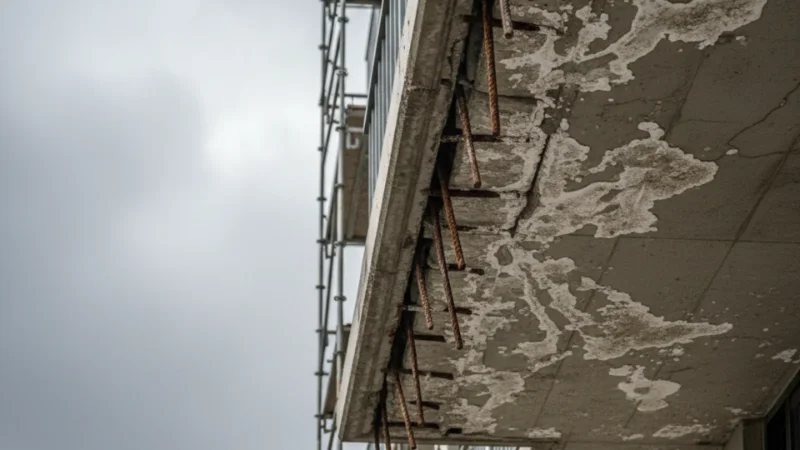
What it looks like: Chunks of concrete or render breaking away from a surface, often exposing rust-stained reinforcement underneath. Frequently appears at balcony edges, soffit corners, and column bases. Sometimes the spalled material is found on the ground or on a balcony below.
What it indicates: Advanced reinforcement corrosion. The internal rusting has generated enough pressure to fracture the concrete cover entirely. At this stage the structural element has measurably lost capacity, and the falling debris is a safety hazard for residents and visitors.
What action to take: Treat as urgent. The immediate risk is falling debris — particularly from balconies, soffits, and overhead awnings. Cordon off affected areas until an engineer has reviewed. Notify the strata committee and update the capital works register. Spalling on a Sydney strata building typically warrants an emergency budget allocation rather than waiting for the next AGM cycle. Under the 2026 strata reforms, an unactioned spalling defect creates direct liability for the owners corporation if it appears in subsequent disclosure.
What it looks like: Discoloured patches on plasterboard ceilings or walls inside units, common areas, or stairwells. Often darker in the centre and lighter at the edges. May be accompanied by paint blistering, peeling, or a musty smell. Sometimes mould forms at the same location.
What it indicates: Active water ingress to the interior. The water has crossed the building envelope — typically through a failed waterproofing membrane (above a balcony or planter), a failed flashing detail, or a service penetration that wasn't sealed. Each rain event delivers more water to the affected location, expanding the damaged area and degrading the structure beneath.
What action to take: Trace the source by looking at what's directly above the affected location. If a unit ceiling is damp and the unit above has a balcony — the balcony membrane has failed. If a stairwell wall is damp and there's a planter or roof feature above — that's the source. Photograph the damp patch on multiple visits over a fortnight to confirm whether it's expanding (active) or stable (historical). Active ingress requires immediate scope to identify and fix the entry point. Don't repaint until the source has been resolved — paint over moisture fails within weeks.
What it looks like: Tiles that have separated from the substrate underneath. Visible signs include hairline cracks running through tiles, grout lines that have opened, individual tiles that have lifted at the edges, and tiles that produce a hollow drumming sound when tapped (use the back of a screwdriver).
What it indicates: The tile bond has failed — usually because water has penetrated through grout or perimeter joints, saturated the screed underneath, and broken the bond between the tile, the adhesive, and the substrate. Once tiles drum, water is moving freely beneath the finish, and the waterproofing membrane below is either failed or compromised. The tile is acting as a lid on a water-saturated cavity.
What action to take: This is the leading indicator on most Sydney strata balconies. By the time a tile is visibly lifting, the membrane below has typically been compromised for 12–24 months. Get a balcony condition assessment that includes lifting representative tiles to inspect the substrate and the membrane. Budget for full balcony rectification — see our balcony waterproofing cost guide for current Sydney rates.
What it looks like: After rain, water sits on a balcony, podium, rooftop, or common-area surface for hours instead of draining away. Sometimes visible as standing water in low spots. Sometimes evidenced by tide-line staining where water has repeatedly sat and evaporated.
What it indicates: The drainage falls have failed — either because the slab has settled, because the original construction had inadequate falls, or because the drainage outlets are blocked or poorly placed. Standing water on a waterproofing membrane reduces its service life dramatically, even when the membrane itself was correctly installed. Water that doesn't drain finds another path — through cracks, through penetrations, through deteriorating seals.
What action to take: Photograph the pooling 30 minutes and 2 hours after rain stops to document the drainage failure. Get a survey of falls — modern waterproofing standards (AS 4654.2) require minimum 1:100 falls to drainage. If the falls don't comply, fixing them requires removing the existing screed and reinstating with correct falls. This is part of a full rectification, not a top-up repair. Budget accordingly under the capital works plan.
One sign in isolation might be cosmetic. Two or more in the same area — particularly any combination of efflorescence, rust staining, and spalling — represents an active corrosion mechanism that requires structural assessment. The seven signs above don't need all to be present to warrant action; any pair of them on the same balcony, soffit, planter, or facade element is enough.
Under the April 2026 NSW strata reforms, owners corporations are now required to document known defects in the standardised 10-year capital works fund plan with estimated costs and timelines. Section 184 certificates issued at lot sale must disclose outstanding capital works. Compliance notices from NSW Fair Trading attract on-the-spot fines of up to $5,500, plus the appointment of a compulsory strata managing agent at the owners corporation's expense. The signs above aren't just maintenance items — they're documented obligations.
It depends on the driver. A failed balcony membrane can move from efflorescence to spalling in 18–36 months. A coastal facade with chloride attack progresses over 3–7 years. The point is that progression accelerates — once the corrosion has started, the cracks it generates expose more steel to more moisture, which increases the rate of corrosion further.
If the sign is rust staining or spalling, yes — both indicate the corrosion mechanism is already active inside the structure. If the sign is only efflorescence or damp patching, monitor for a fortnight. If the symptom expands or new symptoms appear, commission an assessment. For Sydney strata buildings older than 25 years, a routine condition assessment every 5 years is good practice regardless of visible symptoms — particularly under the new capital works fund reporting requirements.
For a typical 6–12 storey Sydney apartment building, a comprehensive assessment with concrete testing costs $10,000–$25,000 depending on building size, access, and the depth of investigation needed. For a building facing a $400,000+ remedial program, this is the cheapest investment in scope accuracy you'll make.
Thermal imaging is a useful diagnostic tool but not a substitute for physical investigation. It identifies temperature differentials that often indicate moisture, but interpretation requires experience — surface heating, insulation gaps, and reflective surfaces all create false positives. Use thermal imaging as part of an assessment, not on its own.
No. The action depends on extent and progression. A single localised sign with no progression over 6 months may warrant monitoring and a planned future repair. Multiple progressing signs across a building system (all balconies, the whole facade, the planter line) typically warrant a staged remediation program documented in the capital works plan.
Worth raising with the engineer who prepared it. A competent condition assessment should include systematic photographic recording of all visible symptoms, with locations mapped to the building's drawings. If you can see signs that aren't in the report, ask whether they were assessed and what the conclusion was. Don't proceed with remediation works on a report that hasn't documented what you can see.
Atomic Projects is a Class 2 registered remedial builder specialising in waterproofing remediation, concrete repair, and water-ingress investigation for Sydney strata buildings. If you've identified two or more of these signs in your building, book a free site walkthrough. We'll inspect the visible symptoms, review your engineer's defect report (if you have one), and give you a defensible scope before you commit to a remediation budget.

Send photos, the engineer's report, or just the symptoms — whatever you've got. A registered builder reads it and calls you back. No call centre, no obligation.