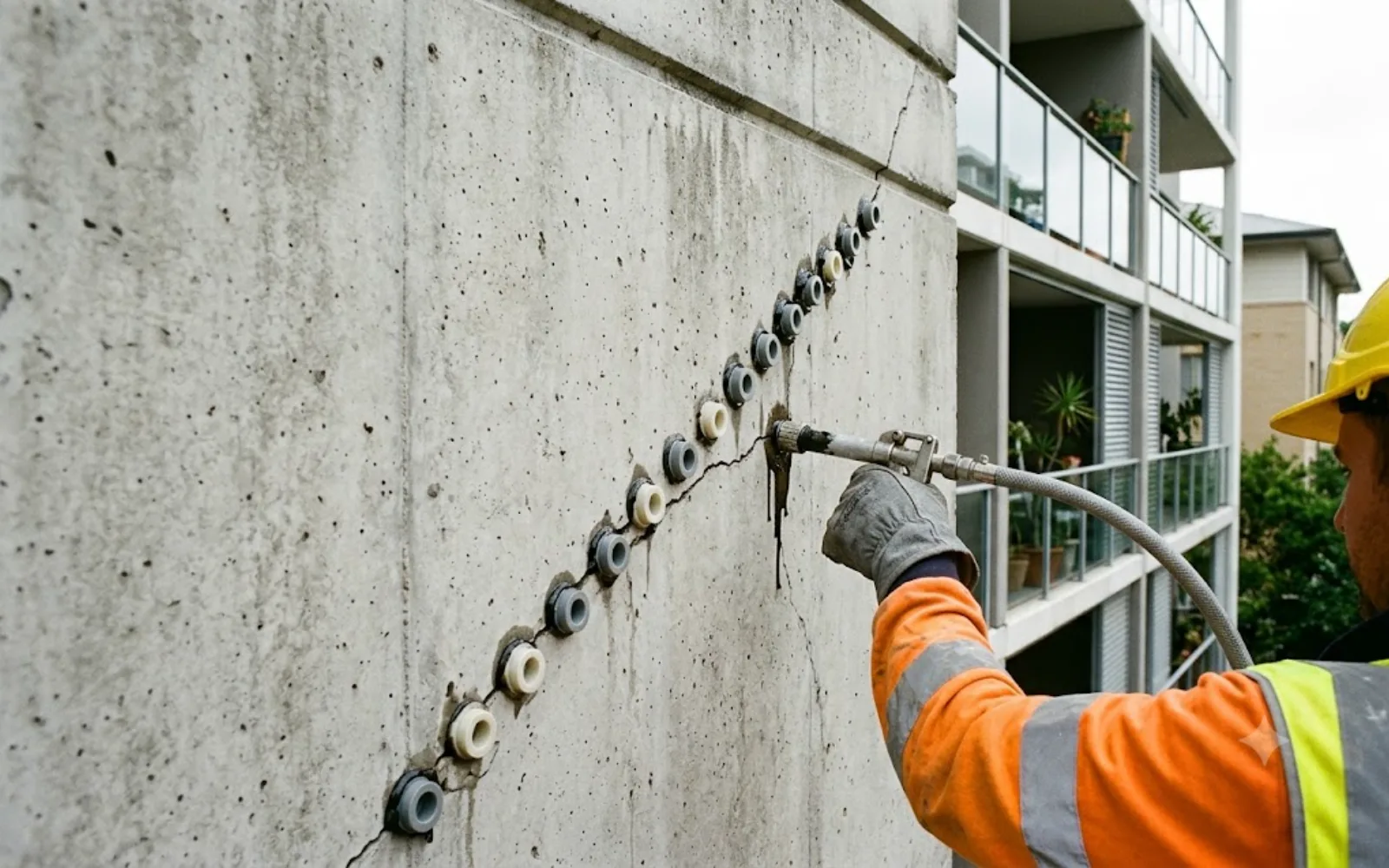
Concrete cracks can occur from shrinkage, movement, settlement, overload, or corrosion-related damage. Left untreated, they can allow water ingress, accelerate reinforcement corrosion, and compromise the structural performance of the element. Crack injection is a proven remedial method for restoring integrity and waterproofing, but it must be designed for the crack's nature — epoxy for structural bonding, polyurethane for flexible, waterproof sealing.
Selecting the wrong resin type is one of the most common mistakes in crack injection work. Epoxy in a moving crack will re-open within months; polyurethane in a structural crack won't restore load-transfer capacity. Atomic Projects assesses each crack individually before specifying the injection system — this diagnosis step is what separates a durable repair from one that fails prematurely.
How We Deliver Crack Injection Repairs
- Investigation & Crack Mapping
- Measure crack width, length, and pattern to identify cause and movement potential.
- Moisture content testing to determine if the crack is active and leaking.
- Surface Preparation & Port Installation
- Clean crack surfaces of dust, laitance, and loose material.
- Install injection ports at calculated intervals (typically 150–300mm) for full-depth penetration.
- Seal crack surface with a temporary epoxy paste to prevent resin escape.
- Resin Selection & Mixing
- Epoxy Injection – High-strength adhesive resin to structurally re-bond cracked concrete.
- Polyurethane Injection – Hydrophobic or hydrophilic resin to form an elastic, waterproof seal in moving or wet cracks.
- Controlled Injection Process
- Inject resin under calculated pressure to avoid blowouts or further cracking.
- Monitor backflow at adjacent ports to ensure complete fill.
- Finishing & Quality Assurance
- Remove surface seals and ports once resin has cured.
- Grind flush and apply protective coatings if required.
- Conduct adhesion and leak testing to verify performance.
Applications
- Structural Beams & Columns – Restoring load-bearing capacity.
- Basement Walls & Lift Pits – Sealing against groundwater ingress.
- Podium Slabs – Preventing water migration to occupied spaces below.
- Façade Elements – Arresting crack propagation in exposed surfaces.
Why Atomic Projects for Crack Injection
- Material-Specific Expertise: We use resin systems from leading manufacturers like Sika, Parchem, and Fosroc, matched to the exact crack profile.
- Movement Analysis: We differentiate between static and dynamic cracks to avoid premature failure.
- Engineer-Verified: All structural injection works are performed under engineering specifications for certification.
Frequently Asked Questions
How do I know if a crack needs epoxy or polyurethane injection?
The key factors are whether the crack is structurally active (still moving) and whether it's wet. Static, dry cracks in load-bearing elements are candidates for epoxy injection to restore structural continuity. Cracks that show movement (seasonal, thermal, or load-related) or are actively leaking water should be sealed with polyurethane resin, which remains flexible and waterproof. Our team will assess each crack before specifying the system — the wrong choice leads to premature failure.
Can crack injection be done without disrupting building occupants?
In most cases, yes. Crack injection is a relatively contained operation that can be performed in basements, plant rooms, and exposed structural elements with minimal disruption to residents or tenants. The process doesn't generate significant dust or noise. Access to the internal face of walls or slabs is sometimes required, which may need brief notification to affected lots.
Is crack injection a permanent repair?
For static cracks in non-moving structures, epoxy injection creates a repair that is often stronger than the original concrete — it can be considered permanent where the cause of cracking has been addressed. Polyurethane injection in moving cracks is a durable waterproof seal rather than a structural repair, and may require periodic inspection and maintenance over time as building movement continues.
What is the cost of crack injection versus full concrete replacement?
Crack injection is almost always significantly more cost-effective than demolishing and replacing a structural element. For beams, columns, basement walls, and podium slabs, targeted injection can restore integrity for a fraction of the cost of structural replacement. The key is catching cracks early before they widen, multiply, or allow sufficient water ingress to initiate reinforcement corrosion.
Does crack injection require council or certifier approval?
For most remedial crack injection in existing buildings, no separate Development Application is required — the works are carried out under the building's maintenance and repair obligations. Where works are part of a larger structural remediation that changes the use or structure of the building, an engineer's report and potentially a construction certificate may be required. We can advise on approval requirements as part of our scope assessment.
Related Services
Crack injection isn't just about "filling a gap." Done properly, it's precision surgery for your concrete — restoring integrity, stopping leaks, and extending the structure's life for decades. As a Class 2 Registered Builder with over 10 years of experience in remedial works across Sydney, Atomic Projects delivers crack injection repairs specified to engineering standards and verified for performance. Call us on 0410 515 509 or email hello@atomicprojects.com.au to arrange an assessment.