
It's your levy and your lot value on the line.
When a defect goes unfixed, it's owners who carry the cost — a special levy you didn't budget for, and a unit that's harder to sell. We give you the evidence and the costed scope to get your owners corporation acting, not deferring.
No obligation. We respond within 24 hours.
Get evidence for your commitee



Give your committee something they can't defer.
Most owners can't get the owners corporation to act on a defect because there's nothing concrete in front of it — just a vague worry, no clear scope and no number. So it gets deferred for “another report,” and the defect quietly gets worse.
We fix that for you. We carry out a proper investigation, write a plain-English costed scope, and give you the evidence to put in front of the committee — so the OC can vote on real figures instead of kicking it down the road another year.
Get evidence for your committee →We confirm what's actually wrong
An independent investigation you can put in front of the committee — so the conversation starts with a confirmed cause, not a guess about whether it's serious.
We cost it in plain English
A scope owners who aren't builders can actually read and vote on — line by line, in money, not jargon — so nobody on the committee can say they didn't understand it.
We show what acting now saves vs deferring
We lay out what it costs to fix now against what it costs to wait — so the levy conversation at the AGM is about facts, not fear, and the committee has a reason to vote yes.
We can deliver it — residents in place
Once the OC approves, we stage the works around residents, document every step, and hand over a complete record.
Where an owner gets stuck on a defect — and how we help at each point.
As one owner you don't control the decision — the owners corporation does. Things stall at four points: spotting it, getting the OC to act, who pays, and the works actually happening. Here's the trap at each, and how we help you get past it.
Knowing it's serious.
You see a crack or a leak but can't tell cosmetic from structural — so you're not sure it's worth raising, and nothing happens.
We assess it and tell you straight whether it's urgent.
Getting it on the agenda.
You raise it at the AGM without evidence, and it gets deferred for “another report” — so a year goes by and the defect keeps spreading.
We give you a costed scope the committee can vote on.
Knowing who's liable.
Owners assume it's their bill — or assume it's definitely not — and the confusion over who pays stalls the whole thing.
We scope the work; your strata manager confirms the OC-vs-lot split.
Works that actually happen.
Even approved works stall on a builder who can't deliver around residents — so the OC hesitates to commit, and it drags out.
Staged in place, documented, closed out.
A deferred defect is your levy later — and your lot value now.
When the OC defers a defect, it doesn't go away — it gets more expensive and starts showing up where it hurts you. The cost lands on every owner, and it lands hardest the longer it's left.
Your share of the levy only grows
Caught early, it's a manageable special levy spread across the block. Caught late — once the defect has spread — it's a much bigger one, and every owner pays a slice of the difference, including you.
It shows on your sale
Open defects surface in strata reports and pre-purchase inspections. A buyer's solicitor sees an unresolved issue and it knocks value off every lot in the block — or kills the sale altogether.
The OC's duty doesn't remove yours to push
Under the Strata Schemes Management Act the owners corporation must maintain and repair common property — but in practice it's often an individual owner who has to push to get it actioned before it worsens.
What waiting actually costs you — not just the building.
When an owners corporation defers a defect, the whole-building number grows — and so does your slice of it. This is an illustrative model of a typical defect across a ~40-lot block, showing one owner's share. Real figures vary with unit entitlements and the confirmed scope — it's illustrative, not a quote.
Figures are an illustrative model of one owner's share — assuming a ~40-lot block with equal entitlements — not a quote or a guarantee. The point is the curve, not the exact number: your real figure depends on your unit entitlements and the confirmed scope. We're not selling the number; we're showing why a defect is cheaper to your levy now than later.
The proof is in the projects.
Three real owners-corporation programmes that got approved and delivered — with residents staying in their homes throughout, every stage on the record. The kind of outcome you can point your committee to.
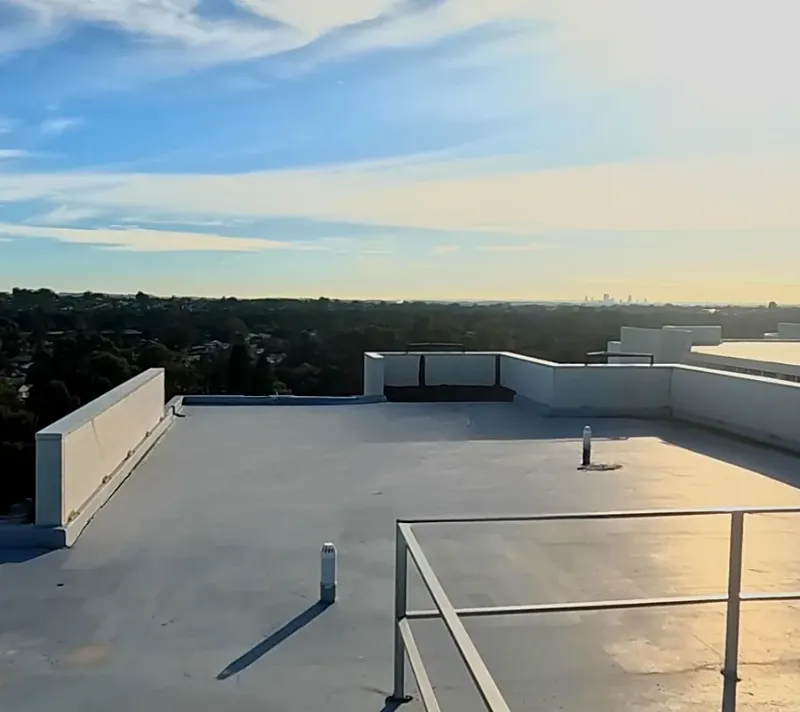
Mid-Rise Strata — Warwick Farm
One residential tower with active roof leaks. Rooftop waterproofing had failed and water was getting into the units below every time it rained. We stripped the roof back to substrate, found the root-cause of failure at service penetrations and installed a new sheet membrane system with proper falls and drainage.
"They set up their team and completed the works all at once, not a single day of lost time was caused."
— STRATA MANAGER, WARWICK FARM

Mid-rise strata — Killara
A root-cause investigation traced concrete cancer and cracking through the internal slabs to magnesite topping — so a full slab remediation was needed to restore the structure. We removed the drummy concrete, treated and replaced corroded steel, and reinstated with Sika repair mortar under the direction of a Class 2 Design Practitioner. Residents stayed in place the whole time.
"Residents stayed in place the entire time — the staged works kept the building safe and the disruption minimal."
— COMMITTEE MEMBER, KILLARA
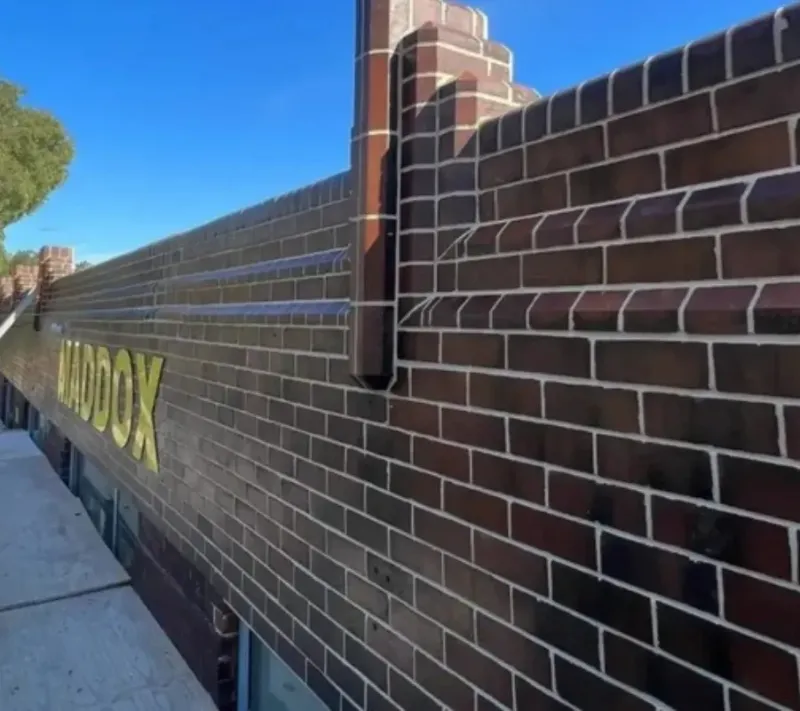
Low-rise strata — Alexandria
Bricks detaching from a heritage facade directly above the footpath — a falling-debris risk to pedestrians. Run under a Class 2 registered practitioner: a full restoration program of repointing, brick replacement, crack stitching with stainless steel helicals and corbel rebuilds, with the compliance trail documented throughout. Facade stabilised in two months with zero compromise to the building's original character.
"Bricks were literally falling onto the footpath. They made it safe within days and then restored the whole facade."
— STRATA MANAGER, ALEXANDRIA
Acting now vs hoping it holds.
There's a real gap between fixing a defect properly now and waiting to see if it holds — and most of that gap lands on owners. Here's how the two play out for you.
How to get a defect actioned — and what to send us.
A committee defers what's vague and acts on what's concrete. The way to get a defect off the “another report” pile is to put it on the agenda with evidence behind it. Here's what a committee needs to vote yes, and what to send us so we can build it.
What gets a defect actioned
Put these six things in front of the committee and there's very little left to defer — it becomes a yes/no on real numbers, not a maybe on a worry.
A confirmed cause — not a worry. An independent assessment of what's actually wrong.
A costed, plain-English scope — that owners who aren't builders can read and vote on.
What it costs to wait — the price of acting now against deferring another year.
Who's liable — the OC-vs-lot split, confirmed by your strata manager.
Staging so residents stay — so nobody has to move out for the works.
Documentation — a record the OC can stand behind and refer back to.
What to send us
The more of this you have, the faster we can give you something the committee can act on. Don't have it all? The defect and the building are enough to start.
Photos of the defect — from inside your lot or the common area.
Any strata report or minutes — that mention the issue, if you have them.
Your next AGM or committee date — so we work to your timeline.
The building address & rough number of lots — to gauge scale and your share.
Whether other owners are affected — it strengthens the case to the committee.
What remedial works cost — so you know what the OC's looking at.
Costs depend on severity, access and how much of the building is involved. These are realistic ranges to give you and the committee a sense of scale — your fixed price is confirmed after we investigate the cause, before any work starts.
A single defect or wet area — membrane, concrete repair, balustrade or drainage.
Several defects fixed together under one contract across the building.
Full façade, cladding, structural and waterproofing programmes.
Every scope is transparent and fixed off a confirmed cause — no mystery line items, no “we'll see when we open it up” that turns into a special levy the owners didn't see coming.
The work is warrantied in writing. Verify everything.
Most balcony repairs fail because the last contractor patched instead of fixed — and walked away with no warranty. We don't.
We'd rather you check than take our word for it.
From your call to a scope for the committee — no mystery.
We're a fit for some situations, not all.
This is for you if…
- ✓You own a lot in a strata building with a defect the owners corporation should be acting on.
- ✓You want evidence and a costed scope to take to the committee, so the OC can vote on real numbers.
- ✓The building is occupied and works need staging around residents.
- ✓You want the issue properly investigated and documented — not patched over.
- ✓The works are likely around $100K and up across the building.
Probably not us if…
- —It's a single-dwelling house, not a strata building.
- —You just want the cheapest patch on the day — that's not how we work.
- —It's a sub-$100K cosmetic touch-up — a local trade is a better fit than a remedial builder.
- —You need it done this week with no investigation — we confirm the cause first.

You'll deal with the builder, not a call centre.
I started Atomic Projects because I watched owners get stuck between a defect that's getting worse and a committee that won't move without evidence. Every project we take, I'm accountable for — one point of contact who actually runs the job. Send me the photos or the report and I'll tell you straight what it'll take to fix — and give you something the OC can act on.
What an owner will want to know.
I'm just one owner — what can I actually do?+
Who pays — me or the owners corporation?+
The committee won't act. What are my options?+
Will this defect affect my unit's value or sale?+
Can I get my own assessment, or does it have to go through the OC?+
Are you registered for regulated work?+
How does an owners corporation approve remedial works?+
What is the first step when a building defect appears?+
How are remedial works funded in a strata scheme?+
Will remedial works disrupt everyone in the building at once?+
What happens if the owners corporation ignores a defect?+
Don't wait for the levy you didn't see coming.
Send us photos of the defect, any strata report, and your next AGM date. A registered builder calls back within 5 minutes, 7am–5pm weekdays.