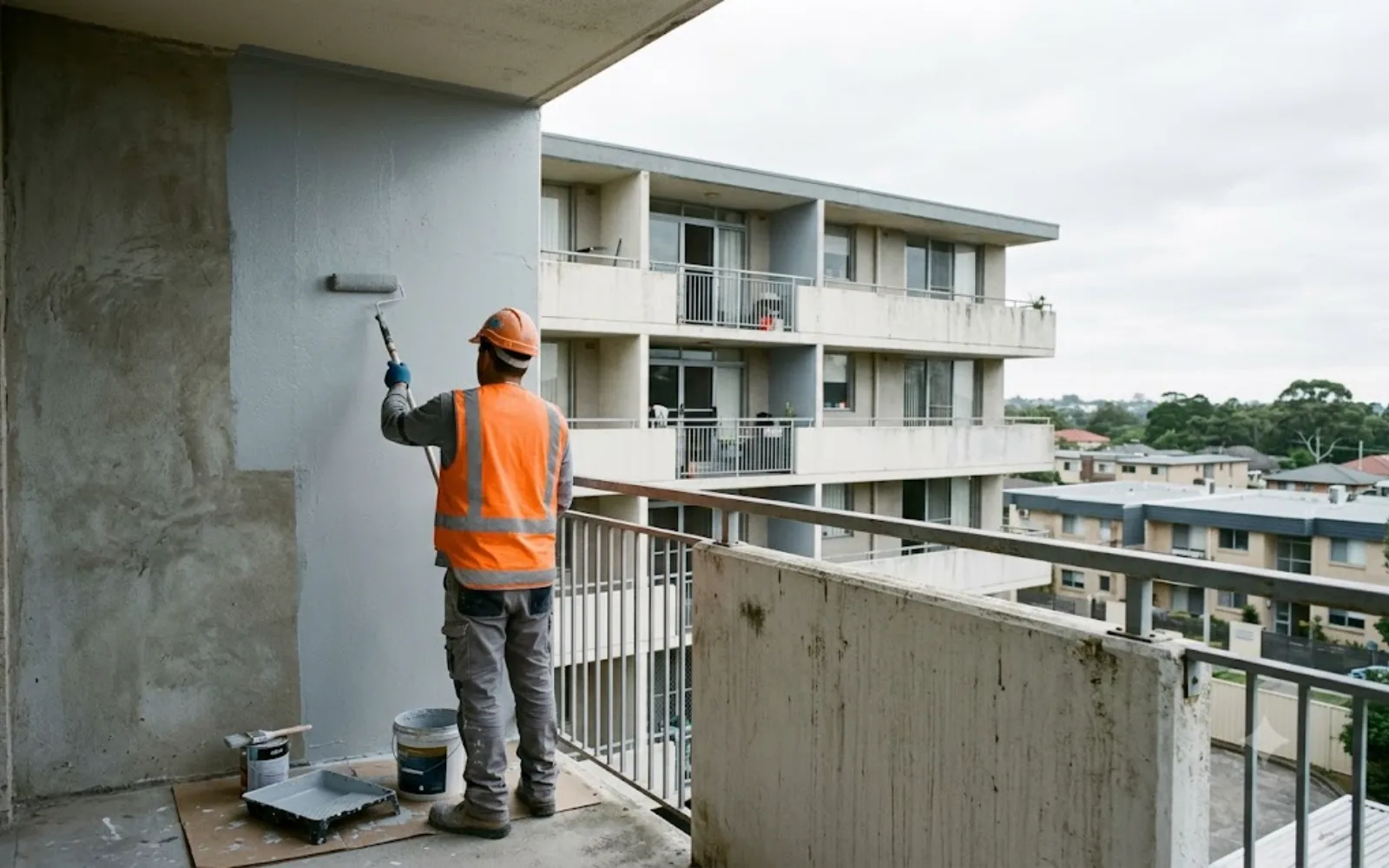
Anti-carbonation and protective coatings are the preventive half of concrete repair. Where breakout, steel treatment, and reinstatement fix the damage that has already happened, a protective coating system controls what gets into the concrete next — carbon dioxide, moisture, and airborne chlorides. By slowing that ingress, the coating keeps the carbonation front away from the reinforcement and reduces the supply of the very things that drive corrosion, which is why a properly specified coating is the step that makes a repair last rather than repeat.
The mechanism is straightforward but the specification is not. Anti-carbonation coatings work as a barrier with high resistance to CO2 diffusion, while still allowing the concrete to breathe and release water vapour so moisture is not trapped behind the film. On chloride-exposed structures, protective systems are chosen to also resist the ingress of salt-laden water. Getting the balance right — CO2 resistance, water resistance, and vapour permeability — is what separates a coating that protects the structure from one that blisters and peels within a couple of seasons.
For Sydney’s coastal apartment buildings, facades, balconies, and exposed concrete elements, the case for protective coatings is strong: constant exposure to salt air, wind-driven rain, and thermal cycling means unprotected concrete keeps carbonating and absorbing chloride throughout its life. For strata schemes and owners corporations, an anti-carbonation coating programme is one of the most cost-effective ways to extend service life after a concrete repair — provided it is applied over a sound, prepared substrate and maintained on a cycle, not treated as a one-off paint job.
How We Deliver Protective Coating Systems
- Substrate Assessment
- Assess the concrete surface for soundness, existing coatings, carbonation, moisture, and contamination, because a coating is only as good as the substrate under it.
- Identify and schedule any concrete repair, crack treatment, or spalling reinstatement that must be completed before coating.
- Surface Preparation
- Clean and prepare the surface — removing laitance, loose material, dirt, and failed coatings — to a sound, profiled condition suitable for adhesion.
- Make good minor surface defects and blowholes with a compatible levelling or fairing coat so the finished system is continuous.
- System Selection
- Specify the coating system to the exposure: anti-carbonation coatings where CO2-driven corrosion is the risk, and protective anti-chloride systems where salt ingress dominates.
- Select systems that balance CO2 resistance and water resistance with vapour permeability, in line with EN 1504-class surface-protection principles, so moisture is not trapped behind the film.
- Application
- Apply the primer and coats at the specified film build and coverage rate, in the correct conditions, to achieve the protective performance the system is designed for.
- Coordinate with balcony and facade waterproofing so the protection is continuous across details, junctions, and transitions.
- Maintenance Planning
- Set out the recommended inspection and recoat cycle so the owners corporation can budget for cyclical maintenance and keep protection intact over the long term.
Why Atomic Projects
- Repair first, then protect: We do not coat over unsound concrete — repairs are completed so the coating protects a sound structure rather than hiding an active problem.
- Exposure-matched systems: Coatings are specified to the real risk on your building — carbonation, chloride, or both — and balanced for breathability so they do not trap moisture.
- Standards-based: Systems applied to EN 1504-class surface-protection principles and manufacturer specification for film build and warranty validity.
Frequently Asked Questions
How is an anti-carbonation coating different from ordinary exterior paint?
Ordinary paint is chosen for colour and weathering; an anti-carbonation coating is engineered specifically to resist the diffusion of carbon dioxide into the concrete while still letting water vapour escape. That combination is what protects the reinforcement — it slows the carbonation front and does not trap moisture behind the film. A standard decorative paint offers little of this protection and can actually make things worse if it seals moisture in.
Can we just coat our concrete instead of repairing it?
No — coating is not a substitute for repair. A protective coating controls what gets into sound concrete going forward, but it cannot fix concrete that is already spalling, cracked, or hiding corroding steel. If you coat over active corrosion, the damage keeps progressing underneath and the coating fails with it. The correct sequence is to complete any concrete and steel repairs first, then apply the protective system over the sound, prepared surface.
How long do protective coatings last before they need recoating?
A properly specified and applied system is designed to provide many years of protection and is then maintained and recoated as part of the building’s cyclical maintenance plan. As an indicative guide, anti-carbonation and protective coatings typically require re-coating every 10–15 years depending on exposure and the specified system, with the exact interval confirmed against the specified manufacturer system and substrate condition. We set the expected cycle out in the scope so it can be planned and budgeted rather than left until the coating visibly fails.
Will a coating stop concrete cancer that has already started?
Not on its own. Once reinforcement corrosion and spalling are underway, the driver is inside the concrete at the steel, and a surface coating cannot reverse that. The corrosion has to be addressed directly — through spalling repair, steel treatment, and where relevant realkalisation or chloride extraction — and the coating then protects the repaired structure from further ingress. Used that way, as the protective finishing step, a coating is exactly what keeps the repair from coming back.
Does a coating programme need a strata committee decision?
Protective coating of facades and exposed concrete is usually planned capital works, which in most schemes requires a general meeting resolution above the relevant spending threshold, and it is often programmed alongside concrete repair and facade maintenance. We provide condition assessments, specifications, and scopes of works to support committee decisions, tendering, and long-term maintenance planning.
Related Services
A protective coating is cheap insurance on an expensive repair. Skip it, and the carbonation and chloride that caused the damage simply start again on the concrete you just fixed. Apply it properly, over sound concrete and on a maintenance cycle, and you turn a repair into decades of extended service life.
As a Class 2 Registered Builder with over 10 years of experience in remedial works across Sydney, Atomic Projects delivers anti-carbonation and protective coating systems grounded in real repair practice and specified to recognised standards. Call us on 0410 515 509 or email hello@atomicprojects.com.au to arrange an assessment.
— Ben Tran, General Manager, Atomic Projects