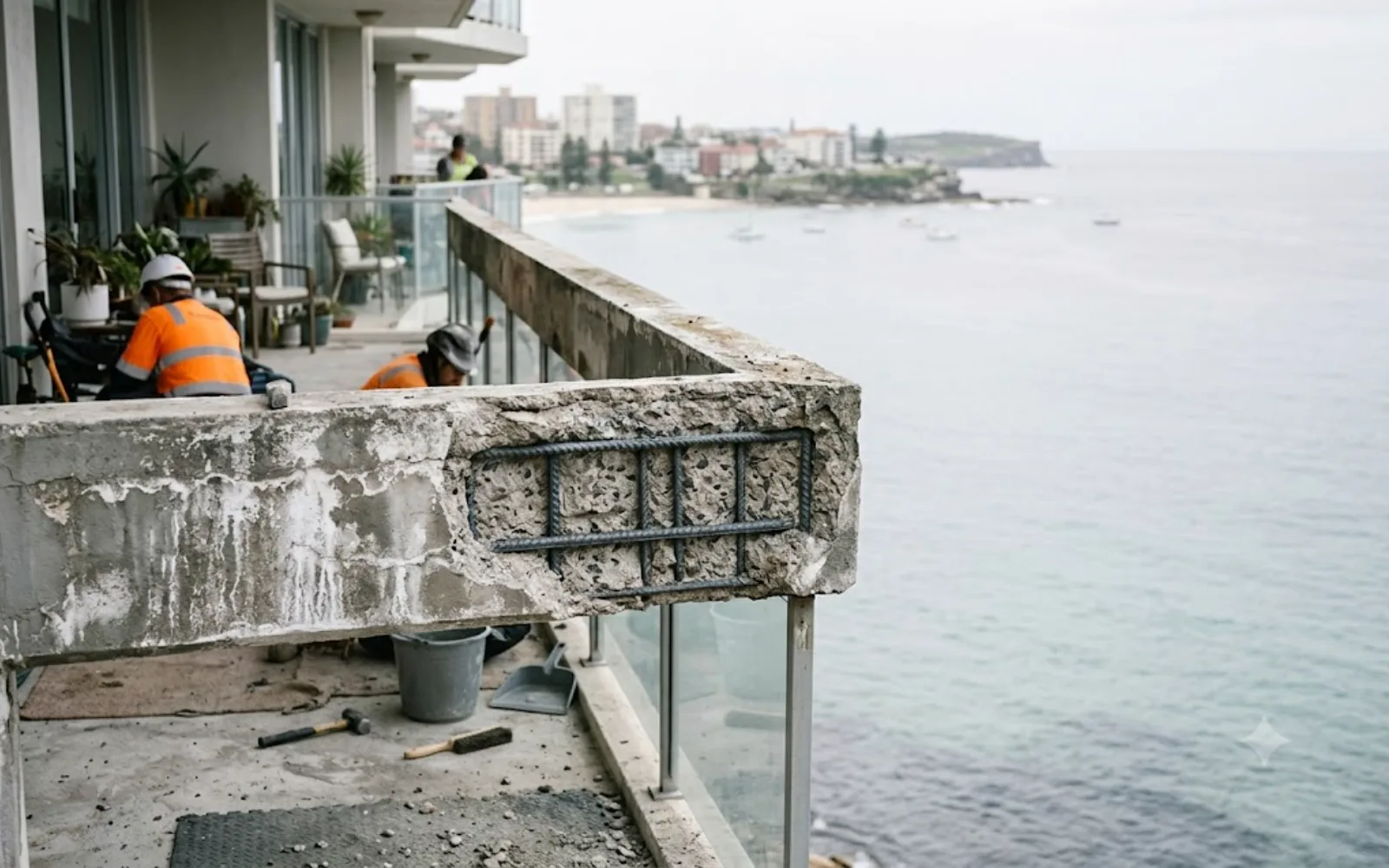
Chloride attack is the more aggressive of the two main corrosion mechanisms in concrete. Chloride ions — carried in from sea spray, salt-laden air, marine environments, and occasionally de-icing salts (rare in Australia) — penetrate the concrete and reach the embedded reinforcement. Unlike carbonation, chlorides do not need to lower the pH of the whole concrete mass. Once the chloride concentration at the steel passes a critical threshold, it breaks down the passive film locally and drives intense, pitting corrosion at those points.
That localised behaviour is what makes chloride attack dangerous. Corrosion can be advanced at a specific bar location while the surrounding concrete still looks sound, and pitting reduces the cross-section of the reinforcement quickly, undermining its load capacity. As the steel corrodes and expands, it cracks and spalls the cover concrete, which in turn lets in more moisture and chloride and accelerates the whole process.
For Sydney’s coastal and near-coastal buildings this is a constant exposure risk — beachfront and harbourside apartment blocks, balconies, planter boxes, basements exposed to chloride-bearing groundwater, and any element regularly wetted by salt spray. For strata schemes and owners corporations in these locations, chloride attack is often the single biggest driver of concrete deterioration, and it needs to be diagnosed and treated on the basis of measured chloride levels, not appearance alone.
How We Diagnose & Remediate Chloride Attack
- Chloride Testing & Assessment
- Take dust or core samples at increasing depths and test for chloride content, building a profile of how far chlorides have penetrated and how much has reached the steel.
- Half-cell potential and corrosion-rate surveys to map where reinforcement is actively corroding.
- Cover meter readings and delamination survey to define the full extent of affected concrete.
- Breakout & Steel Preparation
- Break out chloride-contaminated and delaminated concrete back to sound, lower-chloride material — going far enough that the repair is not sitting against still-contaminated concrete.
- Mechanically clean the exposed reinforcement to a bright metal finish and assess section loss; supplement or replace severely pitted bars with new steel lapped into sound reinforcement.
- Electrochemical Treatment Where Warranted
- Chloride extraction: where chlorides are widespread but the structure is otherwise repairable, an applied current can draw chloride ions out of the concrete towards a temporary external anode, reducing the concentration around the steel.
- Cathodic protection: for structures with ongoing chloride exposure, an impressed-current or galvanic cathodic protection system holds the steel at a potential where corrosion is suppressed, providing long-term control rather than a one-off repair.
- Reinstatement
- Reinstate broken-out areas with proprietary structural repair mortars compatible with the parent concrete, in accordance with AS 3600 and EN 1504-class repair principles.
- Protective Systems
- Apply protective anti-chloride and anti-carbonation coatings or membranes to limit further ingress of chlorides and moisture.
- Coordinate with balcony and facade waterproofing so salt-laden water is kept off the structure in the first place.
Why Atomic Projects
- Measured, not guessed: We drive the repair strategy from a chloride profile and corrosion survey, so breakout extent and treatment type match the actual contamination.
- Full toolkit: From conventional breakout-and-reinstate through to chloride extraction and cathodic protection, we specify the level of intervention the exposure justifies.
- Standards-based: Works delivered to AS 3600 and recognised EN 1504 repair principles, with proprietary systems installed to manufacturer specification for warranty validity.
Frequently Asked Questions
How is chloride attack different from ordinary concrete cancer?
Concrete cancer is the general term for the spalling that reinforcement corrosion causes. Chloride attack is one specific driver of that corrosion — and typically the most aggressive one in coastal buildings. Because chlorides cause localised pitting rather than a uniform corrosion front, the steel can lose a lot of section at specific points, and the contamination stays in the concrete unless it is broken out or electrochemically extracted. That is why chloride-driven corrosion often needs a more thorough approach than carbonation-driven corrosion.
Why does chloride-contaminated concrete need to be removed rather than just coated over?
Because the chloride is already inside the concrete, at the steel. A surface coating stops new chloride and moisture getting in, but it does not remove what is already there, and corrosion can keep running underneath. Where contamination is concentrated, the reliable fix is to break out the affected concrete back to sound material, or to use chloride extraction to draw the ions out. Coatings then play their proper role — keeping future salt and water off a repaired, protected structure.
What is cathodic protection and when is it used?
Cathodic protection is an electrochemical technique that holds the reinforcement at an electrical potential where corrosion is effectively stopped, using either an impressed current or sacrificial galvanic anodes. It is used on structures with heavy or ongoing chloride exposure where conventional patch repair alone would keep failing around the edges. It is a long-term management system for the whole element rather than a single repair, and it suits high-value coastal structures where durability matters. As an indicative guide, it is generally suited to structures with widespread chloride contamination where localised patch repair would keep failing; whether it is warranted on a given building, and which system is appropriate, is confirmed by condition assessment and a corrosion engineer rather than being a fixed rule.
Our building is right on the water — can this be prevented from coming back?
Chloride exposure never goes away in a coastal location, so the goal is control rather than a one-time cure. A properly remediated structure — contaminated concrete removed, steel treated, protective coatings applied, and where justified a cathodic protection system installed — combined with keeping salt water off the concrete through good waterproofing, dramatically slows the rate of future attack. We build the ongoing maintenance and inspection cycle into the scope so it can be managed, not just reacted to.
Does this need a strata committee decision?
Chloride remediation is usually significant capital works, which in most schemes requires a general meeting resolution above the relevant spending threshold. Where a corrosion survey identifies a safety risk — for example loss of section in a structural element or spalling above a public area — urgent works can often be authorised by the committee under urgent maintenance provisions. We provide the testing results, condition reports, and scopes of works needed to support committee decisions and tendering.
Related Services
On the Sydney coast, chloride attack is not a matter of if but when — and the buildings that last are the ones that treat it on the basis of real chloride data and then keep the salt water out. A patch over contaminated concrete is a repair with a countdown on it.
As a Class 2 Registered Builder with over 10 years of experience in remedial works across Sydney, Atomic Projects delivers chloride attack remediation grounded in real repair practice and specified to recognised standards. Call us on 0410 515 509 or email hello@atomicprojects.com.au to arrange an assessment.
— Ben Tran, General Manager, Atomic Projects