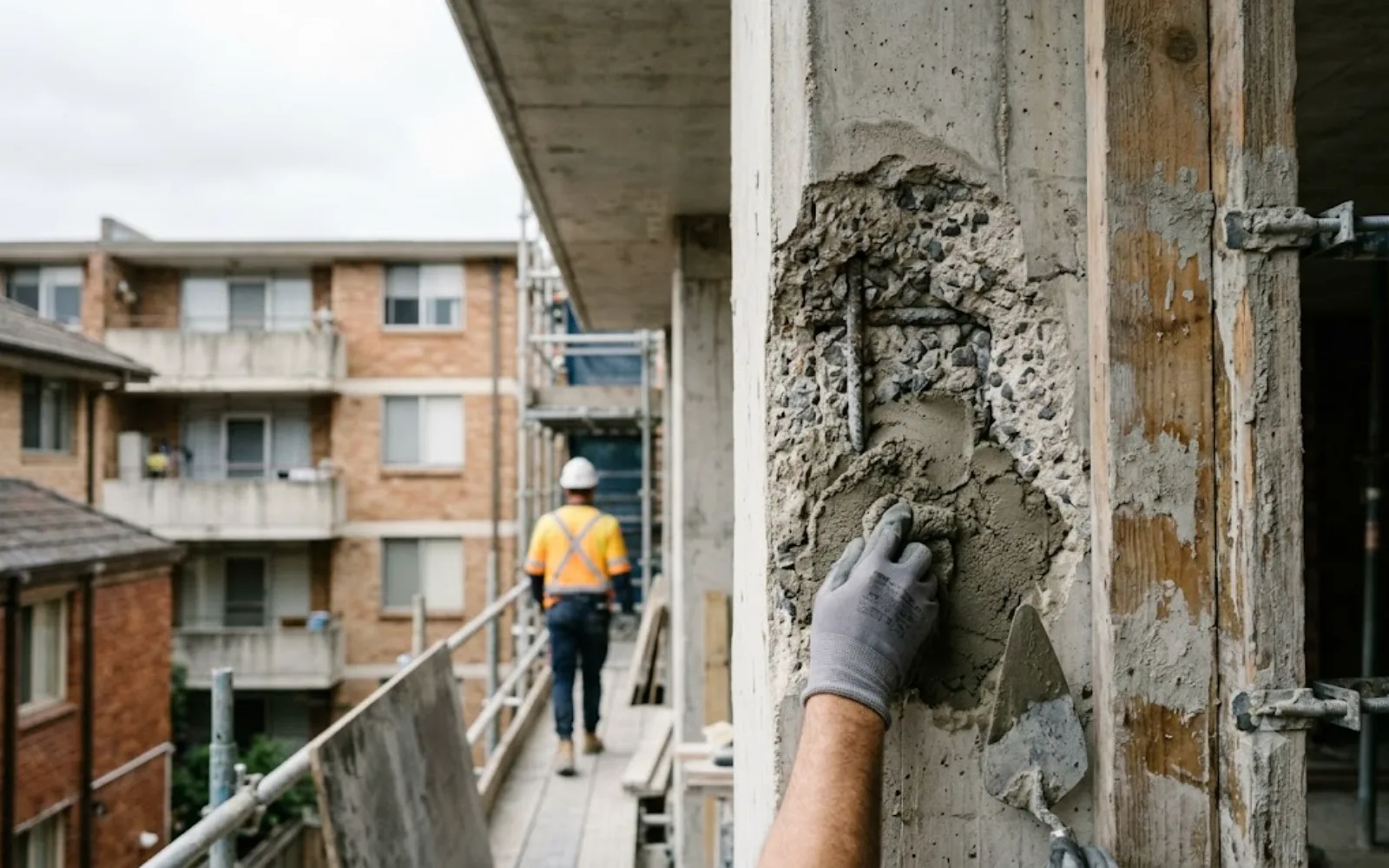
Honeycombing is a concrete defect that originates at the time of the pour rather than from age or environmental attack. It shows up as rough, stony, void-filled patches where the cement paste failed to fully surround the aggregate — usually because the fresh concrete was poorly compacted, the mix was not workable enough to flow around congested reinforcement, or the formwork leaked and let the fines escape. The result is concrete that is porous, weak, and often has exposed aggregate and visible voids.
It matters because honeycombed concrete does not do the job the design assumed. The voids reduce the effective cross-section and strength of the element, they leave the reinforcement with little or no proper cover, and they create open pathways for water, carbonation, and chlorides to reach the steel. In other words, a honeycombing defect is not just cosmetic — left unreinstated, it becomes a starting point for reinforcement corrosion and long-term deterioration exactly where the concrete is already weakest.
In Sydney apartment and mixed-use buildings, honeycombing and similar construction defects turn up on new and recent structures during defect inspections and handover, and on older structures where a poorly finished area has quietly been letting water in for years. For strata schemes and owners corporations — particularly on newer Class 2 buildings where defects may fall within statutory warranty or a defects liability period — getting these areas properly identified, documented, and reinstated is both a durability issue and a rectification issue worth pursuing.
How We Reinstate Honeycombing & Defects
- Inspection & Assessment
- Identify and map honeycombed areas, voids, cold joints, and other defects, including tap testing to find the full extent of unsound material behind the surface.
- Check reinforcement cover and exposure at each defect and assess whether the void has compromised the structural section.
- Document findings to support defect rectification, warranty claims, or engineering sign-off where relevant.
- Breakout to Sound Concrete
- Cut and break out the honeycombed and unsound concrete back to solid, well-compacted material, squaring up the edges to avoid feather-edging the repair.
- Expose any reinforcement within the defect and clean it back to a sound condition.
- Reinforcement & Substrate Preparation
- Where bars are exposed, clean to a bright metal finish and apply anti-corrosion primer where required.
- Prepare the substrate to a sound, roughened, saturated surface-dry condition so the repair mortar bonds fully.
- Structural Reinstatement
- Reinstate the void with a proprietary structural repair mortar selected to match the strength and modulus of the parent concrete, placed and compacted to eliminate further voids.
- Works carried out in line with AS 3600 (concrete structures) and EN 1504-class repair principles, so the reinstated element performs as a structural repair, not a surface patch.
- Finishing & Protection
- Finish the repair flush and consistent with the surrounding surface.
- Apply protective or anti-carbonation coatings where the element is exposed, so the reinstated area is protected against future ingress.
Why Atomic Projects
- Structural, not cosmetic: We break out to genuinely sound concrete and reinstate with matched structural mortar, rather than skimming over a void and trapping the problem.
- Defect documentation: Our assessment records support strata defect claims, warranty rectification, and engineering sign-off where the defect sits within a liability period.
- Standards-based: Reinstatement carried out to AS 3600 and recognised EN 1504 repair principles with proprietary systems applied to specification.
Frequently Asked Questions
Is honeycombing just a cosmetic problem?
No. It can look like a surface blemish, but honeycombed concrete is porous and under-strength, and it usually means the reinforcement in that area has little or no proper cover. That combination lets water and corrosive agents reach the steel and reduces the effective strength of the section. It should be assessed and reinstated as a structural defect, not painted over — painting over it simply hides an open pathway to the reinforcement.
Our building is nearly new and we have found honeycombing — is that a defect we can claim?
Very possibly. Honeycombing is a construction defect — it results from how the concrete was placed and compacted — so on recent Class 2 buildings it may fall within statutory warranty or the defects liability period. As an indicative guide, statutory warranties under the NSW Home Building Act generally run for 2 years for minor defects and 6 years for major (structural) defects, so the timing of when the defect is identified matters. The important first step is proper identification and documentation of the extent and location, which is exactly what our assessment provides. Whether a specific instance is claimable ultimately depends on the building’s contract and warranty position, which is confirmed against the scheme’s own documents. We can supply the technical documentation to support that conversation.
Why do you break out the concrete instead of just filling the holes?
Because the visible void is usually smaller than the unsound material behind it. If you simply fill the surface, you leave weak, porous concrete underneath and the repair has nothing solid to bond to, so it fails. Breaking out to sound, well-compacted concrete and squaring the edges gives the structural repair mortar a proper substrate to bond to and lets it restore the section correctly.
Will the repair be as strong as the original concrete?
When done properly, yes — that is the whole point of using structural repair mortars matched to the strength and modulus of the parent concrete and reinstating to AS 3600 principles. A correctly executed reinstatement restores the section so that area carries load as intended, rather than remaining a weak spot. The key is matched materials, a sound substrate, and proper compaction of the repair. Our remedial work is also typically backed by a workmanship warranty, with the term confirmed per contract.
Does this need a strata committee decision?
It depends on scale and whether it is a warranty rectification. Isolated defect reinstatement is often modest enough to fall under general maintenance, while larger programmes typically require a general meeting resolution above the relevant spending threshold. Where honeycombing has led to a safety concern — for example exposed corroding steel above a walkway — urgent works can often be authorised under urgent maintenance provisions. We provide the assessment reports and scopes needed for committee decisions, tendering, or a defect claim.
Related Services
Honeycombing is the structure telling you it was never fully built in that spot. Reinstating it properly — back to sound concrete, with matched structural mortar — closes the gap before it becomes the place your reinforcement starts to rust.
As a Class 2 Registered Builder with over 10 years of experience in remedial works across Sydney, Atomic Projects delivers honeycombing and defect reinstatement grounded in real repair practice and specified to recognised standards. Call us on 0410 515 509 or email hello@atomicprojects.com.au to arrange an assessment.
— Ben Tran, General Manager, Atomic Projects