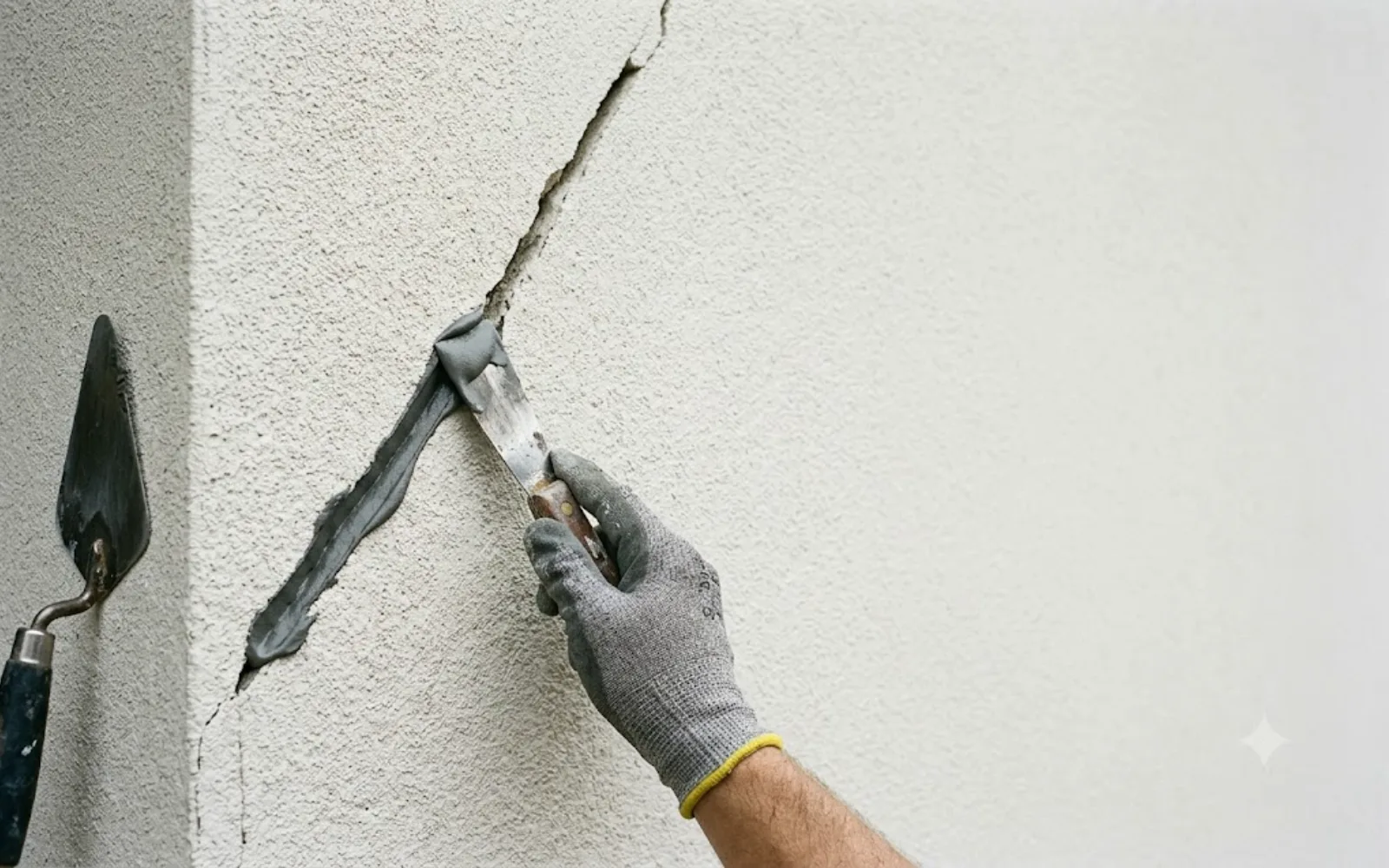
Almost every masonry, render, or concrete façade develops cracks over time — but not all cracks mean the same thing. A hairline crack in a render coat is a very different problem to a stepped crack running through brickwork or a horizontal crack tracking along a concrete slab edge. The danger is treating them all the same: filling a crack that is being driven by ongoing movement simply guarantees it reopens, often wider than before.
Cracking matters because it breaks the weather line. Once a crack opens, it becomes a direct pathway for water into the wall — driving render delamination, concrete spalling and reinforcement corrosion, efflorescence, and internal damp. Left unread, a moving crack can also signal a genuine structural issue — foundation settlement, slab deflection, or a failed lintel — that needs an engineer, not a tube of sealant.
Across Sydney's strata buildings we see the same pattern repeatedly: cracks that were cosmetically patched by a painter three years ago, now back and worse, because nobody diagnosed why the wall was moving. Our approach separates cosmetic cracking from structural movement first, then repairs each on its own terms — and where the building needs to move, we give it a controlled place to do so.
Our Process
- Crack Survey & Classification
- We map every crack across each elevation and classify it by width, pattern, and behaviour — cosmetic hairline, active thermal, or structural. Crack width is assessed against the damage categories in AS 2870 (Residential Slabs and Footings) as a diagnostic reference so severity is graded objectively, not guessed.
- Monitoring & Cause Diagnosis
- Where movement is suspected, we install tell-tales or take comparative readings over time to confirm whether a crack is live or dormant. Diagnosing the cause — thermal cycling, moisture movement, settlement, or overloading — dictates the entire repair strategy.
- Structural Referral Where Required
- If cracking indicates a structural cause, we engage a structural engineer before any cosmetic repair proceeds. Concrete-related structural repairs are carried out in line with AS 3600 (Concrete Structures); masonry works follow AS 3700 (Masonry Structures).
- Crack Repair — Non-Structural
- Stable, dormant cracks are cut out, cleaned, and repaired with flexible, paintable fillers or, for render, cut back and re-rendered with a reinforcing mesh across the repair to distribute future stress.
- Crack Stitching — Structural Masonry
- Where cracks threaten masonry continuity, we install stainless-steel helical stitching bars bedded across the crack in the mortar beds, re-tying the wall without changing its appearance.
- Introducing Movement Joints
- Where cracking is caused by a lack of articulation — the wall has nowhere to expand — we cut in new control or movement joints at engineered locations, then seal them with a backing rod and a correct-movement-class sealant so the façade can flex without cracking again.
- Reinstatement & Weatherproofing
- Repairs are made good to match the surrounding finish, and the treated zones are re-coated or sealed to restore the continuous weather line across the elevation.
Key Considerations
- Diagnosis Before Repair – Filling a moving crack without understanding its cause is the single most common reason cracks return. Cause first, repair second.
- Cosmetic vs Structural – The two demand completely different responses. Misclassifying a structural crack as cosmetic can leave a genuine safety issue unaddressed.
- Movement Needs Somewhere to Go – Many recurring cracks exist because the façade has no articulation. Introducing movement joints treats the cause, not just the symptom.
Value to the Client
- Stops water ingress at the crack and protects the structure behind it.
- Distinguishes genuine structural risk from harmless cosmetic cracking.
- Prevents repeat cracking by giving the building controlled movement.
- Restores a uniform façade appearance and protects property value.
- Avoids the false economy of patch-and-repaint cycles that never hold.
Frequently Asked Questions
How do I know if a crack in our building's façade is serious or just cosmetic?
Width and pattern are the first indicators. Fine, stable hairline cracks in render are usually cosmetic, while stepped cracks through brickwork, diagonal cracks radiating from window corners, or cracks wider than around 5mm can indicate structural movement. Behaviour matters more than appearance, though — a crack that is actively widening over months is more concerning than a wider crack that has been dormant for years. A proper survey classifies each crack objectively rather than relying on a visual guess.
Why do cracks keep coming back after they've been filled and painted?
Because the underlying movement was never addressed. If a crack is being driven by thermal expansion, moisture movement, or settlement, filling it with a rigid product simply creates a new weak point that reopens with the next movement cycle. The correct fix is to diagnose the cause first — then either use a flexible repair that accommodates movement, or introduce a proper movement joint so the wall has a controlled place to flex. Patch-and-paint without diagnosis is the most common reason strata buildings pay for the same crack twice.
What is a movement joint and why would our façade need one?
A movement joint (also called a control or expansion joint) is a deliberate gap built into a wall that allows it to expand and contract without cracking. Many older buildings, and some poorly detailed newer ones, simply don't have enough of them — so the façade cracks at its weakest points instead. Where our diagnosis shows this is the cause, we cut in new joints at engineered locations and seal them with a flexible, correct-movement-class sealant, giving the building a designed place to move.
Do you need a structural engineer to repair façade cracks?
Not for cosmetic cracking — that is remedial builder's work. But where the survey indicates a structural cause, such as footing settlement, slab deflection, or a failed lintel, we engage a structural engineer before any repair proceeds. Repairing the surface while ignoring a structural cause hides a potentially serious problem. We would rather confirm the cause is benign than paint over a genuine defect, and concrete or masonry structural repairs are carried out to AS 3600 and AS 3700 respectively.
Will crack repairs be visible on the finished façade?
Our aim is that they should not be. Non-structural repairs are made good to match the surrounding texture and re-coated, and helical stitching is bedded into the mortar joints and concealed. New movement joints are a deliberate architectural line and are detailed as neatly as possible, sealed in a colour matched to the façade. On rendered elevations, the most uniform result is often to re-coat the full elevation rather than spot-patch, which avoids visible join lines.
Related Services