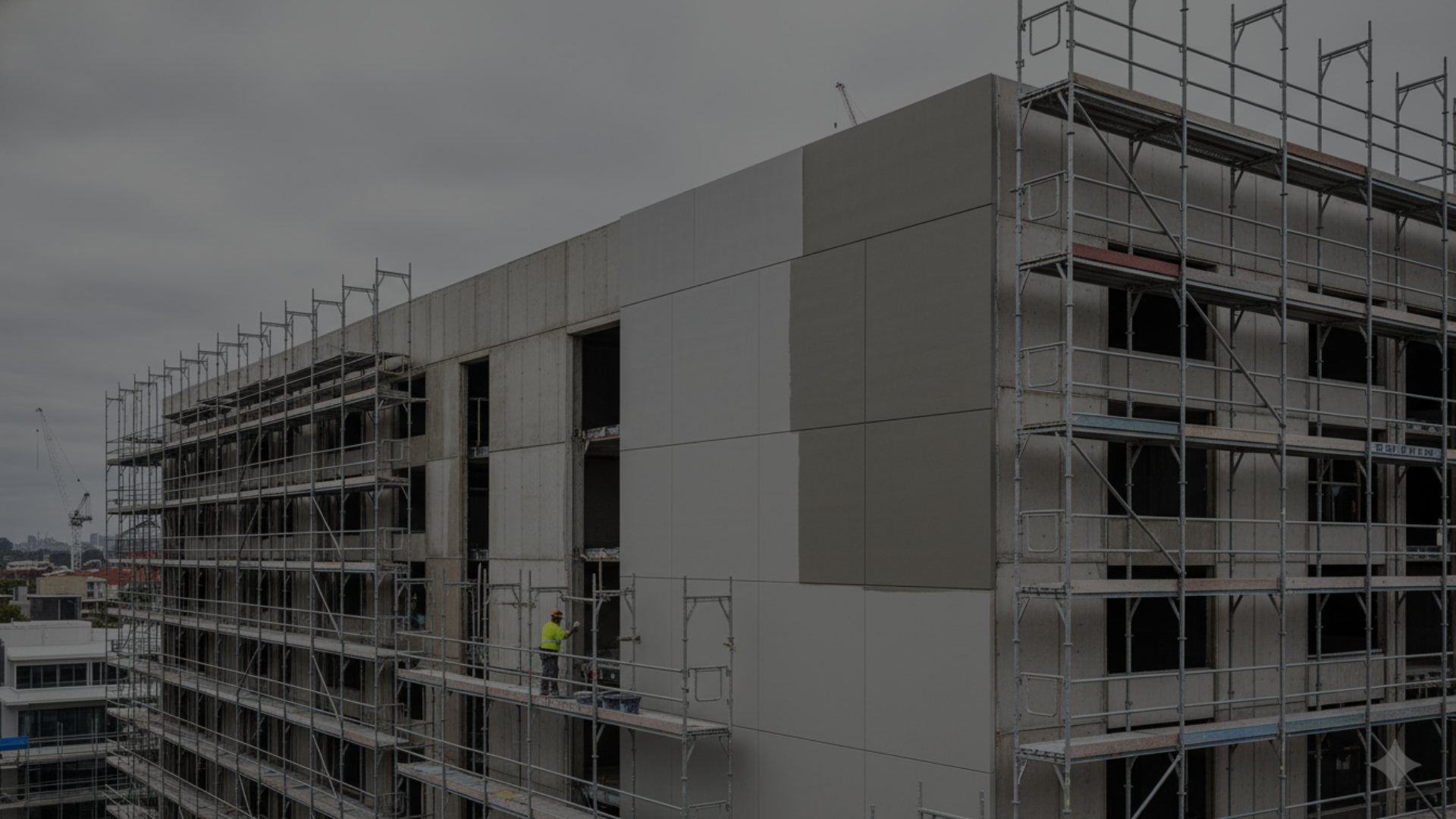
Render systems are one of the most common finishes for façades across Sydney. Over time, however, they become vulnerable to cracking, delamination, water ingress, and staining. These aren't simply visual defects — once cracks form, they create a pathway for water to penetrate, leading to concrete spalling, rusting reinforcement, and serious structural issues beneath the surface.
Our render and coating renewal service is designed to rebuild the façade envelope so it performs as both a protective and aesthetic barrier. We approach each project by addressing not only the visible surface, but also the condition of the substrate beneath.
Our Process
- Inspection & Diagnosis
- We assess cracks, hollow drummy render, staining, and water entry points. Thermal imaging and moisture meters may be used to locate hidden failures.
- Substrate Preparation
- Loose render is removed back to a sound base. Exposed concrete or brickwork is repaired, ensuring the new render bonds effectively.
- Re-rendering
- Using high-performance mixes matched to the building's substrate (cementitious, polymer-modified, or lime-based for heritage), we apply new layers with strict thickness control to avoid future delamination.
- Movement & Control Joints
- Where cracking is linked to structural movement, new control joints are introduced to relieve stress and prevent repeat cracking.
- Protective Coatings
- The façade is sealed with breathable, elastomeric, or anti-carbonation coatings depending on the building's needs. These protect against UV, moisture, and pollution while improving appearance.
- Final QA & Finish
- Every elevation is visually assessed for uniformity, adhesion, and protective performance before sign-off.
Key Considerations
- Compatibility – Incorrect mixes can cause debonding, shrinkage, or accelerated failure.
- Weather Dependence – Application must occur under suitable conditions to ensure curing and adhesion.
- Aesthetics – Coating systems affect colour, texture, and sheen — critical for high-value properties.
Value to the Client
- Stops moisture ingress and protects structure.
- Enhances appearance with a fresh, uniform finish.
- Extends façade life by shielding against pollutants and UV.
- Prevents expensive structural damage hidden beneath render.
- Restores property value by eliminating unsightly cracks and stains.
Frequently Asked Questions
How can I tell if the render on my building needs to be replaced rather than patched?
Patching is suitable for isolated, localised cracks with a sound substrate beneath. If large sections of render sound hollow when tapped, are delaminating, or if cracking is widespread and recurring, full render renewal is typically more cost-effective and durable. A professional diagnostic assessment — including a sounding survey — will give you a clear picture of extent and options.
What type of render system is best for a building near the Sydney coastline?
For coastal environments, we typically specify polymer-modified cementitious renders with elastomeric or siloxane topcoats. These systems have the flexibility to accommodate thermal movement, the breathability to allow moisture vapour to escape, and the durability to resist salt-laden air. The exact specification depends on the building's substrate and exposure class.
Will the new render match the colour and texture of the existing façade?
Exact matching can be challenging, particularly on older buildings. We select render mixes and coating colours as closely as possible to the existing finish. In many cases, the most cost-effective and visually consistent outcome is to renew the entire elevation rather than patch sections, which avoids visible join lines and delivers a uniform result.
How long does render renewal typically last?
A well-specified and properly applied render system in Sydney's climate should last 15 to 25 years before major intervention is needed. The primary factors affecting longevity are substrate preparation quality, the coating system applied, and the building's maintenance regime. We provide maintenance guidance with every project.
Does render renewal require strata committee approval?
Yes — render renewal is considered a major capital works item and typically requires strata committee approval, and in some cases an extraordinary general meeting (EGM). We regularly assist owners corporations with scope of works documentation and quotations formatted for committee review and 10-year capital works plan reporting.
Related Services