Sealants are a building's first line of defence against water ingress, air leakage, and energy loss. Over time, exposure to UV, thermal cycling, movement, and environmental pollutants causes them to harden, crack, or separate from adjoining surfaces. When this happens, water penetrates the joint, leading to hidden leaks, corrosion, mould growth, and costly structural repairs.
At Atomic Projects, we specialise in complete sealant and joint remediation, restoring the integrity of your building envelope while ensuring the joint can accommodate ongoing structural movement.
Our Sealant Replacement Process
- Inspection & Scope Development
- Identify all joints with adhesion failure, cohesive cracking, or debonding.
- Assess joint design, width, depth, and movement capability requirements.
- Old Sealant Removal
- Carefully cut and remove deteriorated sealant without damaging adjoining substrates.
- Grind or clean surfaces to expose sound, contaminant-free edges for new adhesion.
- Joint Preparation
- Install correct backer rod or bond breaker tape to control sealant depth and shape.
- Prime surfaces where required by manufacturer specifications.
- Application of New Sealant
- Use high-performance polyurethane, hybrid, or silicone sealants selected for UV resistance, movement capability, and service life.
- Apply under controlled temperature and humidity conditions to ensure optimal curing.
- Tooling & Finishing
- Tool sealant for smooth, even finish ensuring full contact with joint edges.
- Remove masking and clean surrounding surfaces for a professional result.
- Final QA & Documentation
- Test adhesion and elasticity.
- Provide photographic and written records for compliance and warranty purposes.
Common Joint Remediation Scenarios
- Expansion joint sealant failure on façades.
- Perimeter seals around glazing systems leaking.
- Wet area joint breakdown in bathrooms, balconies, and podiums.
- Acoustic and fire-rated sealant replacement.
Why Atomic Projects for Sealant & Joint Works
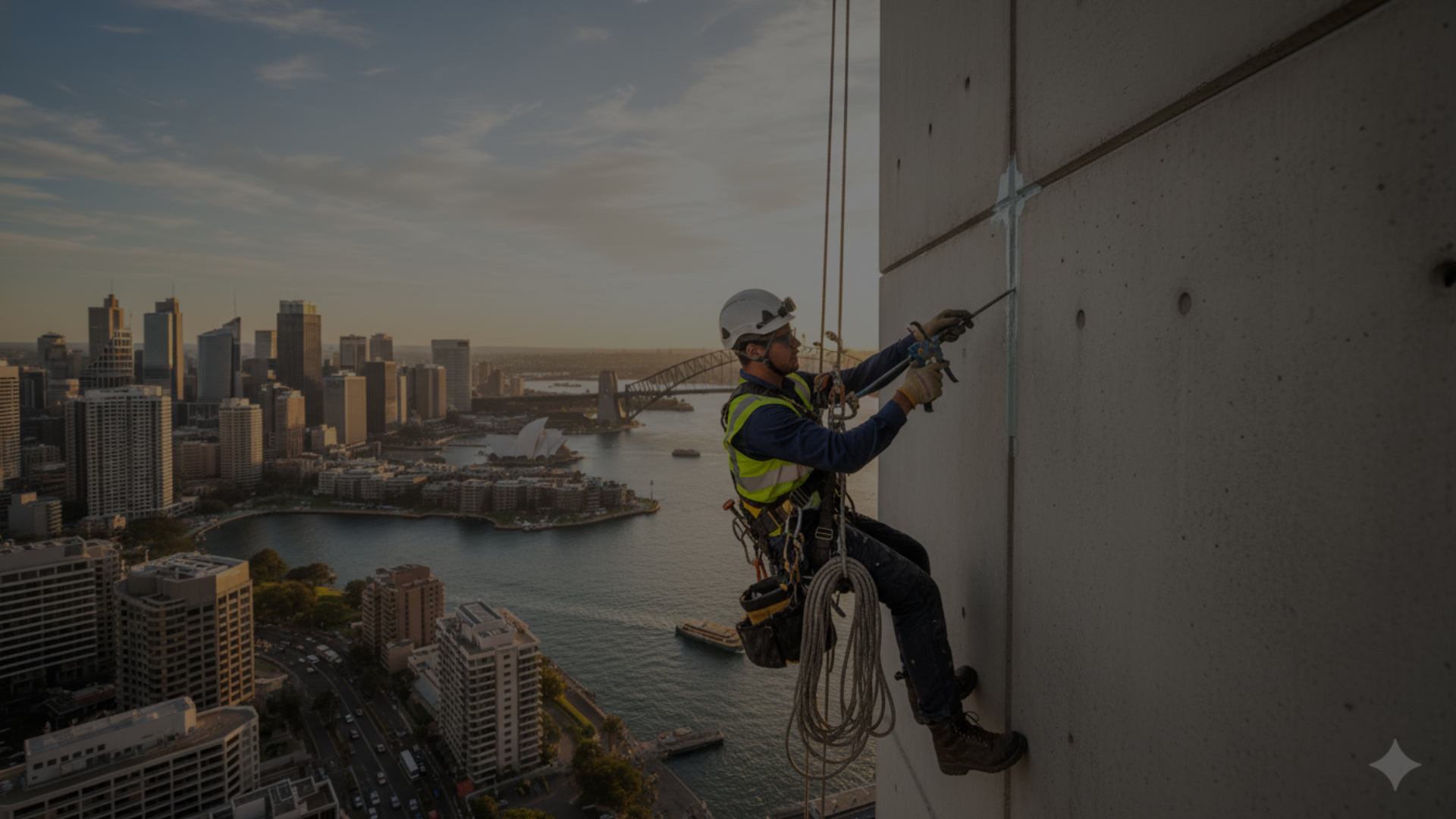
- Specialist Rope Access & Swing Stage Teams: We access difficult, high-risk areas without major disruption.
- Manufacturer-Approved Applicators: Our works meet or exceed warranty conditions.
- Longevity Focused: Correct sealant selection ensures service life of 10–20+ years in Australian conditions.
- Airtight & Watertight: Our remediation restores both waterproofing and thermal efficiency.
Frequently Asked Questions
How often should building sealants be inspected and replaced?
Most high-performance polyurethane and hybrid sealants have a design life of 10–20 years in Australian conditions, but regular inspection is recommended every 5 years, or after significant weather events. UV exposure, building movement, and harsh coastal environments accelerate deterioration, so older buildings or those in exposed locations should be checked more frequently.
Can sealant replacement be done at height without scaffolding?
Yes — our specialist rope access and swing stage teams can carry out façade sealant replacement at any height without the cost and disruption of full scaffolding. This is often the preferred approach for high-rise buildings where only perimeter joints need attention and full scaffold would be prohibitively expensive.
What type of sealant should be used on a building façade?
The correct sealant type depends on joint width, substrate type, expected movement, UV exposure, and colour match requirements. Polyurethane sealants are commonly used for façade movement joints; silicone is preferred for glazing interfaces. We select products based on manufacturer guidelines and site-specific requirements, not price.
How do I know if a sealant has failed versus just looking old?
A failed sealant will show cracking through its body (cohesive failure), pulling away from one or both sides of the joint (adhesive failure), or hardening to the point where it can no longer accommodate movement. Cosmetic discolouration or mould growth on the surface doesn't always indicate failure, but should prompt a closer inspection.
Is sealant replacement considered common property in a strata building?
In most cases, yes — façade sealants, expansion joints, and external window perimeter seals are common property and the owners corporation's responsibility to maintain under the Strata Schemes Management Act 2015. Lot owners may be responsible for internal wet area sealants within their units. We can assist with scope preparation for OC committee approval.
Related Services