


Why an engineer's investigation comes before builder quotes: what it costs, what the report covers, and how it protects your building's budget.
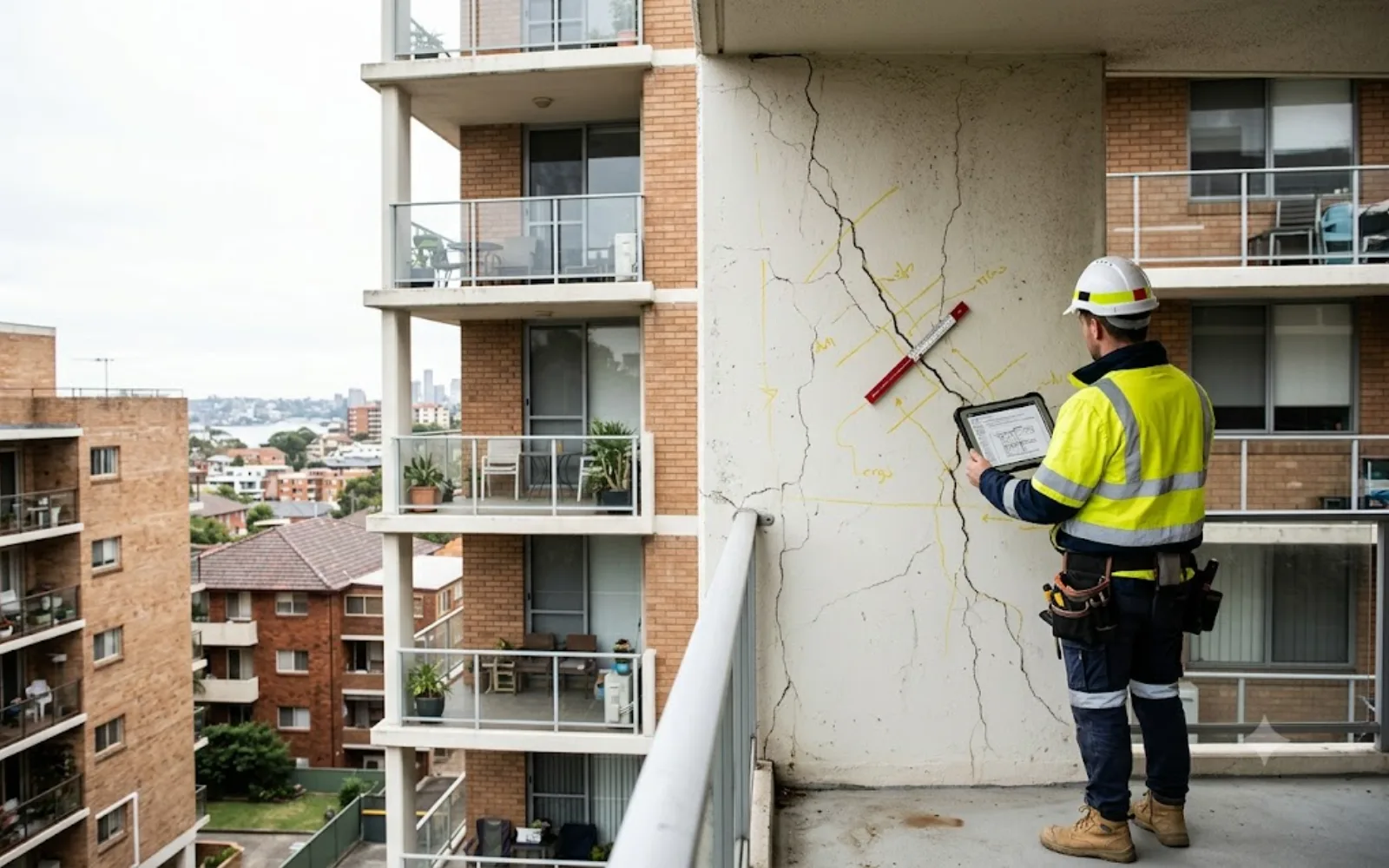
You've noticed damage — cracks, leaks, spalling concrete, a failing facade. Your instinct is to call a builder and get quotes. But if a builder quotes without a proper investigation, you're comparing guesses, not solutions.
This post explains the investigation process: what an engineer does, what it costs, and why it protects your building and your committee from approving work based on incomplete information.
We see this regularly — a building gets three builder quotes without an engineer's report, and the committee picks the cheapest one. Here's what typically goes wrong.
Without an engineer defining the work, each builder is guessing what needs fixing. One quotes to patch the surface. Another quotes to strip back and rebuild. You can't compare prices when the scope is different — and you won't know which scope is right.
If the root cause wasn't diagnosed, the repair treats the symptom. Water keeps tracking. Steel keeps corroding. The building ends up back at square one — with the added cost of undoing the failed repair before starting again.
Under the DBP Act, Class 2 building work requires declared designs and compliance documentation. If the builder works without an engineer's specification, there's no design declaration, no compliance pathway, and no protection for the owners corporation.
A builder who quoted without investigating will find surprises during the work — and every surprise becomes a variation. Budgets that looked competitive at tender can exceed the engineer-specified quote by 30–50% once variations are added.
A building investigation isn't just a site visit with a clipboard. For a strata or commercial building, the typical process looks like this:
The cost depends on building size, the number of defect types, and the extent of testing required. A targeted investigation on a single element — one leaking area, or a section of spalling concrete — starts from around $1,500, with typical engagements from $2,000. Multi-element investigations across larger complexes (facade, waterproofing, concrete and structural together) typically range from $10,000 to $25,000.
Put that in perspective. A single unit in your building might be worth $800K–$2M, and the building could hold $10M+ in combined property value. An investigation starting from $1,500 is a fraction of a percent of what it protects.
You already insure the property against fire, flood and liability. An investigation works on the same principle — except insurance pays out after something goes wrong, and an investigation stops it going wrong in the first place.
From about one week for a targeted single-element investigation, up to 6–8 weeks for complex multi-element assessments on larger buildings. Your strata manager coordinates access with residents, and each unit visit typically takes 30–60 minutes. There's no demolition during an investigation — it's diagnostic work only.
A $1,500 investigation can prevent $100,000+ in failed repairs, scope variations and repeat work. We've inherited projects where the previous builder worked without a specification and the repairs failed within two years. The owners corporation paid for the original work, paid again to undo it, then paid a third time to do it properly.
A builder can describe what they see on the surface. But they're not qualified to diagnose root cause, specify remediation methodology to Australian Standards, or produce the compliance documentation required under the DBP Act. An engineer does all three — and their report is the document your committee uses to make an informed decision.
Were those three quotes for the same scope? If each builder assessed the building independently, they probably proposed different scopes — three different jobs at three different prices. An engineer's specification levels the field: same scope, same standard, comparable pricing.
It depends on the defect. Concrete cancer and structural cracking need a structural engineer. Waterproofing failures need a waterproofing or building envelope consultant. Facade issues — cladding, render, curtain walls — need a facade engineer. Some buildings need more than one. If you're not sure, call us on 0410 515 509 and we'll tell you what type of specialist to engage. No charge for the guidance.
Minimally. The engineer needs access to affected areas — balconies, ceilings below leak points, common areas, sometimes the roof. Each unit visit is typically 30–60 minutes, scheduled through your strata manager.
It's the most common objection — and it makes sense on the surface. But builder quotes without a specification are estimates from a visual walk-through; the real cost only appears once things are opened up. Would you buy a house without a building inspection? That inspection costs $500–$1,000 on a purchase worth $800K+. A building investigation is the same logic at a larger scale.
Because we've seen what happens when buildings skip this step. We prefer to quote against an engineer's scope — the price is fixed, the methodology is proven, and the committee knows exactly what it's approving. It's better for the building, and frankly, it's better for us too.
Atomic Projects is a Sydney remedial building contractor and Class 2 registered practitioner (licence 360636C) with $20M+ of remedial work delivered. Call 0410 515 509 or email hello@atomicprojects.com.au.

Send photos, the engineer's report, or just the symptoms — whatever you've got. A registered builder reads it and calls you back. No call centre, no obligation.