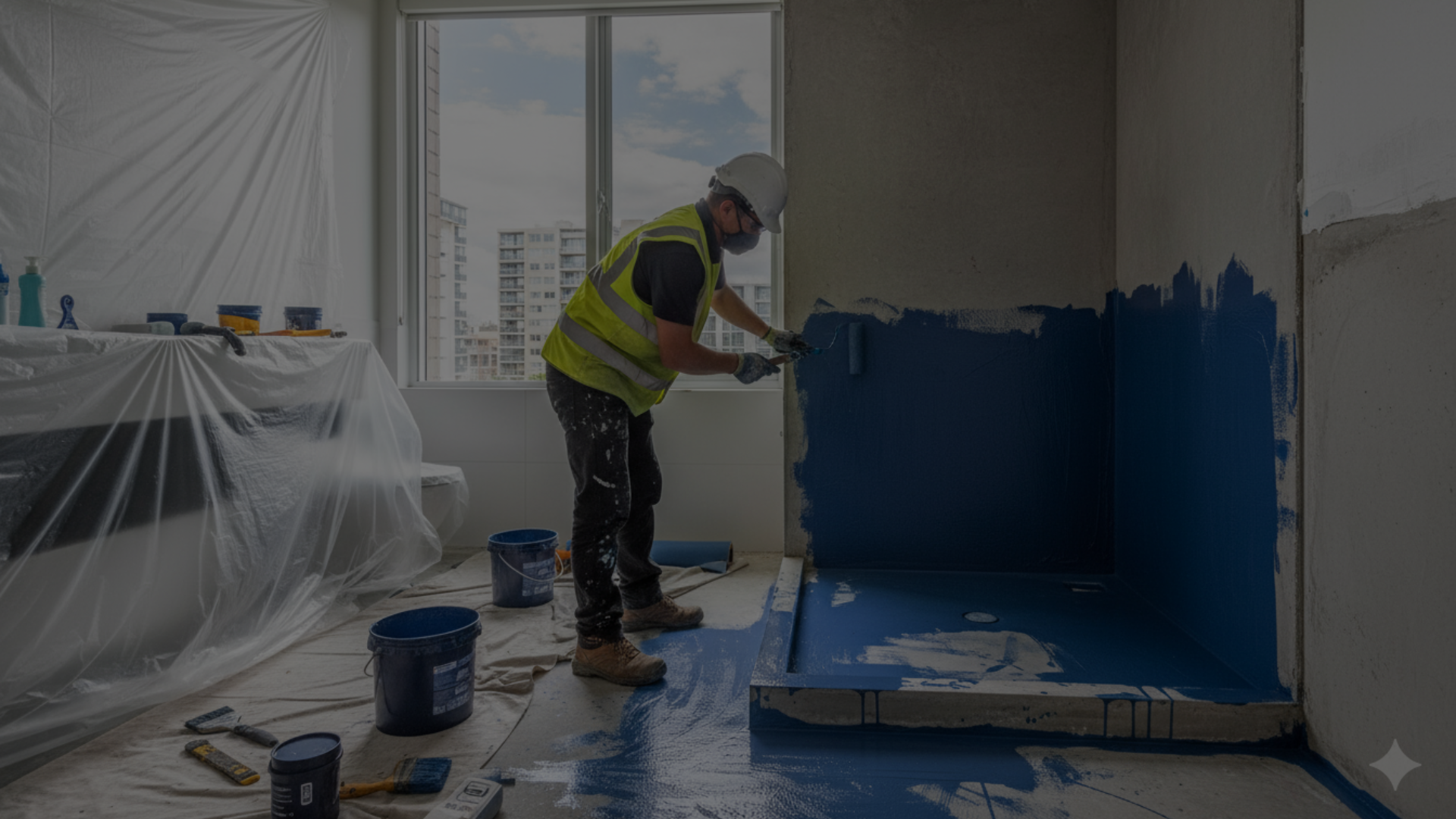
Wet areas — including bathrooms, ensuites, laundries, and commercial washrooms — are high-risk zones for water ingress. When waterproofing fails in these spaces, moisture seeps into walls, floors, and ceilings, causing mould growth, swelling of timber framing, tile debonding, and structural decay.
At Atomic Projects, we treat wet area waterproofing as a critical infrastructure task, not an afterthought. Our systems are installed with meticulous attention to junctions, penetrations, and transitions, following the latest AS 3740 requirements.
Our Bathroom & Wet Area Waterproofing Process
- Inspection & Substrate Assessment
- Identify any existing leaks, rot, or structural movement.
- Check drainage positions, falls, and substrate integrity before commencing works.
- Substrate Preparation
- Ensure all surfaces are clean, dry, and structurally sound.
- Prime surfaces with compatible primers to improve membrane adhesion.
- Fill cracks and gaps with suitable sealants or mortars.
- Critical Area Detailing
- Reinforce junctions (wall-to-floor, wall-to-wall, hob interfaces) with bond breakers or joint tape.
- Apply additional membrane layers around tap penetrations, drains, and waste outlets.
- Membrane Application
- Install high-performance liquid or sheet membranes, depending on site requirements.
- Apply multiple coats to achieve the manufacturer's specified dry film thickness.
- Extend membrane behind wall linings and into door thresholds to prevent lateral moisture migration.
- Drainage & Falls Compliance
- Ensure minimum falls to drains (1:60 in showers, 1:80 in other wet areas) for effective water flow.
- Curing & Quality Checks
- Allow full curing time before tiling to avoid membrane compromise.
- Conduct flood testing where required to verify watertightness.
Common Wet Area Waterproofing Failures We Repair
- Membranes not extending behind wall tiles or into doorways.
- Incorrect bond breaker installation, leading to cracking at corners.
- Single-coat or under-thickness applications.
- Poor adhesion due to unprimed or dusty substrates.
- Drains without puddle flanges.
Why Atomic Projects for Bathroom & Wet Area Waterproofing
- Standards-First Approach: All works meet or exceed AS 3740:2021 requirements.
- Product-Matched Systems: Membranes selected for flexibility, chemical resistance, and compatibility with adhesives.
- Zero Shortcuts: Every coat measured, every junction reinforced, every penetration sealed.
- Warranty Confidence: Manufacturer-backed warranties on approved systems.
Frequently Asked Questions
How do I know if the bathroom waterproofing in my apartment has failed?
Tell-tale signs include damp spots or mould on the walls or ceiling in the bathroom below yours, tiles lifting off the wall or floor, persistent musty smell, or water staining at wall junctions. A moisture investigation using calibrated meters can confirm whether the waterproofing layer has been compromised before strip-out begins.
Do all the tiles need to be removed to re-waterproof a bathroom?
Yes — the waterproofing membrane is installed beneath the tile bed and screed, so a full strip-out is required for a proper remediation. Applying a topical coating over existing tiles does not constitute compliant waterproofing under AS 3740 and will not protect against structural moisture damage.
Can Atomic Projects waterproof bathrooms in an occupied building?
Yes. We carry out bathroom waterproofing in strata buildings on a unit-by-unit basis, typically completing each wet area within 5–8 working days from strip-out to tiling handover. We coordinate with building managers to schedule works with minimal disruption to neighbouring residents.
What's the difference between bathroom waterproofing and general waterproofing?
Bathroom waterproofing under AS 3740 requires membranes to be applied to specific heights, with particular detailing at junctions, penetrations, and hob interfaces. It's a prescriptive standard with exact requirements for film thickness, coverage, and curing times. General external waterproofing standards (like AS 4654) apply to balconies and podiums, which have different loading and exposure conditions.
Who is responsible for wet area waterproofing in a strata building?
In NSW, the responsibility depends on the location — within-lot areas (e.g., ensuite floors) are generally the lot owner's responsibility, while common property bathrooms (e.g., pool change rooms, lobby amenities) are the owners corporation's responsibility. We work with both lot owners and OC representatives and can assist with defect reporting documentation for disputes.
Related Services