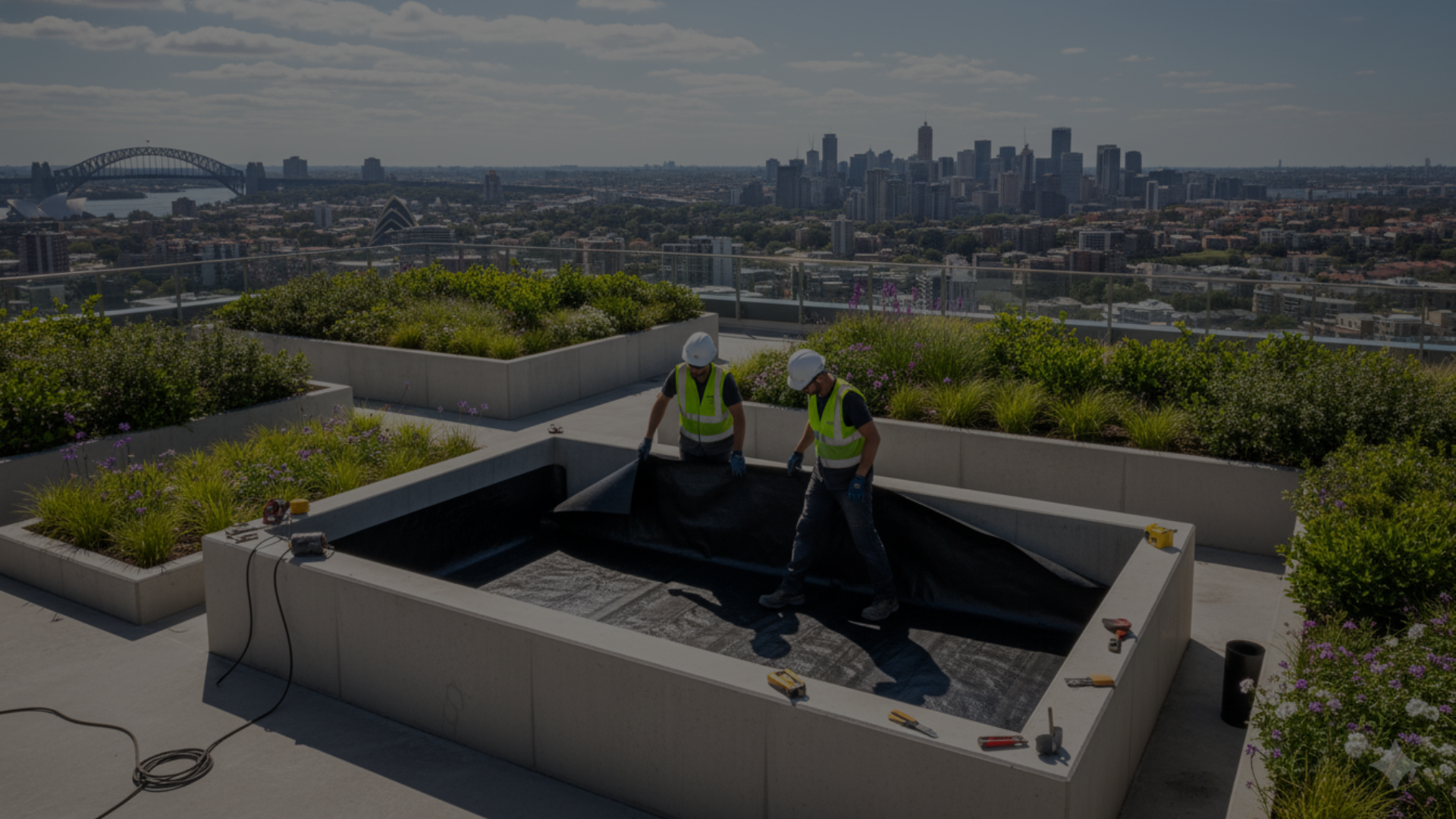
Planter boxes may look like harmless landscaping features, but they are one of the most common sources of water ingress in modern buildings. Over time, water seeps through poorly detailed or deteriorated membranes, causing leaks into apartments, corrosion of reinforcing steel, and rot in timber framing.
At Atomic Projects, we approach planter box waterproofing as a structural protection system — not just a landscaping finish. Our solutions balance water retention for plant health with controlled drainage to protect the building.
Our Planter Box Waterproofing Process
- Assessment & Diagnosis
- Inspect for existing leaks, drainage failures, and substrate damage.
- Identify root ingress or chemical attack from fertilisers and soils.
- Demolition & Substrate Preparation
- Remove all soil, plants, and existing lining materials.
- Clean surfaces thoroughly to remove dust, efflorescence, and loose coatings.
- Repair cracks, voids, and surface defects in the substrate.
- Drainage System Installation
- Install or upgrade drainage outlets with puddle flanges to prevent leaks.
- Fit protection layers such as drainage cell sheets to allow water flow while protecting the membrane.
- Membrane Application
- Apply a root-resistant, chemical-resistant waterproof membrane system — either liquid-applied or sheet-based depending on the design.
- Reinforce all joints, corners, and penetrations with bond breaker tape or fabric reinforcement.
- Apply multiple coats to achieve full manufacturer-specified dry film thickness.
- Protection Layer & Refill
- Install geotextile fabric above the drainage layer to separate soil from drainage cells.
- Refill with appropriate soil media designed for planter boxes to prevent excessive water retention.
- Final Quality Control
- Conduct flood testing before soil reintroduction to ensure watertightness.
- Provide a full photographic QA record for compliance and warranty purposes.
Common Planter Box Waterproofing Failures We Repair
- Missing or inadequate drainage outlets leading to pooling water.
- Membranes damaged by root penetration.
- Use of non-root-resistant membranes.
- Under-thickness or single-coat membrane applications.
- Soil placed directly on membranes without protection layers.
Why Atomic Projects for Planter Box Waterproofing
- Root & Chemical Resistance: Systems designed to withstand fertiliser chemicals and aggressive root systems.
- Compliant Detailing: All outlets, corners, and joints reinforced to prevent leaks.
- Holistic Approach: Balances plant health with complete building protection.
- Proven Track Record: Experience in podium gardens, rooftop landscaping, and ground-level planters.
Frequently Asked Questions
How do I know if my planter box waterproofing has failed?
Signs include damp patches on the ceilings or walls of spaces below the planter, pooling soil water, efflorescence on adjacent masonry, or rust staining on concrete. A leak investigation will confirm whether the waterproofing membrane is the source, as water often travels laterally before appearing at the damage point.
Do the plants need to be permanently removed?
For a full membrane replacement, yes — all soil and plants must be removed to access the substrate. We recommend working with a landscaper to retain and replant healthy specimens after works are complete. In some cases, partial-access repairs may be possible for isolated failures.
What makes planter box waterproofing different from standard waterproofing?
Planter boxes require membranes that are specifically root-resistant and chemical-resistant to handle fertilisers, organic acids from decomposing matter, and the physical pressure of root growth. Standard balcony membranes are not always suitable and can fail prematurely without root-barrier protection layers.
How long should planter box waterproofing last?
A correctly installed root-resistant system with appropriate drainage should last 15–25 years depending on the product used and the conditions. Using the correct drainage cell and protection layers significantly extends membrane life by reducing physical abrasion and UV exposure.
Can we combine planter box waterproofing with other remedial works?
Absolutely. Planter box waterproofing is often combined with podium deck waterproofing works, since planters typically sit on podium slabs. Coordinating both scopes in a single mobilisation reduces cost and disruption for residents and building managers.
Related Services