Atomic Projects white logo

Get Your Free E Book

23 Pages of Exclusive Trade Secrets
Thank you! Your submission has been received!
Oops! Something went wrong while submitting the form.
Limited Time Only
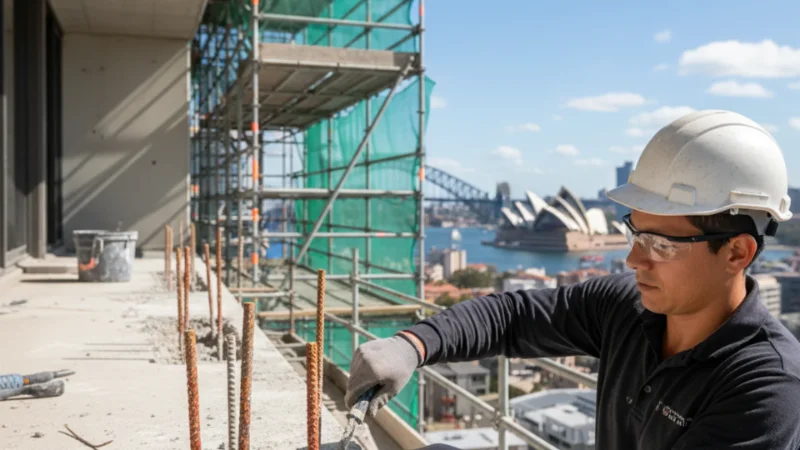
Concrete spalling repair in progress on a Sydney strata apartment balcony — anti-corrosion primer on exposed reinforcement with fresh repair mortar applied

Concrete Repair Cost in Sydney: What Strata Buildings Actually Pay in 2026

If your strata committee has just received an engineer's report flagging concrete spalling, cracking, or carbonation damage, the first question is always the same: how much will this cost?

The honest answer is that concrete repair costs in Sydney strata buildings range from $5,000 for a few localised patches to $1 million-plus for full structural remediation across a high-rise facade. That range is not helpful when you are trying to set levies.

This guide breaks down what Sydney strata buildings are actually paying in 2026 — by repair type, by severity, and by the hidden cost drivers that blow budgets when committees do not account for them upfront.

What Determines Concrete Repair Cost in a Strata Building

Five factors drive the final number on your quote:

1. Repair type and severity. A cosmetic patch to a spalled soffit costs a fraction of a full structural repair where reinforcement has corroded through. The methodology changes — and so does the price per square metre.

2. Access requirements. Ground-floor concrete damage is straightforward. Seventh-floor balcony soffits require scaffolding or rope access. Access alone can account for 30–50% of total project cost on multi-storey buildings.

3. Number of affected areas. A single balcony repair carries fixed mobilisation costs that are spread across just one unit. A building-wide program spreads those same fixed costs across 40 balconies — the per-unit rate drops significantly.

4. Site constraints. CBD buildings with traffic management requirements, night-work restrictions, or limited staging areas incur costs that suburban buildings do not. A site in Parramatta may cost 20–30% less than an identical scope in the Sydney CBD purely due to logistics.

5. Scope certainty. If your engineer defines the scope after invasive investigation (removing concrete to inspect reinforcement), the quote will be accurate. If the scope is estimated from a visual inspection alone, expect contingency allowances of 15–20% — or worse, variation claims during the works.

Concrete Repair Cost by Type: 2026 Sydney Rates

These ranges reflect what strata buildings in Greater Sydney are paying in 2026 for contractor-delivered repairs (inclusive of preparation, materials, and application — exclusive of access unless noted).

Crack Injection (Epoxy or Polyurethane)

Cost: $60–$90 per linear metre. Used for structural cracks that need to be sealed and bonded. Epoxy injection restores structural capacity; polyurethane injection is used where flexibility or waterproofing is the priority.

Typical strata application: carpark slabs, basement walls, balcony slabs with live cracking.

Surface Crack Repair (Routing and Sealing)

Cost: $30–$50 per linear metre. For non-structural cracks that need cosmetic repair and weather sealing. Router cuts a channel, sealant fills and bonds.

Typical strata application: walkway slabs, rendered facades with map cracking.

Concrete Spalling Repair (Patch Repair)

Cost: $250–$600 per m² (minor/localised). $450–$900 per m² (moderate structural). $900–$1,500+ per m² (severe/widespread).

This is the most common repair in Sydney strata buildings. The process: break out damaged concrete to 25mm behind corroded reinforcement, treat rebar with zinc-rich primer, apply polymer-modified repair mortar, finish to match existing profile.

Minor means a handful of isolated patches less than 0.5m² each. Moderate means systematic damage across a structural element. Severe means the reinforcement has lost more than 20% of its cross-sectional area and the repair becomes structural rather than cosmetic.

Balcony Concrete Repair

Cost: $3,500–$30,000+ per balcony. The wide range reflects the reality that some balconies need a 0.3m² spalling patch and a new waterproof membrane, while others need full soffit breakout, rebar replacement, recasting, and complete waterproofing system installation.

For a typical Sydney strata building with 20–40 balconies where 60% need moderate repair, budget $150,000–$400,000 for the concrete repair scope alone; add waterproofing, tiling, and make-good for $250,000–$600,000 total project cost.

Carbonation Treatment

Cost: $80–$150 per m². Applied to concrete surfaces where carbonation has reduced the alkaline protection around reinforcement but active corrosion has not yet started. A migrating corrosion inhibitor or re-alkalisation treatment extends the service life of the concrete without breakout.

This is preventive — it costs a fraction of the reactive spalling repair that becomes necessary if carbonation is left untreated.

Protective Coating Systems

Cost: $40–$80 per m². Anti-carbonation coatings, elastomeric membranes, or silane-based penetrating sealers applied after repair to protect the concrete from future deterioration.

Not optional. Without protection, your $250/m² repair will need repeating in 10–15 years instead of lasting 30+.

The Hidden Costs That Blow Strata Budgets

The per-square-metre rates above are the contractor's direct cost for the repair work itself. In a strata building, the total project cost includes several additional line items that committees often miss in early budgeting.

Access and Scaffolding

$10,000–$15,000 per elevation for scaffolding; $2,000–$5,000 per drop for rope access. On a 6-storey building with 4 elevations, scaffolding alone can add $40,000–$60,000 to the project. Rope access is cheaper per drop but slower for large-area repairs. The most cost-effective approach depends on the volume of repair work — if more than 30% of an elevation needs attention, scaffolding is usually more economical than rope access.

Engineering and Investigation

$5,000–$20,000 for a structural condition assessment; $8,000–$30,000 for invasive investigation with core sampling. This is not wasted money. A $15,000 invasive investigation that defines scope accurately will save $50,000+ in variation claims compared to a $5,000 visual-only assessment that leaves the contractor guessing at reinforcement condition.

Resident Communication and Access Coordination

$3,000–$8,000 for a resident liaison program. On occupied strata buildings, coordinating access to private balconies, managing noise complaints, and scheduling around residents costs time. Some builders absorb this in their preliminaries; others charge it separately. Ask.

Contingency

10–20% of total project cost. Non-negotiable for any concrete repair project. You cannot see behind concrete without breaking it out. Even with thorough investigation, hidden defects appear during works. A 15% contingency is standard; anything less is optimistic.

Waterproofing (Post-Repair)

$120–$250 per m² for liquid-applied membrane systems. Concrete repair on a balcony or wet area without re-waterproofing is incomplete work. The membrane system is often a separate trade and a separate cost line.

What a Real Sydney Strata Project Looks Like: Budget Breakdown

Here is a representative budget breakdown for a 30-unit, 5-storey strata building in Sydney's Inner West with moderate concrete spalling across balconies and the carpark soffit:

Cost ComponentAmount% of Total
Structural engineer's investigation$18,0004%
Scaffolding (2 elevations + carpark)$45,00010%
Concrete breakout and repair (balconies)$180,00040%
Concrete repair (carpark soffit)$65,00014%
Waterproofing (balconies)$55,00012%
Protective coatings$25,0005%
Preliminaries and site management$30,0007%
Contingency (15%)$35,0008%
Total$453,000100%

This is a mid-range project. It is not the cheapest possible approach (which would defer the carpark) and not the most expensive (which would include facade panels and tiling make-good). It represents what a responsible committee approves when the engineer says the damage is progressing and further deferral increases cost by 8–12% per year.

How to Get Accurate Quotes (Not Just Cheap Ones)

The NSW Strata Schemes Management Act 2015 (Section 102) requires owners corporations to obtain at least two independent quotations for any expenditure exceeding $30,000. For concrete repair projects, this is not just a legal box to tick — it protects the building.

Here is what separates an accurate quote from a cheap one:

An accurate quote includes: a defined scope of work based on investigation findings, specified repair methodology (product systems, application standards), clearly stated access strategy, a program with milestone dates, provisional sums for areas that could not be investigated, and a contingency mechanism.

A cheap quote typically omits: investigation scope (assumes best case), waterproofing (leaves it as a variation), contingency (claims it will not be needed), and make-good to finishes (tiles, paint, render).

The building that chooses the cheapest quote often pays 30–40% more in variations than the building that chose the most detailed quote at a slightly higher base price.

The April 2026 Capital Works Fund Changes

From 1 April 2026, any new or reviewed 10-year capital works fund plan in NSW must be prepared using the new mandatory standard form. This standard form requires a more detailed breakdown of anticipated remedial expenditure, including concrete repair provisions.

What this means for your building: if your capital works fund plan was prepared before April 2026 and does not include adequate provision for concrete repair identified in your building's condition assessment, it is likely non-compliant with the new standard form requirements on its next review.

Get your concrete condition assessed now. The cost of a $15,000 investigation is trivial compared to the cost of an underfunded capital works plan that forces a special levy when repairs become urgent.

When to Act (The Cost of Waiting)

Concrete deterioration is not linear. It accelerates. A spalling patch that costs $400/m² today will cost $900/m² in three years if the reinforcement continues to corrode. The structural engineer's rule of thumb: every year of deferral on active concrete damage increases the eventual repair cost by 8–12%.

For a building with $200,000 in identified concrete repair needs today, deferring for 3 years does not save $200,000 — it turns it into $280,000–$330,000. Plus the risk of a safety incident that triggers emergency works at premium rates.

Next Steps for Your Strata Committee

If your building has visible concrete spalling, cracking, or water staining on soffits, the path forward is straightforward:

  1. Commission a structural condition assessment. This identifies the extent and severity of damage and provides a defined scope for quotation.
  2. Obtain at least two independent quotes from DBP-registered remedial contractors (required under NSW law for projects over $30,000).
  3. Compare quotes on methodology and scope, not just price. The cheapest quote usually has the largest exclusion list.
  4. Check your capital works fund plan. Does it provision for the repair cost identified? If not, you need to update it under the new April 2026 standard form.

Atomic Projects is a DBP-registered remedial building contractor with a diagnostic-first approach — we define the scope through invasive investigation before we quote. Get a concrete repair assessment for your strata building →

Frequently Asked Questions

How much does concrete repair cost per square metre in Sydney? Concrete repair costs in Sydney range from $250–$600/m² for minor localised spalling, $450–$900/m² for moderate structural repairs, and $900–$1,500+/m² for severe widespread damage. These rates are for the repair work only — access, engineering, and waterproofing are additional.

How much does concrete balcony repair cost in a strata building? Individual balcony repairs range from $3,500 for a minor spalling patch to $30,000+ for full soffit breakout and recasting. For a typical 20–40 unit Sydney strata building with 60% of balconies needing moderate repair, budget $250,000–$600,000 including waterproofing and make-good.

What hidden costs should strata committees budget for in concrete repair projects? Key hidden costs include scaffolding ($10,000–$15,000 per elevation), engineering investigation ($5,000–$30,000), waterproofing ($120–$250/m²), resident coordination ($3,000–$8,000), and contingency (10–20% of total). Access and scaffolding alone can represent 30–50% of total project cost on multi-storey buildings.

How many quotes do strata buildings need for concrete repair in NSW? Under Section 102 of the NSW Strata Schemes Management Act 2015, owners corporations must obtain at least two independent quotations for any expenditure exceeding $30,000. For concrete repair projects, compare quotes on methodology and scope completeness, not just price.

Does concrete damage get more expensive to repair if you wait? Yes. Concrete deterioration accelerates once it starts. The structural engineering rule of thumb is that every year of deferral on active concrete damage increases eventual repair cost by 8–12%. A $200,000 repair need today becomes $280,000–$330,000 if deferred for three years.

Concrete Repair Cost in Sydney: What Strata Buildings Actually Pay in 2026

Concrete spalling repair in progress on a Sydney strata apartment balcony — anti-corrosion primer on exposed reinforcement with fresh repair mortar applied

If your strata committee has just received an engineer's report flagging concrete spalling, cracking, or carbonation damage, the first question is always the same: how much will this cost?

The honest answer is that concrete repair costs in Sydney strata buildings range from $5,000 for a few localised patches to $1 million-plus for full structural remediation across a high-rise facade. That range is not helpful when you are trying to set levies.

This guide breaks down what Sydney strata buildings are actually paying in 2026 — by repair type, by severity, and by the hidden cost drivers that blow budgets when committees do not account for them upfront.

What Determines Concrete Repair Cost in a Strata Building

Five factors drive the final number on your quote:

1. Repair type and severity. A cosmetic patch to a spalled soffit costs a fraction of a full structural repair where reinforcement has corroded through. The methodology changes — and so does the price per square metre.

2. Access requirements. Ground-floor concrete damage is straightforward. Seventh-floor balcony soffits require scaffolding or rope access. Access alone can account for 30–50% of total project cost on multi-storey buildings.

3. Number of affected areas. A single balcony repair carries fixed mobilisation costs that are spread across just one unit. A building-wide program spreads those same fixed costs across 40 balconies — the per-unit rate drops significantly.

4. Site constraints. CBD buildings with traffic management requirements, night-work restrictions, or limited staging areas incur costs that suburban buildings do not. A site in Parramatta may cost 20–30% less than an identical scope in the Sydney CBD purely due to logistics.

5. Scope certainty. If your engineer defines the scope after invasive investigation (removing concrete to inspect reinforcement), the quote will be accurate. If the scope is estimated from a visual inspection alone, expect contingency allowances of 15–20% — or worse, variation claims during the works.

Concrete Repair Cost by Type: 2026 Sydney Rates

These ranges reflect what strata buildings in Greater Sydney are paying in 2026 for contractor-delivered repairs (inclusive of preparation, materials, and application — exclusive of access unless noted).

Crack Injection (Epoxy or Polyurethane)

Cost: $60–$90 per linear metre. Used for structural cracks that need to be sealed and bonded. Epoxy injection restores structural capacity; polyurethane injection is used where flexibility or waterproofing is the priority.

Typical strata application: carpark slabs, basement walls, balcony slabs with live cracking.

Surface Crack Repair (Routing and Sealing)

Cost: $30–$50 per linear metre. For non-structural cracks that need cosmetic repair and weather sealing. Router cuts a channel, sealant fills and bonds.

Typical strata application: walkway slabs, rendered facades with map cracking.

Concrete Spalling Repair (Patch Repair)

Cost: $250–$600 per m² (minor/localised). $450–$900 per m² (moderate structural). $900–$1,500+ per m² (severe/widespread).

This is the most common repair in Sydney strata buildings. The process: break out damaged concrete to 25mm behind corroded reinforcement, treat rebar with zinc-rich primer, apply polymer-modified repair mortar, finish to match existing profile.

Minor means a handful of isolated patches less than 0.5m² each. Moderate means systematic damage across a structural element. Severe means the reinforcement has lost more than 20% of its cross-sectional area and the repair becomes structural rather than cosmetic.

Balcony Concrete Repair

Cost: $3,500–$30,000+ per balcony. The wide range reflects the reality that some balconies need a 0.3m² spalling patch and a new waterproof membrane, while others need full soffit breakout, rebar replacement, recasting, and complete waterproofing system installation.

For a typical Sydney strata building with 20–40 balconies where 60% need moderate repair, budget $150,000–$400,000 for the concrete repair scope alone; add waterproofing, tiling, and make-good for $250,000–$600,000 total project cost.

Carbonation Treatment

Cost: $80–$150 per m². Applied to concrete surfaces where carbonation has reduced the alkaline protection around reinforcement but active corrosion has not yet started. A migrating corrosion inhibitor or re-alkalisation treatment extends the service life of the concrete without breakout.

This is preventive — it costs a fraction of the reactive spalling repair that becomes necessary if carbonation is left untreated.

Protective Coating Systems

Cost: $40–$80 per m². Anti-carbonation coatings, elastomeric membranes, or silane-based penetrating sealers applied after repair to protect the concrete from future deterioration.

Not optional. Without protection, your $250/m² repair will need repeating in 10–15 years instead of lasting 30+.

The Hidden Costs That Blow Strata Budgets

The per-square-metre rates above are the contractor's direct cost for the repair work itself. In a strata building, the total project cost includes several additional line items that committees often miss in early budgeting.

Access and Scaffolding

$10,000–$15,000 per elevation for scaffolding; $2,000–$5,000 per drop for rope access. On a 6-storey building with 4 elevations, scaffolding alone can add $40,000–$60,000 to the project. Rope access is cheaper per drop but slower for large-area repairs. The most cost-effective approach depends on the volume of repair work — if more than 30% of an elevation needs attention, scaffolding is usually more economical than rope access.

Engineering and Investigation

$5,000–$20,000 for a structural condition assessment; $8,000–$30,000 for invasive investigation with core sampling. This is not wasted money. A $15,000 invasive investigation that defines scope accurately will save $50,000+ in variation claims compared to a $5,000 visual-only assessment that leaves the contractor guessing at reinforcement condition.

Resident Communication and Access Coordination

$3,000–$8,000 for a resident liaison program. On occupied strata buildings, coordinating access to private balconies, managing noise complaints, and scheduling around residents costs time. Some builders absorb this in their preliminaries; others charge it separately. Ask.

Contingency

10–20% of total project cost. Non-negotiable for any concrete repair project. You cannot see behind concrete without breaking it out. Even with thorough investigation, hidden defects appear during works. A 15% contingency is standard; anything less is optimistic.

Waterproofing (Post-Repair)

$120–$250 per m² for liquid-applied membrane systems. Concrete repair on a balcony or wet area without re-waterproofing is incomplete work. The membrane system is often a separate trade and a separate cost line.

What a Real Sydney Strata Project Looks Like: Budget Breakdown

Here is a representative budget breakdown for a 30-unit, 5-storey strata building in Sydney's Inner West with moderate concrete spalling across balconies and the carpark soffit:

Cost ComponentAmount% of Total
Structural engineer's investigation$18,0004%
Scaffolding (2 elevations + carpark)$45,00010%
Concrete breakout and repair (balconies)$180,00040%
Concrete repair (carpark soffit)$65,00014%
Waterproofing (balconies)$55,00012%
Protective coatings$25,0005%
Preliminaries and site management$30,0007%
Contingency (15%)$35,0008%
Total$453,000100%

This is a mid-range project. It is not the cheapest possible approach (which would defer the carpark) and not the most expensive (which would include facade panels and tiling make-good). It represents what a responsible committee approves when the engineer says the damage is progressing and further deferral increases cost by 8–12% per year.

How to Get Accurate Quotes (Not Just Cheap Ones)

The NSW Strata Schemes Management Act 2015 (Section 102) requires owners corporations to obtain at least two independent quotations for any expenditure exceeding $30,000. For concrete repair projects, this is not just a legal box to tick — it protects the building.

Here is what separates an accurate quote from a cheap one:

An accurate quote includes: a defined scope of work based on investigation findings, specified repair methodology (product systems, application standards), clearly stated access strategy, a program with milestone dates, provisional sums for areas that could not be investigated, and a contingency mechanism.

A cheap quote typically omits: investigation scope (assumes best case), waterproofing (leaves it as a variation), contingency (claims it will not be needed), and make-good to finishes (tiles, paint, render).

The building that chooses the cheapest quote often pays 30–40% more in variations than the building that chose the most detailed quote at a slightly higher base price.

The April 2026 Capital Works Fund Changes

From 1 April 2026, any new or reviewed 10-year capital works fund plan in NSW must be prepared using the new mandatory standard form. This standard form requires a more detailed breakdown of anticipated remedial expenditure, including concrete repair provisions.

What this means for your building: if your capital works fund plan was prepared before April 2026 and does not include adequate provision for concrete repair identified in your building's condition assessment, it is likely non-compliant with the new standard form requirements on its next review.

Get your concrete condition assessed now. The cost of a $15,000 investigation is trivial compared to the cost of an underfunded capital works plan that forces a special levy when repairs become urgent.

When to Act (The Cost of Waiting)

Concrete deterioration is not linear. It accelerates. A spalling patch that costs $400/m² today will cost $900/m² in three years if the reinforcement continues to corrode. The structural engineer's rule of thumb: every year of deferral on active concrete damage increases the eventual repair cost by 8–12%.

For a building with $200,000 in identified concrete repair needs today, deferring for 3 years does not save $200,000 — it turns it into $280,000–$330,000. Plus the risk of a safety incident that triggers emergency works at premium rates.

Next Steps for Your Strata Committee

If your building has visible concrete spalling, cracking, or water staining on soffits, the path forward is straightforward:

  1. Commission a structural condition assessment. This identifies the extent and severity of damage and provides a defined scope for quotation.
  2. Obtain at least two independent quotes from DBP-registered remedial contractors (required under NSW law for projects over $30,000).
  3. Compare quotes on methodology and scope, not just price. The cheapest quote usually has the largest exclusion list.
  4. Check your capital works fund plan. Does it provision for the repair cost identified? If not, you need to update it under the new April 2026 standard form.

Atomic Projects is a DBP-registered remedial building contractor with a diagnostic-first approach — we define the scope through invasive investigation before we quote. Get a concrete repair assessment for your strata building →

Frequently Asked Questions

How much does concrete repair cost per square metre in Sydney? Concrete repair costs in Sydney range from $250–$600/m² for minor localised spalling, $450–$900/m² for moderate structural repairs, and $900–$1,500+/m² for severe widespread damage. These rates are for the repair work only — access, engineering, and waterproofing are additional.

How much does concrete balcony repair cost in a strata building? Individual balcony repairs range from $3,500 for a minor spalling patch to $30,000+ for full soffit breakout and recasting. For a typical 20–40 unit Sydney strata building with 60% of balconies needing moderate repair, budget $250,000–$600,000 including waterproofing and make-good.

What hidden costs should strata committees budget for in concrete repair projects? Key hidden costs include scaffolding ($10,000–$15,000 per elevation), engineering investigation ($5,000–$30,000), waterproofing ($120–$250/m²), resident coordination ($3,000–$8,000), and contingency (10–20% of total). Access and scaffolding alone can represent 30–50% of total project cost on multi-storey buildings.

How many quotes do strata buildings need for concrete repair in NSW? Under Section 102 of the NSW Strata Schemes Management Act 2015, owners corporations must obtain at least two independent quotations for any expenditure exceeding $30,000. For concrete repair projects, compare quotes on methodology and scope completeness, not just price.

Does concrete damage get more expensive to repair if you wait? Yes. Concrete deterioration accelerates once it starts. The structural engineering rule of thumb is that every year of deferral on active concrete damage increases eventual repair cost by 8–12%. A $200,000 repair need today becomes $280,000–$330,000 if deferred for three years.

Take the next step.

Fill out the form below and let's build something that lasts.

Phone: Call us at 0410 515 509

Email: Send us a message at hello@atomicprojects.com.au

Form: Fill out the form — we usually respond within 1 business day.

Max file size 10MB.
Uploading...
fileuploaded.jpg
Upload failed. Max size for files is 10 MB.
Thank you! Your submission has been received!
Oops! Something went wrong while submitting the form.