


Concrete roof waterproofing for Sydney strata: the warning signs, liquid vs sheet membranes, costs and timeframes, who pays, and AS 4654 compliance.
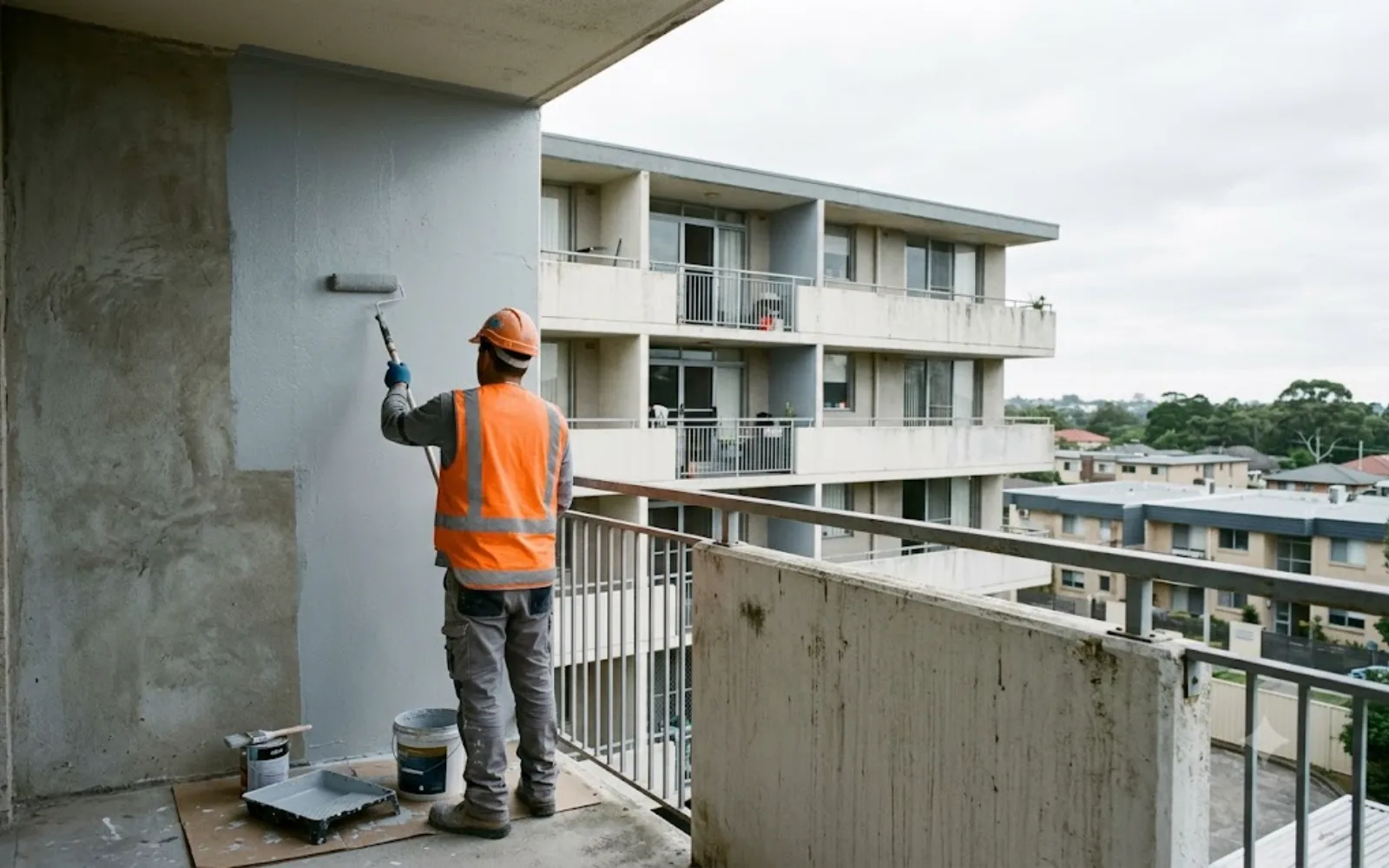
A concrete roof looks permanent. The waterproofing on top of it is not. On almost every Sydney strata building we inspect, the slab is sound and the membrane is the thing that has failed — cracked, blistered, lifted at the upturns, or simply worn out after 15 to 25 years. By the time water is showing up in a top-floor ceiling, the membrane has usually been leaking for months, and the damage is no longer just cosmetic.
This guide explains what concrete roof waterproofing actually involves, how to read the warning signs, the membrane systems used on Sydney strata roofs, what the work costs and how long it takes, who pays for it in a strata building, and how it ties back to the Australian Standard. It is written for strata committees and building managers who need to make a sound decision before the next big rain.
Atomic Projects is a Class 2 DBP Registered Building Practitioner and has delivered $20M+ of remedial work across 100+ Sydney strata buildings, on projects ranging from $50k balcony repairs to $5M+ facade programs. Concrete roofs sit squarely in that work. You can see our approach to waterproofing remediation on strata buildings for the full picture; this article focuses on the roof.
Concrete roof waterproofing is the waterproof membrane layer applied over a concrete roof slab to stop water passing through into the structure below. Concrete is strong but not watertight — it cracks and lets water through. On strata buildings the membrane protects the slab, the reinforcement inside it and everything beneath, so when it fails the whole building is exposed.
A concrete roof slab is designed to carry load, not to keep water out on its own. Concrete is porous and it moves — it shrinks, it flexes with temperature, and it develops fine cracks over time. Left bare, water tracks through those cracks, reaches the steel reinforcement, and starts the corrosion cycle that eventually becomes concrete spalling (often called concrete cancer). The membrane is the sacrificial layer that keeps water away from the slab and the steel. When it reaches the end of its life, re-waterproofing is not optional maintenance — it is what protects the most expensive asset the owners corporation holds.
The clearest signs are water stains or blistering paint on top-floor ceilings, efflorescence (white salt deposits) on soffits and walls, ponding water that sits on the roof more than 48 hours after rain, and a membrane that is cracked, bubbled or peeling at the edges. Any one of these means the membrane is past its service life.
Most committees notice the problem from inside first — a brown ring on a ceiling, a musty smell in the top-floor hallway, paint lifting in a corner. On the roof itself, the tells are a membrane that has gone brittle and crazed, upturns that have debonded from the parapet, split or lifted sheet laps, and ponding that never fully drains. Blocked or undersized drainage makes all of this worse, because standing water finds every weakness. If your building is seeing repeat leaks that keep getting patched, the patching is the symptom — the membrane as a whole has usually failed.
Concrete roofs leak because the waterproof membrane has failed, not usually because the slab itself has. The common causes are an aged or UV-degraded membrane, cracked or debonded upturns at parapets and penetrations, poor falls that let water pond, movement cracks in the slab, and failed sealant around drains, pipes and plant.
In our inspections across Sydney strata roofs, the failure almost always starts at a detail rather than in the open field of the membrane: the upturn behind a parapet, the collar around a vent or air-conditioning penetration, the junction at a box gutter, or a drain outlet that was never properly dressed in. These are the points the five legacy guides on this site used to cover one at a time — the single most common cause, delaying repairs, DIY versus professional, and so on. This page now consolidates all of that into one place. For leaks that extend beyond the roof into the structure, our guide on membrane options and what roof repairs typically cost goes a level deeper on diagnosis.
Neither is universally better — the right choice depends on the roof. Liquid-applied membranes (polyurethane, PMMA) are seamless and detail complex roofs with many penetrations well. Sheet membranes (torch-on bituminous, TPO) give a consistent, factory-controlled thickness and suit large open roofs. On most Sydney strata roofs a liquid system wins on the detailing.
The two families solve the same problem differently. A liquid-applied membrane is rolled or sprayed on and cures into one continuous film with no joins, which is a real advantage on a cluttered strata roof full of pipes, plant plinths and parapet upturns — there are no laps to fail. Sheet membranes are manufactured to a guaranteed thickness and installed in rolls, which gives predictable performance on large, simple roof fields but relies on every lap and termination being perfectly executed on site.
| Factor | Liquid-applied (PU / PMMA) | Sheet (torch-on / TPO) |
| Joints | Seamless, no laps | Lapped — laps are the weak point |
| Complex detailing (penetrations, upturns) | Excellent | Fair — needs skilled terminations |
| Thickness control | Depends on applicator | Factory-consistent |
| Trafficable / plant roofs | Yes, with the right system | Yes, with protection |
| Typical service life | ~15–25 years | ~15–25 years |
Whichever system is specified, it must be installed to the manufacturer's system and to AS 4654.2 — the surface preparation, priming, upturn heights and falls matter more than the brand on the tin.
There is no single rate — a concrete roof is priced on its size, access, the number of penetrations, and whether the slab underneath needs concrete repair first. As a guide, a straightforward re-coat on a sound slab is the cheapest scope; a full strip-and-re-membrane with concrete repair and new drainage is the most expensive. Every roof should be priced after an inspection.
The biggest cost driver is not the membrane itself — it is what sits underneath and around it. If the slab needs concrete repair before the new membrane goes on, or the drainage has to be rebuilt, or crane and hoarding access is difficult, the cost moves well up the range. The indicative bands below are for Sydney strata and are a starting point for budgeting only, not a quote.
| Scope | What's involved | Indicative range* | Typical timeframe |
| Localised repair / re-coat | Sound slab, re-prime and re-coat field + re-detail upturns | $ (lowest) | 1–2 weeks |
| Full re-membrane | Strip old membrane, prep slab, new liquid or sheet system, re-dress drains | $$ | 3–6 weeks |
| Re-membrane + concrete repair | As above plus concrete spalling repair to AS 3600 and new falls/drainage | $$$ (highest) | 6–12 weeks |
*Indicative scope bands for Sydney strata, priced on inspection — not fixed rates. We don't quote a roof we haven't assessed.
A localised re-coat on a sound slab usually takes one to two weeks. A full re-membrane runs three to six weeks, and a re-membrane combined with concrete repair and new drainage can run six to twelve weeks. Weather is the biggest variable, because most membranes need a dry, prepared substrate before they can be applied.
The timeline is driven by curing and drying as much as by labour. Concrete repairs need time to cure, primers need the slab genuinely dry, and most membranes have minimum and maximum re-coat windows between coats. A good contractor sequences the work around the forecast and stages it so the building is never left with an open, unprotected slab overnight. For a plain-language walkthrough of how a job like this runs on an occupied building, see what to expect during waterproofing works.
In a NSW strata scheme the roof and its waterproofing membrane are almost always common property, which makes the owners corporation responsible for maintaining and renewing them. The OC must keep common property in a state of good and serviceable repair under the Strata Schemes Management Act, so budgeting for roof re-waterproofing sits with the scheme, not the individual lot owner below.
Because the roof slab and membrane are common property, the cost of re-waterproofing is a common-property expense funded through the capital works fund (or a special levy where the fund is short). The owners corporation also carries a positive duty to maintain and repair common property — deferring a known roof leak can expose the committee to liability for consequential damage to lots below. This is the "who pays" question that strata committees ask most, and the answer is consistent: the scheme owns the roof, so the scheme funds the works.
Yes. External above-ground waterproofing in Australia is governed by AS 4654 — Part 1 covers the membrane materials and Part 2 covers design and installation, including minimum falls, upturn heights and detailing. For Class 2 (residential strata) buildings the National Construction Code references these requirements, so compliant design and installation is not optional.
AS 4654.2 is the standard that separates a membrane that lasts from one that fails early: it sets the fall to drainage so water doesn't pond, the minimum upturn heights at walls and parapets, and how penetrations and terminations must be detailed. On a Class 2 strata building this work also intersects with the Design and Building Practitioners Act, which is why it should be documented and carried out by a registered practitioner. We cover the standard in detail in our explainer on what AS 4654 actually requires — written around balconies, but the design principles apply directly to concrete roofs.
Concrete roof waterproofing rarely sits on its own. It usually turns up alongside concrete repair, drainage and sometimes facade work, which is why it forms one part of Atomic Projects' remedial building services rather than a standalone trade. Getting the roof right protects everything below it.
If your building is seeing repeat leaks, ponding or staining on top-floor ceilings, the sensible next step is an inspection before the next wet season — not another patch. Atomic Projects provides a free, no-obligation assessment of your roof, a plain-English report on the membrane's condition, and a scoped quote. Book a roof assessment and we'll tell you whether you're looking at a re-coat or a re-membrane before you commit a levy to it.

Send photos, the engineer's report, or just the symptoms — whatever you've got. A registered builder reads it and calls you back. No call centre, no obligation.