


Carbonation and chloride attack look identical on a Sydney balcony — but need different repairs. How to tell them apart, and why patching chloride fails.
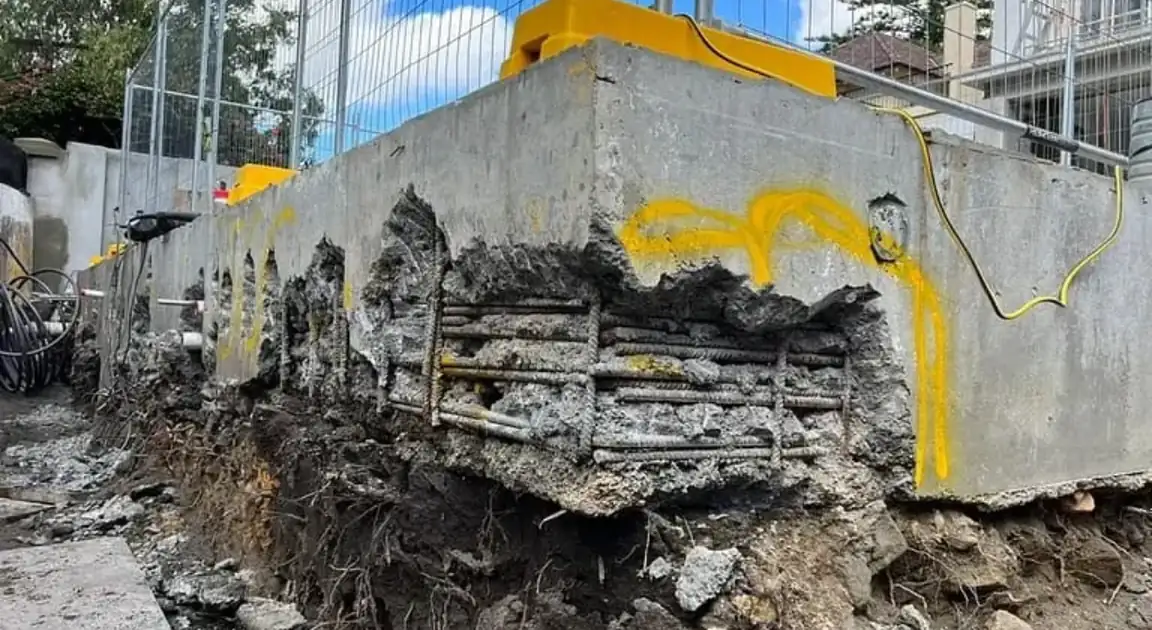
Two buildings in the same suburb, both with concrete spalling off balcony soffits, both quoted around the same money. Five years later one is still sound and the other is back on the agenda with a bigger number attached.
The difference usually isn't the contractor or the mortar. It's that nobody established why the steel was corroding before they decided how to fix it. Carbonation and chloride attack look almost identical from the ground. They behave completely differently once you open the concrete up, and they need different repairs at different prices.
This is the part of a concrete repair that gets skipped most often, and it's the part that decides whether the levy you raise this year is the last one.
Carbonation is CO₂ from the air slowly reacting with the concrete and dropping its alkalinity, which removes the passive film protecting the reinforcement. Chloride attack is salt reaching the steel — from a coastal environment or from the original mix — and breaking that film down locally. Carbonation is gradual and widespread. Chloride attack is aggressive and patchy.
That difference in behaviour is the whole story:
| Carbonation | Chloride attack | |
| Mechanism | Loss of alkalinity across a front moving inward from the surface | Salt ions concentrate at the steel and break down the passive layer locally |
| Pattern of damage | Broad, even, follows low-cover areas and edges | Localised pits, often severe steel section loss in small areas |
| Typical setting | Older inland and sheltered buildings, 1960s–1990s stock | Within ~1km of open water; harbourside and beachside buildings |
| What you see first | Fine map cracking, rust staining, drummy render | Isolated blowouts with sound concrete either side |
| Does it stop after a patch? | Usually yes, if coated | Often no — the surrounding concrete is still contaminated |
If you want the wider picture of how these show up on site, we've covered how we work out what's actually wrong before anything gets priced.
Three tests answer it. A phenolphthalein indicator sprayed on a freshly broken face shows carbonation depth — sound alkaline concrete turns bright pink, carbonated concrete stays colourless. Chloride profiling takes dust samples at increasing depths and measures salt concentration against the steel. Half-cell potential mapping shows where corrosion is active behind intact concrete.
Run alongside cover meter readings and tap testing, those three give you the two numbers that matter: how deep the carbonation front has travelled relative to the actual cover, and whether chloride levels at bar depth are above the corrosion threshold. You can have both mechanisms in one building — a carbonated southern facade and a chloride-affected seaward elevation — which is exactly why testing beats assuming.
Because fixing one spot creates the next one. When you cut out contaminated concrete and fill the void with fresh alkaline mortar, the steel inside the patch re-passivates. The still-contaminated steel immediately around the patch becomes the new anode. This is the incipient anode or "halo" effect, and it commonly brings a building back for major repair within about five years.
This is the single most expensive misunderstanding in remedial concrete work. A patch-only repair on a chloride-affected building isn't a cheaper option — it's the same job done twice. On a carbonated building the same patch, protected with a coating, genuinely does hold.
For carbonation: break out to sound concrete, treat or replace the reinforcement, reinstate with an EN 1504 repair system to AS 3600, then apply an anti-carbonation coating to slow the front and keep CO₂ and moisture out. For chloride attack: the same breakout and reinstatement, plus an electrochemical measure — most commonly galvanic anodes at the patch perimeter — to stop the halo effect forming.
The options, roughly in order of intervention:
The method selection sits inside the EN 1504 framework, which explicitly starts from the diagnosed cause rather than the visible symptom. That's the logic we apply on every concrete cancer repair in Sydney we take on, and it's why two similar-looking jobs can carry different scopes.
Yes, substantially — and the driver isn't the mortar, it's the protection strategy and the quantity of breakout. Carbonation repairs are usually the cheaper of the two because the damage is shallow and predictable. Chloride repairs carry anode supply and installation, more generous breakout margins, and a real chance of extra quantity once the concrete is open.
The cost drivers, in the order they move a number:
| Driver | Carbonation | Chloride attack |
| Breakout quantity | Predictable from cover survey | Frequently exceeds the estimate once opened |
| Steel condition | Surface rust, usually cleaned and treated | Section loss; supplementary bar more likely |
| Protection system | Anti-carbonation coating over the elevation | Anodes per m² or per patch, plus coating |
| Access duration | Shorter, more uniform | Longer; investigation-led, harder to program |
| Risk of return visit | Low once coated | High if anodes are omitted |
We don't publish a $/m² rate here because the rate is meaningless without the test results behind it. For indicative bands and how the quantities build up, see what these repairs actually cost across Sydney strata buildings.
No. Salt-laden air travels well inland with prevailing winds, and AS 3600's exposure classifications treat locations within roughly a kilometre of large expanses of salt water — including much of Sydney Harbour — as near-coastal, with materially higher cover requirements. Buildings built before those requirements tightened are the ones now presenting with chloride damage.
There's a second source people forget: chloride in the original mix. Calcium chloride was used as a set accelerator in some older Australian concrete, which means a building kilometres from the water can still have salt sitting against its reinforcement. That only shows up in a chloride profile, never in a visual inspection.
Commonly, yes. Carbonation tends to dominate sheltered and inland-facing elements while chloride dominates the exposed, weather-facing ones. A sensible scope treats them as separate zones with separate repair specifications rather than applying one method across the whole building.
This is where a lot of money is wasted in both directions. Specify anodes everywhere and you've paid for protection the sheltered elevations never needed. Specify patch-and-coat everywhere and the seaward face is back within a few years. Zoning the building from the test data is the cheapest decision available on the whole project.
Four questions. What were the carbonation depths compared with measured cover? What were the chloride concentrations at bar depth? Which mechanism does the scope assume, and where? And if it's chloride, what stops the incipient anode effect? A scope that can't answer those is a scope that's guessing.
Ask for the raw test data, not just the recommendation. If the investigation didn't include chloride profiling and the building is anywhere near the water, that's a gap worth closing before you go to tender — it costs a fraction of what a second round of repairs costs. It's the same discipline we apply across all our remedial building work at Atomic Projects, and it's worth reading alongside our guide to whether this damage can actually be fixed for good.
And if the report already points to salt, our page on treating salt-contaminated reinforced concrete sets out how those repairs are built.
Carbonation and chloride attack produce the same photographs and completely different projects. One is a patch-and-coat job with a long tail of quiet years. The other needs electrochemical protection or it repeats itself. The tests that tell them apart are cheap, fast, and routinely skipped — and skipping them is how a building ends up paying twice.
Atomic Projects is a Class 2 DBP Registered Building Practitioner and has delivered $20M+ of remedial work across 100+ Sydney strata buildings, from $50k balcony repairs to $5M+ facade programs. If you've got an engineer's report and you're not sure which mechanism it's describing, we'll read it with you.

Send photos, the engineer's report, or just the symptoms — whatever you've got. A registered builder reads it and calls you back. No call centre, no obligation.