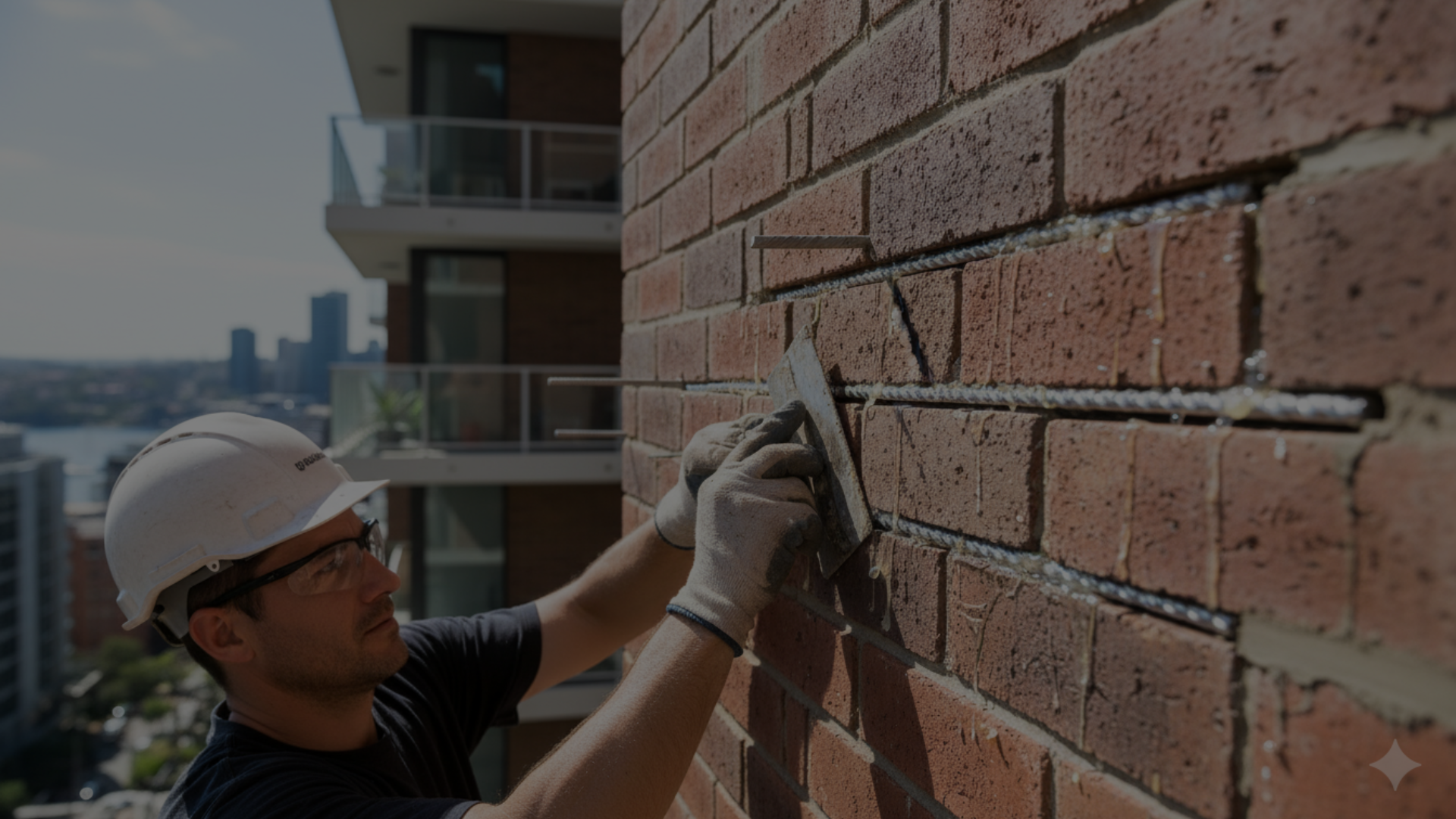
Cracks in brickwork and masonry walls are among the most common — and most misunderstood — defects in Australian buildings. While some cracks are cosmetic, others indicate active structural movement, lintel failure, wall tie corrosion, or foundation settlement. Left unaddressed, structural cracks allow water ingress that accelerates corrosion and deterioration of embedded elements, creating a compounding cycle of damage.
At Atomic Projects, we use engineered crack stitching systems as a non-invasive, highly effective method to restore structural continuity and prevent further movement. Helical stainless-steel bars bonded across cracks redistribute tensile forces through the masonry, stabilising the wall without demolition or significant disruption.
How We Approach Crack Stitching and Masonry Reinforcement
- Cause Analysis and Monitoring — Before any repair, we establish the cause of cracking. Is the crack active (still moving) or historic (arrested)? We use crack monitors, precise measurement surveys, and where appropriate, digital crack monitoring tools to track progression over time before recommending the repair approach.
- Crack Mapping — All cracks are mapped on elevation drawings with widths, orientations, and locations recorded. This documentation is provided to clients and their engineers for design review.
- Mortar Bed Preparation — The mortar bed joint running across the crack is raked out to a consistent depth to receive the helical bar. This is done with precision to avoid disturbing adjacent masonry.
- Helical Bar Installation — High-tensile stainless-steel helical bars are inserted across the crack at regular vertical intervals. Bar length and spacing are specified by the engineer of record based on wall thickness and loading.
- Structural Grout Injection — Bars are fully bedded in a cementitious or epoxy structural grout, ensuring continuous load transfer across the repaired section.
- Repointing and Surface Reinstatement — Mortar joints are repointed with a colour-matched mortar to restore a uniform finish. The result is a repair that is virtually invisible from the exterior.
Frequently Asked Questions
Is crack stitching a permanent fix or just a cosmetic repair?
Crack stitching is an engineered structural repair, not a cosmetic treatment. The helical bars bonded across the crack restore tensile continuity in the wall, preventing further movement where the cause of cracking has been stabilised. Where active foundation movement or other primary causes are still at play, crack stitching is used in combination with other remedial measures. Our reports clearly outline the treatment strategy and any ongoing monitoring requirements.
Do I need an engineer's sign-off for crack stitching?
For structural applications in multi-storey or strata buildings, yes — an engineer's involvement in specifying bar diameter, spacing, and embedment depth is both best practice and typically required for insurance and strata records. We work directly with structural engineers to ensure all works are fully certified.
How do you know if a crack is structural or cosmetic?
Key indicators of structural cracking include diagonal cracks at window or door corners (indicating settlement or lintel deflection), stepped cracks following mortar joints (indicating differential movement), and cracks wider than 1–2mm or showing displacement between faces. Hair-line cracks in render without displacement are typically cosmetic. Our inspection reports classify each crack and recommend the appropriate response.
Can crack stitching be carried out in occupied buildings?
Yes — crack stitching is relatively low-disruption and does not require significant demolition. Most works are completed from scaffolding, rope access, or EWP, with work zones established away from residents. Dust suppression and noise management protocols are applied throughout.
What is the cost difference between crack stitching and full wall reconstruction?
Crack stitching is typically significantly more cost-effective than demolishing and rebuilding a cracked wall section. For a standard residential or strata building, crack stitching repairs can often be completed at 20–40% of the cost of equivalent reconstruction, with minimal disruption and a faster programme.
Related Services
Crack stitching is frequently combined with brick replacement and repointing where spalling accompanies the cracking, and with expansion joint installation where missing or inadequate movement joints have contributed to cracking. For buildings with significant structural concerns, our building investigation and reporting services provide the forensic basis for the repair scope.
Ready to address structural cracking before it worsens? Atomic Projects is a Class 2 Registered Builder with extensive experience in engineered masonry crack repair across Sydney's strata, residential, and commercial building sectors. Contact us to arrange an inspection and crack assessment.
📞 Call Us: 0410 515 509
✉️ Email Us: hello@atomicprojects.com.au
— Ben Tran, General Manager, Atomic Projects