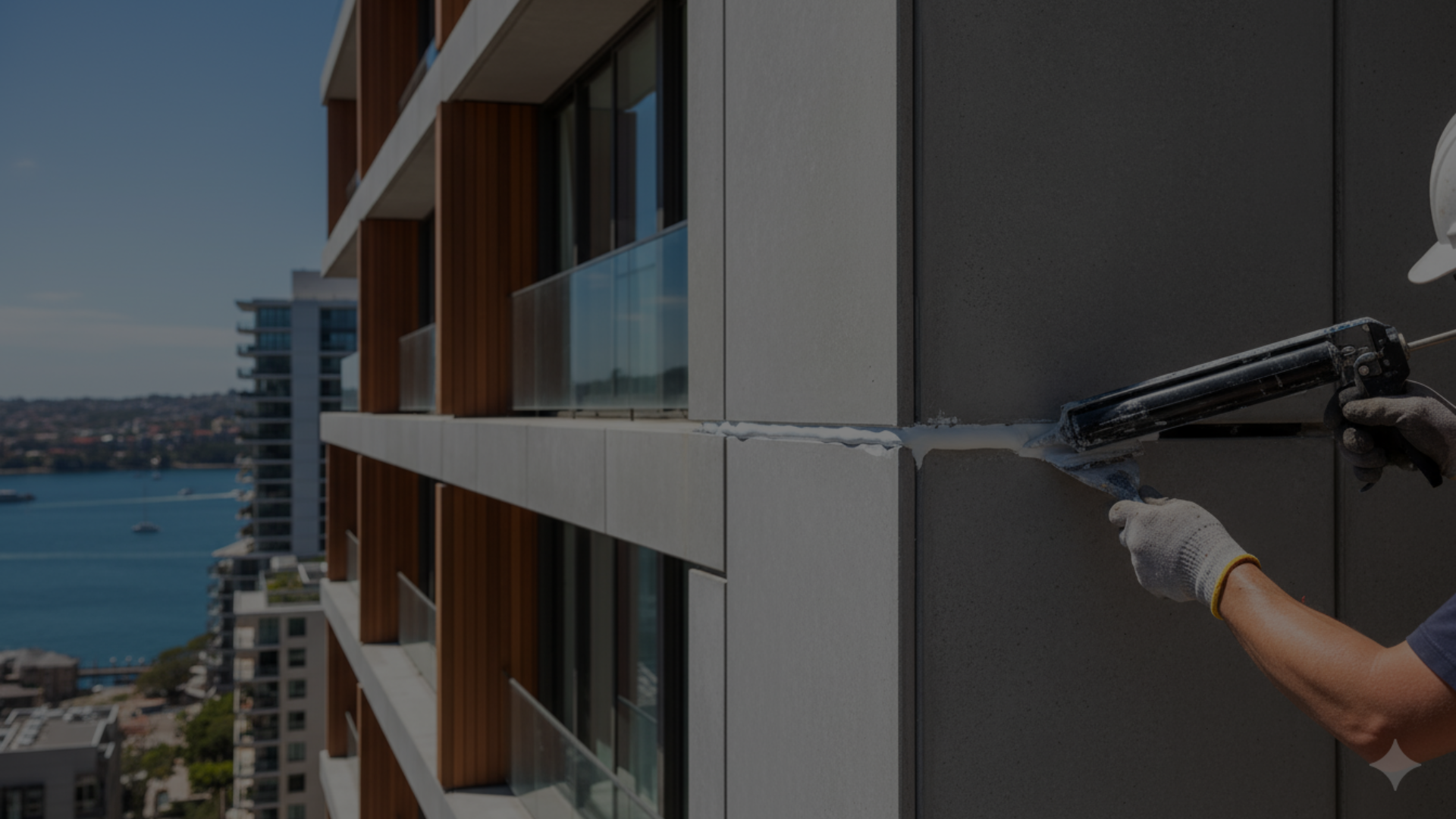
All buildings move. Temperature changes cause materials to expand and contract daily. Structural loads shift and settle over time. Without adequate expansion joints to accommodate this movement, brickwork and render crack, sealants fail, and the building envelope loses its weatherproofing integrity. In many buildings, particularly those constructed from the 1960s to 1990s, expansion joints were either omitted, under-designed, or are now at the end of their service life.
At Atomic Projects, we design, install, and remediate expansion joints in masonry façades as part of a comprehensive building envelope management approach. Our work addresses both new joint installation where joints were never included and failed sealant replacement in existing joints, restoring the façade's ability to flex and breathe without cracking.
How We Approach Expansion Joint Installation and Remediation
- Movement Analysis — We assess the building's thermal movement characteristics, material types, and wall dimensions to calculate where joints are required and at what spacing. For masonry walls, AS 3700 provides guidance on maximum panel lengths between control joints.
- Joint Audit — We inspect all existing expansion and control joints for sealant condition, joint width, depth, and performance. Joints that have failed through adhesive loss, cohesive tearing, or hardening are documented for remediation.
- Joint Cutting — Where new joints are required, we cut precise, clean joints through masonry or render using diamond-tipped cutting equipment. Joint width and depth are sized to accommodate calculated movement range per the relevant standards.
- Failed Sealant Removal — Deteriorated sealant is completely removed — not just bridged over — using precision cutting tools. Joint faces are cleaned of all residue, primer, and contaminants to provide a clean bonding surface.
- Backer Rod and Primer Installation — A correctly sized closed-cell backer rod is installed to control joint depth-to-width ratio (typically 1:2) and prevent three-sided adhesion. Primer is applied where required by the sealant manufacturer to ensure optimal adhesion.
- Premium Sealant Application — We install high-performance, UV-resistant elastomeric sealants (polyurethane, hybrid, or silicone) appropriate to the exposure conditions and expected joint movement. Sealant is tooled to a clean concave profile for both aesthetics and drainage performance.
Frequently Asked Questions
How often should expansion joint sealants be replaced?
The service life of a quality polyurethane or silicone sealant in Australian outdoor conditions is typically 10–20 years, depending on UV exposure, joint movement frequency, and maintenance. South-facing joints in low-UV environments often last longer. We recommend a condition inspection every 5–10 years as part of your building's maintenance plan, with replacement scheduled proactively rather than reactively when leaks appear.
What happens if expansion joints are missing from a masonry wall?
Without expansion joints, thermal movement in the masonry has nowhere to go. The result is cracking — typically diagonal cracks at window corners, horizontal cracks mid-wall, or stepped cracks through mortar joints. Once cracks open, water ingress begins and corrosion of embedded ties, lintels, and reinforcement follows. Retrofitting expansion joints, while more disruptive than including them originally, is a cost-effective alternative to repeated crack patching.
How wide should an expansion joint be?
Joint width depends on the panel length being served and the thermal movement range of the materials. For clay brickwork, joints are typically 10–15mm wide and spaced at 6–8m intervals. Render panels typically require closer joint spacing. Our team calculates joint requirements based on the specific building geometry and materials.
Can expansion joints be made to look less visible?
Yes — sealant colours can be matched closely to the surrounding mortar or render finish. For face brick buildings, sealant is available in a wide range of colours. For rendered façades, we can install narrow joints that blend with the render pattern. While expansion joints are a permanent architectural feature, careful detailing minimises their visual impact.
Is this work disruptive to building occupants?
Expansion joint work typically has a low disruption profile. Access is via scaffolding, EWP, or rope access, and the main nuisance is access equipment near windows or balconies for the duration of the works. We coordinate with building managers to provide advance notice and minimise impact on residents.
Related Services
Expansion joint remediation is closely related to broader façade maintenance. We often combine joint work with brick replacement and repointing, crack stitching, and protective coating application to deliver comprehensive façade remediation in a single mobilisation.
Ready to protect your building from movement-related cracking? Atomic Projects is a Class 2 Registered Builder with specialist expertise in masonry façade remediation across Sydney. Contact us to arrange a joint condition assessment and remediation scope.
📞 Call Us: 0410 515 509
✉️ Email Us: hello@atomicprojects.com.au
— Ben Tran, General Manager, Atomic Projects