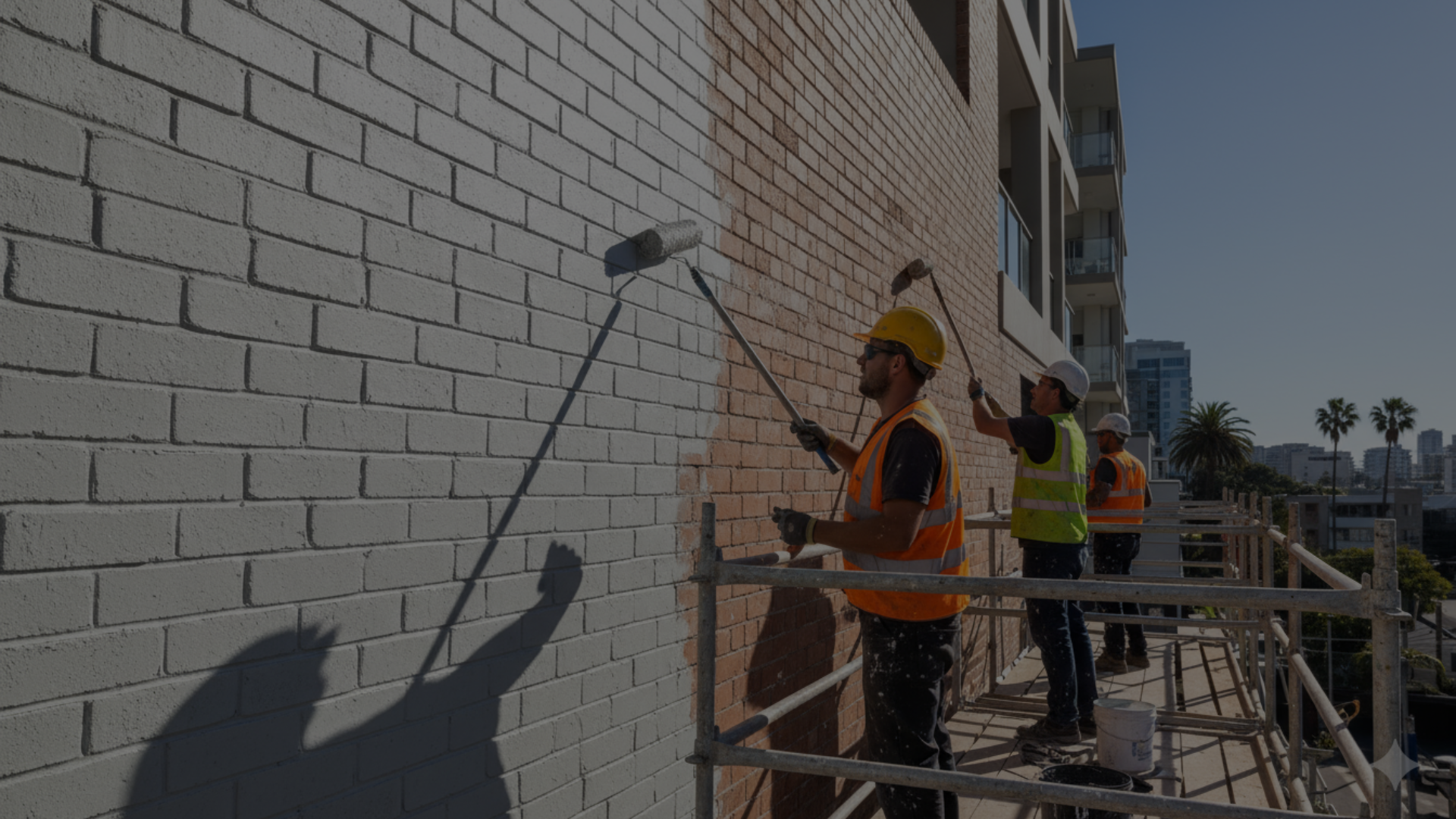
Even the most thorough masonry or render repair is only as durable as the protection applied over it. Uncoated brickwork and render are continually exposed to UV radiation, acid rain, salt-laden air, biological growth, and pollutants that gradually degrade the surface and allow moisture to penetrate. Over time, this leads to staining, efflorescence, increased water absorption, and accelerated deterioration of underlying repair works.
Protective coatings and waterproofing finishes are the final — and often overlooked — line of defence in comprehensive façade remediation. At Atomic Projects, we specify and apply premium protective systems matched to the specific substrate, exposure environment, and aesthetic requirements of each building, backed by manufacturer warranties and compliance documentation.
How We Approach Protective Coating Application
- Substrate and Exposure Assessment — We begin by evaluating the existing surface condition, substrate porosity, moisture content, and the building's geographic exposure (coastal, inland, shaded, north-facing). Each of these factors influences product selection. We use moisture meters and pull-off adhesion tests to confirm the substrate is suitably prepared to receive a coating.
- Product Selection — Coatings are not one-size-fits-all. For breathable masonry surfaces, we typically specify siloxane or silane penetrating water repellents that reduce absorption without altering vapour permeability. For render or concrete surfaces requiring both waterproofing and aesthetic improvement, elastomeric coatings are specified. Heritage substrates require vapour-open systems to prevent moisture entrapment.
- Surface Preparation — All surfaces are cleaned to remove biological growth, efflorescence, loose material, and contaminants. High-pressure water cleaning, chemical cleaning, or mechanical abrasion is used depending on the substrate and contaminant type. A clean, sound surface is essential for coating adhesion and longevity.
- Primer Application — Where specified by the manufacturer, primer coats are applied to improve adhesion and penetration, particularly on high-porosity or variable-porosity substrates such as aged render or rough-face brickwork.
- Coating Application — Coatings are applied by airless spray, roller, or brush depending on the product and substrate profile. Wet film thickness is monitored throughout to ensure full coverage and uniform dry film thickness (DFT) is achieved in line with the manufacturer's technical data sheet.
- Quality Assurance and Documentation — Post-application adhesion tests and coverage measurements are recorded. We provide a photographic QA report and product data sheets alongside the manufacturer warranty on completion.
Frequently Asked Questions
What is the difference between a water repellent and a waterproof coating?
A water repellent (typically siloxane or silane-based) penetrates the substrate and reduces water absorption without forming a surface film. It allows vapour to pass through but repels liquid water. A waterproof coating forms a surface film that provides a physical barrier to water entry but may also restrict vapour movement. The right choice depends on the substrate type and the level of protection required. For breathable masonry, water repellents are usually preferred. For concrete surfaces subject to hydrostatic pressure or high water loads, film-forming waterproof coatings are appropriate.
Will a protective coating change the appearance of my building?
Silane and siloxane penetrating water repellents are colourless and do not alter the appearance of the façade. Elastomeric and acrylic coatings do change the appearance to varying degrees — they are available in a range of colours and sheens and can significantly refresh an aged façade. We provide test patches on site before committing to full application so you can see and approve the final result.
How long do protective coatings last?
Service life varies by product type. Silane and siloxane penetrating repellents typically provide 10–15 years of water repellency under normal exposure conditions. Elastomeric acrylic coatings have a surface life of 10–20 years, with recoating possible to extend the system's life without full removal. Coastal and high-UV environments reduce service life, while protected north-facing and shaded walls tend to extend it.
Can protective coatings be applied to heritage buildings?
Yes, but the system must be carefully selected. Heritage masonry walls built with lime mortars require vapour-open coatings to avoid trapping moisture in the wall and causing damage to the mortar and stone. We work with heritage consultants to select systems compatible with the original fabric and approved by heritage authorities where required.
Should protective coatings be applied after or before repointing?
Always after repointing, render repairs, and any crack stitching or sealant works are complete and fully cured. Applying a coating over defective masonry or recently applied uncured mortar will cause adhesion failure and potentially trap moisture. The correct sequence is: all masonry repairs and repointing first → full cure → cleaning → then coating application.
Related Services
Protective coatings are most effective as the final step in a comprehensive remediation programme. We combine coating application with brick replacement and repointing, render repair and reinstatement, and expansion joint remediation to deliver a fully weather-protected façade.
Ready to protect your building's façade for the long term? Atomic Projects is a Class 2 Registered Builder with expertise in protective coating specification and application across Sydney's residential, strata, and commercial building sectors. Contact us to arrange a substrate assessment and coating recommendation.
📞 Call Us: 0410 515 509
✉️ Email Us: hello@atomicprojects.com.au
— Ben Tran, General Manager, Atomic Projects