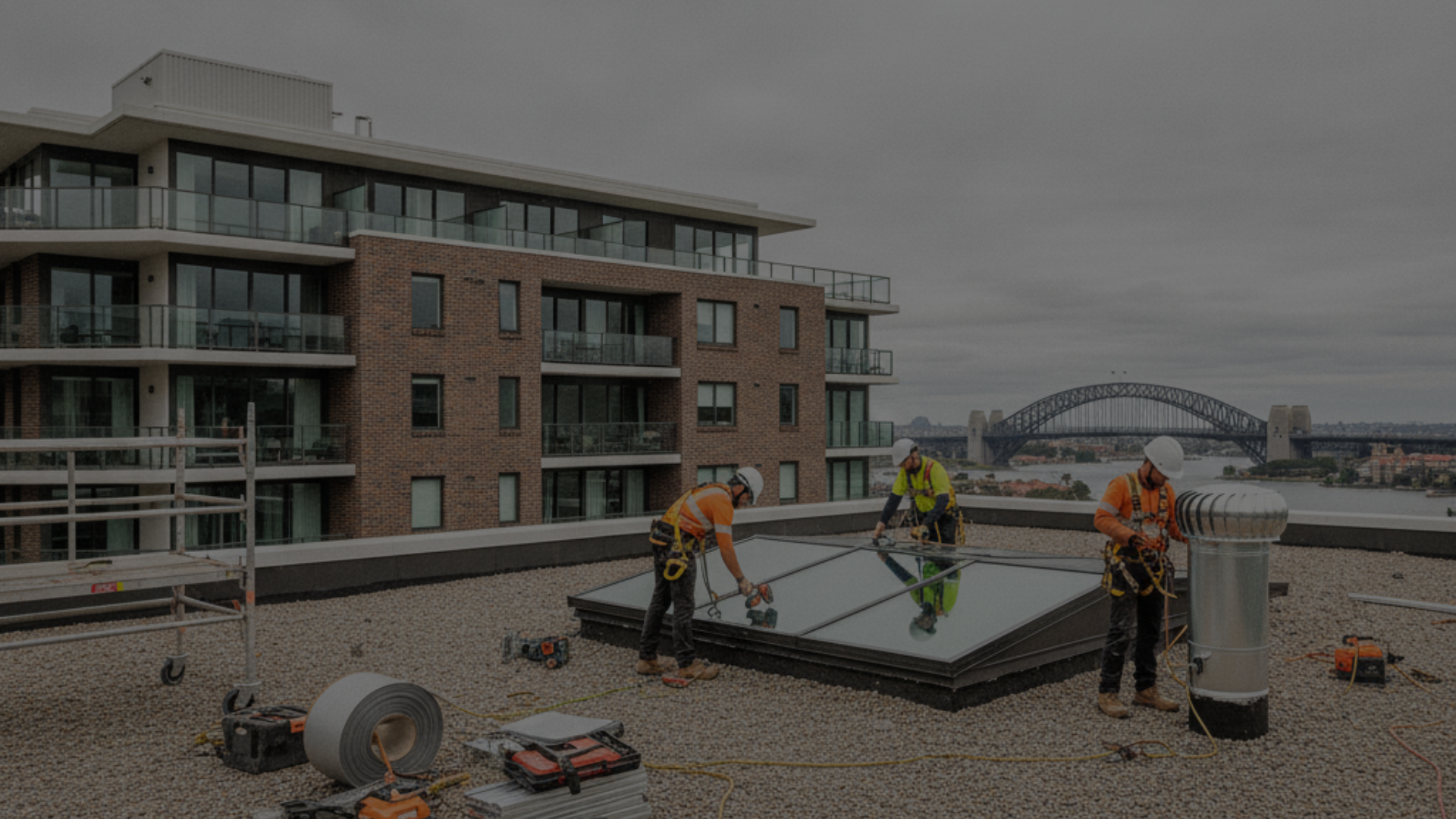
Metal roofing is one of the most durable and widely used roofing systems across Sydney's commercial, residential, and strata buildings. Over time, however, Colorbond®, zincalume, or older steel roofing can corrode, delaminate, or suffer structural fatigue — particularly in coastal environments where salt-laden air accelerates breakdown. When a metal roof begins to fail, water ingress follows quickly, causing damage to insulation, ceiling linings, electrical systems, and the building structure below.
At Atomic Projects, our metal roof replacement service is a complete, engineered solution — from removal of the failed system through to installation of a new high-performance roof with all associated flashings, gutters, and drainage. We manage the full scope so strata managers and building owners deal with one contractor, one schedule, and one point of accountability.
Repair or Replace? The Decision That Decides Everything Else
Not every leaking metal roof needs replacing, and a contractor who quotes a full re-roof without walking the roof first is guessing with your money. The honest test is simple: if corrosion is isolated — a handful of rusted sheets, one failed flashing, a blocked box gutter — targeted repair is good value and buys years. If the fixings are letting go across the field, the sheet undersides show widespread rust blooming through the coating, or the roof has already been patched in three or more unrelated places, the roof is telling you it is finished. Repairing an end-of-life roof is money spent to delay the same decision.
There is a second question that matters just as much: is the roof the problem, or is the drainage? A large share of the "failed metal roofs" we assess are actually water management failures — undersized or corroded box gutters overflowing into the building during heavy rain. Replacing the sheets without fixing the gutters fails again inside a few years. We assess the roof and its drainage as one system and price it that way.
Signs a Metal Roof Is at End of Life
- Rust visible on sheet undersides from inside the roof space — corrosion through the coating, not just surface staining.
- Fixings backing out or rust-haloed, with sheets lifting or drumming in wind.
- Repeated leaks in different locations after separate repairs — the classic patch-cycle pattern.
- Box gutters with visible corrosion, ponding, or overflow staining on the fascia or internal walls below.
- Delaminating or chalking coating on older zincalume and early Colorbond® roofs, especially within a few kilometres of the coast.
- Corroded laps and flashings at penetrations — vents, flues, air-conditioning plant — where differential metals have reacted.
What Metal Roof Replacement Costs in Sydney
For commercial, strata and industrial buildings in Sydney in 2026, indicative ranges are:
- Targeted repair program (sheet sections, flashings, a box gutter run): roughly $15,000–$60,000 depending on access and extent.
- Full metal roof replacement, low-rise strata or commercial: typically $80,000–$350,000 including sarking, flashings and drainage integration.
- Large-footprint or complex programs — big catchment areas, engineered drainage, night works over trading tenancies: $250,000–$700,000+.
The variables that move the number most are access (scaffold, edge protection, crane time), the condition of what sits under the sheets (battens, purlins, sarking), whether asbestos is present, and how much of the drainage system comes along for the ride. Treat any fixed price quoted without a roof inspection carefully — it either carries a fat contingency or a thin scope.
Asbestos: The Question Older Roofs Have to Answer
Many Sydney buildings re-roofed before the late 1980s carry asbestos — either original "super six" corrugated asbestos-cement sheeting still in place, or asbestos remnants in sarking, mastics and flashing seals under later metal. Before any removal starts, the roof is assessed against the building's asbestos register (or tested where no register exists). Where asbestos is present, removal is carried out by a licensed asbestos removalist under a documented control plan, with air monitoring and a clearance certificate issued before the new roof goes on. That certificate matters: it protects the owners corporation, it is what a future buyer's due diligence looks for, and it is not optional under NSW law. We coordinate the licensed removal within the roofing program so it costs days, not a second mobilisation.
Fall Protection and Working Over an Occupied Building
Roof replacement is work at heights over a building full of people, and the safety system is part of the methodology, not an extra. Depending on the roof, that means perimeter edge protection or guardrail, static lines and harness systems for work near openings, controlled exclusion zones below hoisting paths, and staged sheet removal so the building is never left open to weather overnight. On occupied buildings we sequence the works — and where a tenancy below cannot be disturbed, we shift to night works. Residents and tenants stay in place; disruption is communicated before it happens, not after.
Colorbond® Grades, Profiles and When Each Is Right
"Colorbond" is not one product. Standard Colorbond® steel suits most metropolitan buildings; Colorbond® Ultra is specified for severe marine and industrial environments — typically within about a kilometre of breaking surf or near heavy industry — where standard grade corrodes early; and Colorbond® Stainless exists for the harshest coastal exposures. Specifying the wrong grade on a beachfront building is how a 30-year roof becomes a 12-year roof, and it is one of the first things we check when assessing a failed roof that is younger than it should be.
Profile selection — corrugated, Trimdek®, Klip-Lok®, standing seam — is driven by roof pitch, wind loading (AS 1170), appearance and how the sheets are fixed. Low-pitch roofs generally need concealed-fix profiles like Klip-Lok®; heritage streetscapes often call for corrugated. We specify profile, grade and colour in the condition report so the owners corporation approves a defined system, not a brand name.
Our Approach to Metal Roof Replacement
- Roof Condition Assessment — We inspect the full roof area including sheet condition, fixing integrity, batten and rafter health, insulation, and drainage performance. A written condition report is provided before any works begin.
- Scope Definition & Product Selection — We specify the most appropriate Colorbond® profile, grade and colour for the building, considering wind loading (AS 1170), corrosion environment, thermal performance, and aesthetic requirements.
- Controlled Removal — Existing roof sheeting is carefully removed to avoid damage to the structure below. Sarking, battens, and rafters are inspected; any deteriorated elements are replaced. Licensed asbestos removal is coordinated here where required.
- Sarking & Insulation — We install vapour-permeable breather sarking and, where required, bulk or reflective insulation to meet NCC thermal performance requirements.
- New Roof Installation — Sheets are installed with correct laps, factory-formed flashings at ridges, valleys, and penetrations, and concealed or exposed fixings depending on the profile. All edge details are weather-sealed.
- Gutter & Downpipe Integration — Replacement or upgrade of box gutters, eaves gutters, and downpipes is coordinated with the roof replacement for a fully integrated drainage system, sized for actual Sydney rainfall rather than the original design assumption.
- Final Inspection & QA — Hose testing confirms watertightness. All works are documented and a warranty is provided on both materials and workmanship.
Proof: Two Recent Metal Roof Programs
Henrietta St, Chippendale — $250K, 2 months. Rusted-through sheets and undersized box gutters were dumping water into the live commercial tenancy below on every downpour. The cheap option was a sheet-for-sheet swap; the right option was a roof system redesign — sheets, upsized box gutters, flashings and falls replaced as one integrated system. The tenant kept trading for the entire program.
John St, Warners Bay — $600K, 4 months, 5,000m². Box gutters above a Coles supermarket had rusted through and were dropping water onto the shopping floor, compounded by a siphonic drainage system a previous contractor's alteration had broken. We replaced both box gutters and the roof sheeting, had the siphonic system re-engineered and certified by the original system specialist with a 25-year manufacturer warranty, and ran all works above the tenancy 10pm–6am. Coles never lost a trading day.
Different buildings, same lesson: metal roof failures are usually water management failures, and the fix that lasts treats the roof and its drainage as one engineered system.
Who This Service Is For
We deliver metal roof replacement for strata buildings, commercial and retail tenancies, industrial roofs and institutional assets — typically programs from around $50K up, on occupied buildings where staging, documentation and a warranty the committee or asset manager can rely on actually matter. If you need a few sheets patched on a residential carport, a local roofer will serve you better and cost you less; that honesty is also how you know the assessment you get from us is real.
Frequently Asked Questions
How long does a metal roof replacement take for a strata building?
For most low-rise strata buildings (2–4 storeys), a full metal roof replacement takes 2–4 weeks depending on size and access complexity. Large or staged programs — like a 5,000m² roof over a trading supermarket — run longer; our Warners Bay program took four months with night works. We provide a project program before works commence so owners corporations can plan accordingly.
Do residents need to vacate during the works?
In most cases, residents can remain in their apartments. We stage works and install temporary waterproofing where necessary to maintain weather protection throughout the project. Any disruption is communicated well in advance.
How much does it cost to replace a metal roof on a commercial or strata building?
Indicatively: $15,000–$60,000 for a targeted repair program, $80,000–$350,000 for a full low-rise replacement including drainage integration, and $250,000+ for large or complex programs with engineered drainage or night works. Access, substrate condition, asbestos and drainage scope move the number most — a roof inspection turns the range into a fixed price.
What happens if my old roof contains asbestos?
It is removed by a licensed asbestos removalist under a documented control plan before the new roof is installed, with air monitoring and a clearance certificate issued for the building's records. We coordinate the removal inside the roofing program so it adds days, not a separate project.
What warranty do I get on a new Colorbond® roof?
Colorbond® steel carries BlueScope's product warranty (up to 36 years depending on the product and environment). On top of the product warranty, the work itself carries three layers of cover: Atomic Projects' 7-year workmanship warranty, the 12-month defects liability period from practical completion, and the statutory warranties on residential building work in NSW. All of it is documented in your handover pack.
Will the new roof need council approval?
Most like-for-like replacements are covered under exempt development in NSW, but if the profile or colour changes significantly — or the building is heritage-listed — a development application or BASIX certificate may be required. We advise on this during the scoping stage.
Is standard Colorbond® good enough near the coast?
Often not. Within roughly a kilometre of breaking surf, Colorbond® Ultra is the appropriate specification; standard grade in that environment corrodes well short of its expected life and can compromise the product warranty. The corrosion environment is checked as part of our condition assessment.
Can you integrate solar panels into a new metal roof?
Yes. We can design the roof installation with future solar PV in mind, including the correct fixing substrate and cable pathways, so panels can be added without voiding the roof warranty.
Related Services
Metal roof replacement often pairs with box gutter and downpipe replacement, roof waterproofing and membrane systems, and roof flashing and capping repairs. For the full remedial roofing picture, see roof repairs and replacement in Sydney.
Atomic Projects is a Class 2 Registered Builder (licence 360636C) with over 10 years of experience delivering remedial roofing works across Sydney strata and commercial buildings. If your metal roof is nearing end of life, get in touch for an obligation-free assessment — we will tell you whether it needs replacing before we price replacing it.