


Why balconies leak in Sydney strata buildings, who pays, what a proper repair involves and 2026 costs — from a Class 2 DBP-registered remedial builder.
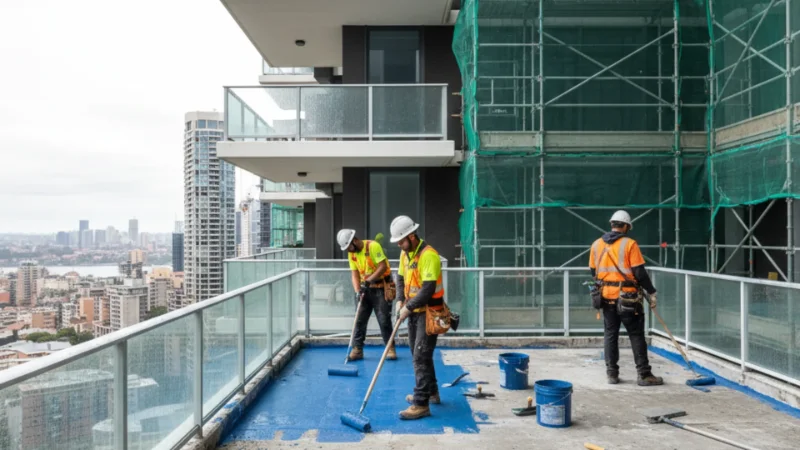
A leaking balcony is rarely just a balcony problem. By the time water shows up on the ceiling below, on a soffit, or as a stain running down an external wall, it has usually been getting past a failed waterproofing membrane for months — and it may already be reaching the steel inside the concrete slab.
This guide is for Sydney strata managers, owners corporation committees and building owners who have a leak and need to understand what is actually causing it, who is responsible for fixing it, what a proper repair involves, and what it costs in 2026. It is written by a Class 2 DBP-registered remedial builder, not a single-trade waterproofer — because a leaking balcony almost always needs both the waterproofing and the concrete trades working together.
Most Sydney balcony leaks come down to a failed or end-of-life waterproofing membrane, made worse by poor drainage or falls that let water pond instead of run off. Cracked tiles, perished grout, failed door thresholds and blocked drains all speed it up. The tiles you can see are rarely the real problem.
The common causes we find, in roughly the order they show up:
You usually cannot tell from the surface — and re-grouting or re-siliconing a balcony that has a failed membrane just hides the leak for a season. A proper diagnosis means a balcony leak investigation: moisture mapping, checking the falls and drainage, and a flood test to find where water actually gets through.
This is where a lot of money gets wasted. A handyman re-grouts the tiles, the leak stops over summer, and it comes back with the first heavy autumn rain — because the water was never getting in through the grout in the first place. A balcony leak investigation and testing program isolates the real entry point before anyone prices a repair, so you fix the cause once instead of the symptom three times.
If the investigation confirms the membrane has failed, surface repairs are false economy. The only durable fix is to replace the waterproofing system properly.
In most NSW strata buildings, the waterproofing membrane and the concrete slab are common property, so investigating and repairing a leaking balcony is generally the owners corporation's responsibility — not the individual lot owner's. Tiled surfaces and some internal finishes can differ. Always confirm against your registered strata plan and by-laws.
This matters because balcony leaks are common and expensive, and disputes over who pays can delay repairs while the slab keeps corroding. NSW building-defect research has repeatedly found waterproofing to be the single most common serious defect in strata buildings — one recent NSW assessment found more than half of strata buildings had serious defects over a six-year window, with waterproofing top of the list. If your building has one leaking balcony, it very often has several developing.
Because responsibility turns on your specific plan, by-laws and where the water is getting in, confirm the position with your strata manager and, where the slab is involved, a remedial engineer before committing to a scope. This article is general information, not legal advice.
A durable balcony repair strips back to the concrete slab, repairs any spalling or corroded steel, re-establishes correct falls to the drain, installs a new membrane to AS 4654.2 with sealed upstands and thresholds, then flood-tests and independently verifies the membrane before tiling. Skipping the strip-back is exactly why cheap repairs leak again.
Here is the sequence we follow on a proper balcony re-waterproof:
The difference between a repair that lasts 20 years and one that leaks again next winter is almost always steps 1 and 5 — the strip-back and the independent verification. A one-trade waterproofer who tiles straight over an unverified membrane, or who never opens up the slab to check the steel, is the reason so many balconies get "fixed" two or three times.
In 2026, a minor balcony reseal might be a few thousand dollars, a full single-balcony strip-and-re-waterproof typically runs $15,000–$30,000, and a balcony that also needs concrete slab repair can reach around $50,000. Whole-building balcony programs across many units run into six or seven figures. Every balcony is scoped individually after investigation.
| Repair scope | What it covers | Indicative 2026 cost | Typical timeframe |
| Minor reseal / re-grout | Surface sealing, grout, perimeter silicone — only worthwhile if the membrane is proven sound | $2,000–$6,000 per balcony | 1–3 days |
| Single balcony re-waterproof | Strip to slab, new membrane to AS 4654.2, re-establish falls, flood test, retile | $15,000–$30,000 per balcony | 2–4 weeks |
| Balcony + concrete/structural repair | Above, plus slab spalling breakout, steel treatment and repair mortars | $25,000–$50,000+ per balcony | 3–6 weeks |
| Whole-building balcony program | Multiple balconies staged, shared access/scaffold, staged independent verification | $150,000–$1M+ | 3–9 months |
These are indicative ranges to help committees budget, not a quote. Access (scaffold versus rope access), the number of balconies, and how far the concrete has gone are the biggest cost drivers. For a fuller picture of how these numbers are built up, see our breakdown of what balcony repairs cost in Sydney. The cheapest quote is almost never the cheapest job — it is usually the one that skips the strip-back and comes back as a bigger bill in two years.
A single balcony re-waterproof usually takes two to four weeks including cure and flood-test time, and residents can normally stay in the apartment — the balcony is out of use, not the home. Whole-building programs run in staged zones so only a few balconies are offline at any one time.
The time that surprises people is the waiting: membranes need to cure and the flood test needs to run its full 24–48 hours before tiling. Rushing those steps is exactly what causes re-leaks, so a good contractor builds the cure and test time into the program rather than skipping it.
Start with a diagnosis, not a quote to re-grout. Get the leak investigated so you know whether it is the membrane, the slab, the drainage or the thresholds — then scope the repair once, properly.
Atomic Projects is a Class 2 DBP-registered remedial builder that has delivered more than $20M in remedial work across 100+ Sydney strata buildings, from $50k balcony repairs to $5M+ facade programs. If you have a leaking balcony, our specialist team handles balcony repairs in Sydney end to end — investigation, concrete repair, waterproofing to AS 4654.2, independent verification and reinstatement.
Book a free balcony leak assessment: get in touch with Atomic Projects.

Send photos, the engineer's report, or just the symptoms — whatever you've got. A registered builder reads it and calls you back. No call centre, no obligation.