


Building Commission NSW found 53% of strata buildings have serious defects, with waterproofing top at 22%. What the 2025 data actually means for your committee — and what to do about it.
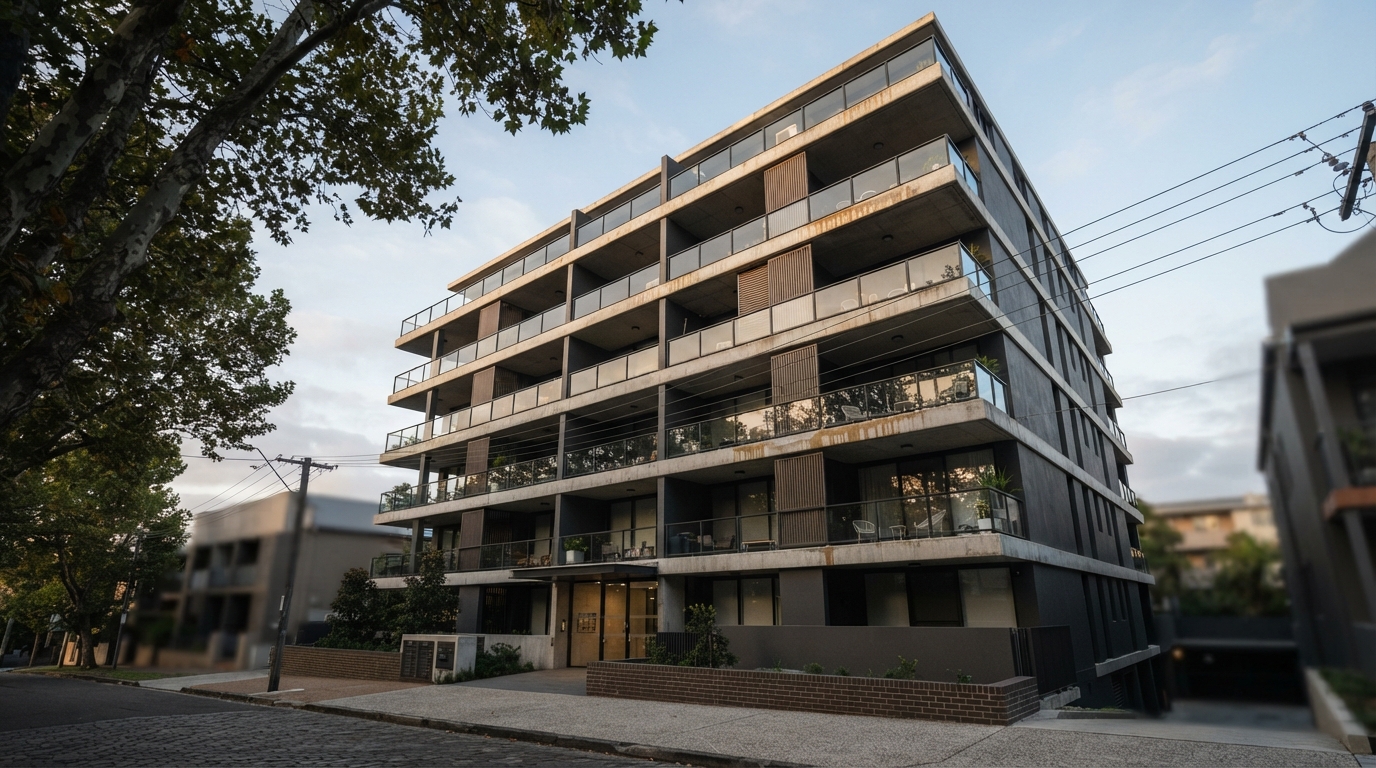
In April 2026, Building Commission NSW published the third instalment of its strata defects research. The headline number has not moved: 53% of NSW strata buildings surveyed had serious defects — identical to the 2023 finding.
If you sit on a strata committee or manage a portfolio, that number is easy to read as background noise. It shouldn't be. Underneath the headline are four findings that tell you what is most likely wrong with your building, whether anyone has told the regulator about it, and why the next two years are the window that matters.
This guide is written by a Class 2 DBP-registered remedial builder. We're not summarising the report for the sake of it — we're reading it the way we read an engineer's report, looking for what it means for the buildings we actually work on.
Building Commission NSW found 53% of surveyed strata buildings had serious defects, unchanged from 2023. Waterproofing was the most prevalent defect at 22%, followed by fire safety systems at 16%. Reporting to the regulator rose to 36%, up from 15% in 2021. Newer buildings showed lower defect rates than older ones.
The research is conducted every two years with Strata Community Association NSW. The 2025 survey ran from 18 June to 31 August 2025 and drew 520 completed responses — a 42% response rate, with a maximum margin of error of ±3.3% at 95% confidence. It covered Class 2 schemes of four storeys and above, registered between July 2018 and June 2024. Self-managed schemes were included for the first time.
That methodology matters for how you read the number. This is a survey of strata managers on relatively new buildings — not a census of every apartment block in NSW. Buildings registered before 2018, which is most of Sydney's stock, aren't in the sample at all.
Waterproofing is the single most common serious defect in NSW strata buildings, present in 22% of buildings registered between 2022 and 2024. Fire safety systems follow at 16%, then building enclosures at 15%, key services at 14%, and structural defects at 10%. Waterproofing has topped this list in every round of the research.
| Defect category | Prevalence (2022–2024 registered buildings) | What it usually looks like on site |
| Waterproofing | 22% | Balcony and podium leaks, planter boxes, roof membranes, basement ingress |
| Fire safety systems | 16% | Passive fire penetrations, door sets, alarm and sprinkler shortfalls |
| Enclosures | 15% | Facade, windows, cladding junctions, curtain wall seals |
| Key services | 14% | Hydraulics, drainage falls, mechanical plant |
| Structural | 10% | Slab cracking, spalling, movement, inadequate support |
Rates of waterproofing and fire safety defects both declined in 2025, and buildings registered 2022–2024 showed lower defect rates than those registered 2018–2021. The reforms appear to be doing something.
But note what the categories obscure. Waterproofing and structural are listed separately, and on paper they look like different problems. On site they're usually the same problem at two stages. Water gets past a failed membrane, reaches the reinforcing steel in the slab, and the steel corrodes and expands until the concrete cracks off from the inside. A building that reports a waterproofing defect at year five very often has a structural one by year ten. That's why we treat signs of water ingress in a strata building as a structural early warning, not a cosmetic complaint.
The headline rate held steady because it measures the standing stock of buildings, not the quality of new construction. Newer buildings in the sample genuinely do have fewer defects. But buildings registered years ago carry their defects with them into each survey, so improvements at the front end take years to move the overall percentage.
This is the most misread number in the report. "No improvement" makes a good headline and a poor conclusion. The disaggregated data — 2022–2024 buildings performing better than 2018–2021 buildings — is the real signal, and it points the other way.
For a committee, the practical reading is this: reform is improving what gets built, but it does nothing for what you already own. If your building was completed before 2018, no reform is going to retrospectively fix your membranes. That is a capital works problem, and it is yours.
Of buildings with serious defects, 36% were reported to the regulator — up from 34% in 2023 and 15% in 2021. Reporting has more than doubled in four years. But it also means roughly two-thirds of buildings with serious defects still are not on the regulator's radar at all.
That gap is worth sitting with. Every unreported defect is a building where the owners corporation is likely absorbing the cost itself rather than pursuing the developer, the builder, or a statutory remedy. Some of that is deliberate. Much of it is committees not realising that reporting is available, or assuming the defect is too old or too minor to bother.
If your building has a defect and you haven't reported it, that decision should be a considered one made with your strata manager and, where warranted, legal advice — not a default. This article is general information, not legal advice.
Treat the 53% figure as a prompt to establish your own building's position rather than as a statistic about someone else's. Commission a condition assessment, get any suspected defect properly diagnosed before you price a repair, and make sure your capital works fund reflects what the assessment finds rather than what was budgeted a decade ago.
The order matters, and it's the order most committees get wrong. The common sequence is: notice a symptom, get three quotes to fix the symptom, pick the cheapest, watch it come back. The sequence that works is: diagnose the cause, scope the repair against the cause, then price it.
We've written the full version of that journey in our guide to going from an engineer's report to completed repairs, but the short version is four steps:
The Design and Building Practitioners Act 2020 changed who can legally carry out and certify remedial work on Class 2 buildings, requiring registered practitioners to declare that designs and work comply with the Building Code. It does not retrospectively fix existing defects, but it does change who you can lawfully engage to rectify them.
Practically, this narrows your contractor list. Remedial work on a Class 2 building now needs a registered practitioner who can make the declarations — which is a smaller field than the general "we do waterproofing" market. If you want the detail on what the Act changed and when, our breakdown of the NSW strata law changes affecting building defects covers the timeline.
In most NSW strata schemes, serious defects in common property — membranes, slabs, facades, fire systems — are the owners corporation's responsibility to rectify, typically funded from the capital works fund or a special levy. Where the building is still within statutory warranty periods, or a developer bond applies, some cost may be recoverable. Responsibility turns on your registered strata plan and by-laws.
The recovery question is where committees lose the most money by waiting. Statutory warranty periods run from completion, not from when you noticed the problem. A defect discovered in year seven that could have been claimed in year five is now entirely the owners corporation's to fund.
Defects do not stabilise. A failed membrane admits water continuously, and the cost curve is not linear — a balcony that needed a $20,000 re-waterproof at year eight can need $50,000 of concrete repair as well by year twelve. Doing nothing is a decision to pay more later, with less recourse.
This is the part the survey data can't show you, because it measures presence of defects, not their trajectory. Every building in that 53% is getting worse at some rate, and the ones that aren't being monitored are getting worse invisibly.
If you don't know your building's defect position, that's the gap to close first — before the next AGM, not after the next leak.
Atomic Projects is a Class 2 DBP-registered remedial builder that has delivered more than $20M in remedial work across 100+ Sydney strata buildings, from $50k balcony repairs to $5M+ facade programs. We handle strata building defect rectification end to end — investigation, diagnosis, repair to standard, independent verification and close-out — and where a building needs more than one trade, the full range of remedial services Atomic Projects delivers sits under one contractor rather than five.
Book a free building assessment: get in touch with Atomic Projects.
Source: Building Commission NSW, 2025 Strata Defects Research Report.

Send photos, the engineer's report, or just the symptoms — whatever you've got. A registered builder reads it and calls you back. No call centre, no obligation.