


What building defect rectification actually involves for Sydney strata buildings — the process, 2026 costs, who pays, and the DBP Act rules, from a Class 2 DBP-registered builder.
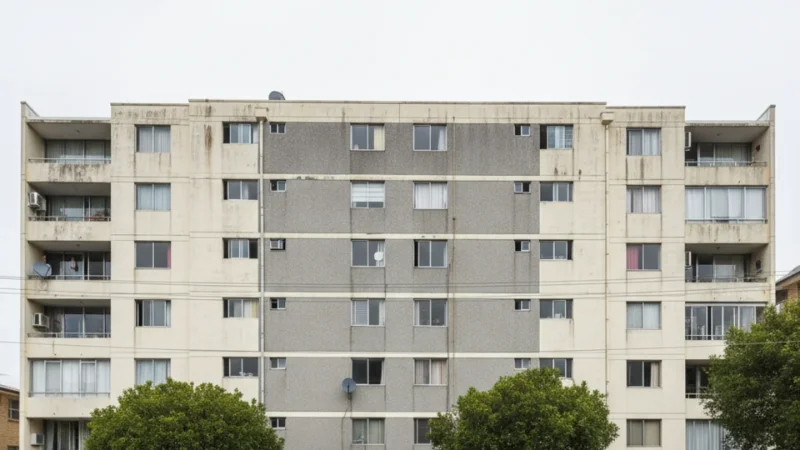
Almost every ageing Sydney apartment building carries defects — the question is whether they've been diagnosed, and whose job it is to fix them. Building defect rectification is the structured process of finding, scoping and permanently repairing those faults, and getting it wrong is expensive: a leak ignored for two years becomes concrete cancer, and a $15,000 repair becomes a $150,000 one.
This guide is for strata managers, committees and owners who've had a defect flagged — in an engineer's report, a building condition assessment, or a resident complaint — and need to understand what rectification actually involves, what it costs, who pays, and the compliance rules that now apply in NSW.
Building defect rectification is the process of investigating, scoping and permanently repairing faults in a building's structure, waterproofing, façade or services. It goes beyond a patch: a proper rectification identifies the root cause, designs a durable fix to the relevant Australian Standard, carries it out, and verifies it — so the defect doesn't return.
The distinction that matters is root cause versus symptom. Bubbling paint is a symptom; the defect is a failed membrane or cracked slab behind it. Rectification treats the cause. That's why the first step is nearly always investigation — often invasive investigation that opens a small section to confirm what's actually failing before anyone prices a repair.
The most common defects in Sydney strata buildings are waterproofing failure (leaking balconies, planter boxes and bathrooms), concrete spalling — also called concrete cancer — cracked or defective façades and cladding, and structural cracking. Fire-safety defects in passive and active systems are increasingly flagged as certification tightens.
These rarely appear alone. A leaking balcony lets water into the slab, which corrodes the reinforcement, which spalls the concrete edge and loosens the balustrade fixing — one defect cascading into four. That's why a competent rectification scope looks at the whole building envelope, not just the spot the owner reported.
Building defect rectification in Sydney ranges from around $5,000–$20,000 for a single localised defect to $500,000–$5M+ for a building-wide programme such as full façade or waterproofing remediation. Most strata rectifications sit in the middle: staged works from roughly $50,000 to $250,000, funded from the capital works fund.
The cost is driven almost entirely by scope and access — how many defects, how far the damage has spread, and whether scaffold or rope access is needed. The cheapest way to control the number is to catch defects early, which is exactly what the remedial building services in Sydney market is built around: diagnose before it cascades.
| Defect type | Typical rectification cost | Indicative timeframe |
| Localised waterproofing / balcony repair | $5,000 – $20,000 | 1–2 weeks |
| Concrete spalling (concrete cancer), per zone | $20,000 – $100,000 | 2–6 weeks |
| Structural crack / slab remediation | $30,000 – $250,000 | 4–12 weeks |
| Building-wide façade or cladding programme | $500,000 – $5M+ | Several months, staged |
In NSW, the owners corporation is responsible for rectifying defects in common property — structure, façade, waterproofing membranes and common services — under the Strata Schemes Management Act. Individual lot owners are generally responsible only for defects wholly inside their lot. Where a defect is still within the statutory warranty period, the original builder or developer may be liable instead.
For newer buildings this is critical: the Home Building Act gives a 6-year warranty for major defects and 2 years for minor ones, and NSW's Building Commission has expanded powers to order developers to fix serious defects. Before an owners corporation funds a rectification itself, it should check whether the defect is a warranty claim — that decision can be worth hundreds of thousands of dollars.
Defect rectification follows a set sequence: investigate and diagnose the defect, scope and design the repair to the relevant standard, obtain quotes and approvals, carry out the works with defined hold points, then verify and hand over. Skipping the diagnosis and design stages is the single most common reason rectifications fail and have to be redone.
On the ground that means invasive investigation to confirm cause, a documented scope of works, a staged programme so the building can fund and tolerate the works, and mandatory verification — flood tests on membranes, engineer sign-off after concrete repairs, third-party verification on critical waterproofing. Across projects like Sergeants Lane and Chandos Street, those hold points are what let us hand back work that actually holds.
Yes — on Class 2 apartment buildings, structural, waterproofing, fire-safety and building-envelope rectification is “regulated building work” under the NSW Design and Building Practitioners Act, so it must be designed, carried out and declared by registered practitioners. From 1 July 2026 the same regime applies to Class 3 and 9c buildings.
Practically, this narrows who a committee can lawfully engage. Unregistered trades can't provide the compliant declarations the Act requires, and non-compliant rectification can jeopardise insurance and future warranty claims. Engaging a Class 2 DBP-registered builder means the work is documented and declared to the standard the building — and the regulator — now expects.
A single localised defect is usually rectified in one to two weeks. A building-wide programme runs over several months, staged so the building stays livable and the owners corporation can fund it in phases. The biggest time variable is investigation and approvals up front — the physical works are often faster than the decision-making that precedes them.
Committees can shorten the timeline by starting the investigation early, appointing a single accountable contractor rather than coordinating multiple trades, and pre-agreeing how the works will be funded. The slowest rectifications are the ones that stall between diagnosis and decision while the defect keeps getting worse.
Building defect rectification is worth doing once, properly: diagnose the root cause, scope it to the relevant standard, check whether it's a warranty claim, and engage a DBP-registered builder to deliver and verify it. Patching symptoms is how a manageable repair becomes a special-levy emergency. The right first step is almost always an investigation, not a quote.
Atomic Projects is a Class 2 DBP-registered building practitioner delivering remedial building services in Sydney — from single balcony repairs and remediation and concrete spalling and cancer repair through to multi-million-dollar façade programmes, with $20M+ delivered across 100+ Sydney strata buildings.
Get a free defect assessment — we'll investigate what's actually failing and give your committee a staged, defensible rectification scope.

Send photos, the engineer's report, or just the symptoms — whatever you've got. A registered builder reads it and calls you back. No call centre, no obligation.