


Why Sydney strata balconies pond, what fall AS 4654.2 requires, the fix options, who pays under s106, and how screed fall correction stops leaks.
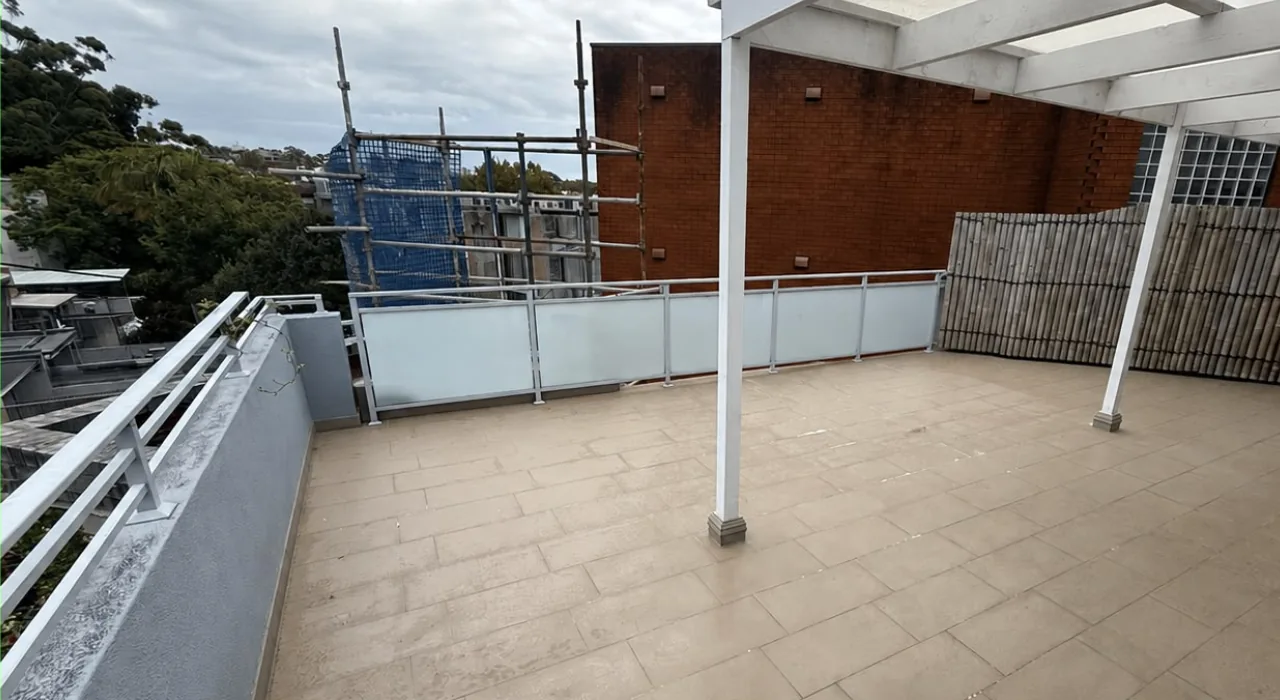
If water sits in a puddle on your balcony for hours after the rain stops, the tiles aren't the problem — the fall underneath them is. "Ponding" is standing water that can't reach the drain because the graded screed below the surface is too flat, has settled, or was laid with a reverse fall. On strata buildings it's one of the most common reasons a balcony keeps leaking after it has already been "repaired".
Correcting the fall is a structural waterproofing job, not a cosmetic one. A leaking balcony is rarely just the balcony — ponding is usually a symptom of a drainage and membrane fault that, left alone, migrates into the slab and the apartment below. This guide explains why balconies pond, what the Australian Standard requires, and the realistic options for fixing it as part of a balcony repair and remediation program.
Water ponds on a balcony when the finished surface and the screed beneath it don't fall steeply enough toward the drainage outlet. The usual causes are a screed laid too flat, a reverse fall toward the building, a drainage outlet set too high, slab deflection over time, or a blocked floor waste. Flat tiles hide a flat screed — the fault is structural, not surface-level.
Most ponding on Sydney strata balconies traces back to how the topping screed was graded when the balcony was built or last re-tiled. The screed is the layer that creates the slope to the drain; if it was floated flat to make tiling easier, or if the outlet sits proud of the surrounding surface, water has nowhere to go. Over a building's life, long-span slabs can also deflect slightly, flattening a fall that was originally adequate.
AS 4654.2 — the standard for external above-ground waterproofing — requires balcony surfaces to be graded so water drains to outlets and does not pond. A minimum fall of 1:100 (roughly 10 mm per metre) to the outlet is the widely specified benchmark, with designers often targeting 1:80 where the finish allows. The membrane substrate must also fall, not just the tiles.
The critical point for strata committees is that the standard applies to the surface you can't see — the membrane and the screed under the tiles — not only the tiled finish. A balcony can look dead-flat and still fail compliance if the membrane below is holding water. This is covered in detail in the falls and detailing AS 4654 requires for balcony waterproofing. A proper assessment checks the fall of the substrate, the height and condition of the outlet, and whether the membrane is still bonded and continuous.
Ponding is a problem, not a cosmetic issue. Standing water sits on the membrane far longer than a draining surface, finding any pinhole, lap or failed upstand and driving moisture into the screed and slab. Over time it causes efflorescence, tile drummy and delamination, and — once water reaches the reinforcement — concrete cancer in the slab edge below.
The damage is cumulative and hidden. Water that ponds doesn't just evaporate; a share of it works through the system and into the structure. Where it reaches the steel reinforcement in the slab, it drives the corrosion and spalling that remediation specialists treat as concrete cancer repairs — a far more expensive problem than the original ponding. That is why a persistently wet balcony should be scoped early rather than watched.
Fixing ponding means re-establishing fall to the outlet and renewing the waterproofing. Options range from a topical re-level of a minor low spot, to re-screeding over a sound substrate, to a full strip-out and rebuild to the slab where the membrane has failed or the fall is reversed. The right option depends on the cause and how far water has already penetrated.
A topical patch is tempting because it's cheap, but it only works where the fall is already close to correct and the membrane below is intact — otherwise it traps the fault. For most strata balconies that have ponded for years, correcting the fall means lifting the finish, grading a new screed, and installing a fresh membrane to AS 4654.2 as part of a membrane and waterproofing remediation. The table below sets out the realistic approaches.
| Approach | What's involved | Best suited to | Indicative timeframe (per balcony) |
| Topical re-level / extra coat | Thin bonded topping or additional membrane coat over an isolated low spot | Minor ponding where fall is nearly correct and membrane is sound | 1–3 days |
| Re-screed over existing | New bonded graded screed to re-establish fall, then new membrane and finish | Flat or shallow screed with a sound substrate beneath | 1–2 weeks |
| Full strip-out and rebuild | Remove tiles, screed and membrane to the slab; re-grade; new membrane to AS 4654.2; re-tile | Reverse falls, failed membrane, or concrete damage beneath | 2–4 weeks |
| Drainage correction | Lower or relocate the outlet, or add a floor waste, so water can escape | Ponding caused by a high or poorly placed outlet (often combined with the above) | 2–5 days |
A single balcony can be re-screeded and re-membraned in one to two weeks; a full strip-out runs two to four. Cost is driven by the number of balconies, access and scaffold, how much has to come up, tile matching, outlet works, and whether concrete repair is needed underneath. A whole-building balcony program is scoped and priced per balcony, not by a flat rate.
There is no honest per-square-metre figure for this work sight-unseen, because the variables that move the price are all hidden until the balcony is opened up: the state of the membrane, whether the slab edge has started to spall, and how closely the replacement tiles have to match an existing scheme. As a scale reference, Atomic Projects delivers balcony work ranging from around $50k single-balcony repairs to $5M+ full-facade and balcony programs across Sydney strata. The only reliable number comes from an on-site assessment that opens up a representative balcony.
In most NSW strata schemes the balcony slab, structural screed and waterproofing membrane are common property, so the owners corporation is responsible for repairing ponding and the owners corporation funds it — typically from the capital works fund. Under section 106 of the Strata Schemes Management Act 2015 the owners corporation has a duty to maintain and repair common property. The tiled finish can be lot property, which is why a scope and a plan matter.
The common-property line usually runs at the membrane: the structure and waterproofing below it are the owners corporation's, while the surface finish above may belong to the lot. Because ponding faults live in the common-property layer, they're generally an owners-corporation responsibility — but every scheme's by-laws and strata plan should be checked. Getting the responsibility question settled early, alongside a defined scope, avoids the stand-offs that delay balcony programs.
Sometimes, but rarely well. Tile-top treatments — re-grouting, a surface-applied coating, or a thin re-level — can help where ponding is minor and the membrane beneath is still intact. Where the fall is genuinely wrong or the membrane has failed, leaving the tiles on simply seals the fault in. A proper fall correction almost always means lifting the finish to reach the screed.
If a committee wants to avoid a full strip-out, the right first step is an assessment that confirms whether the membrane is still sound. That evidence decides whether a lighter-touch repair is defensible or whether it will just move the leak along. Atomic Projects is a Class 2 DBP Registered Building Practitioner with $20M+ delivered across 100+ Sydney strata buildings, and scopes every balcony on the condition found on site rather than a one-size recommendation.
Ponding never fixes itself, and the longer a balcony holds water the more of the slab it reaches. If balconies in your scheme are puddling after rain, the practical next step is a free on-site assessment that opens up a representative balcony, confirms the fall and membrane condition, and sets out the options and responsibilities before any committee decision. Book a balcony assessment and we'll give you a scope you can take to the next meeting.

Send photos, the engineer's report, or just the symptoms — whatever you've got. A registered builder reads it and calls you back. No call centre, no obligation.