


Crack injection or crack stitching? One bonds concrete, the other reinforces masonry. A Sydney remedial builder on which repair your building actually needs.
A crack in a wall or slab rarely tells you, on its own, how worried to be — or how to fix it. Two of the most common repairs an engineer will specify sound similar but do completely different jobs. Crack injection fills and bonds a crack from the inside. Crack stitching reinforces across a crack with steel. Choose the wrong one and you waste money — or worse, you hide a structural problem that keeps moving behind a repair that looks finished.
This guide is written for strata committees, building managers and owners in Sydney who have been handed an engineer's report — or just found a crack that was not there last year — and want to understand what is being proposed before approving the spend.
Crack injection fills a crack by pumping resin into it — epoxy to bond concrete back to full strength, or polyurethane to seal water out. Crack stitching reinforces cracked masonry by bedding stainless-steel helical bars across the crack in the mortar joints. Injection restores a crack; stitching spans it. The material and whether the crack is still moving decide which you need.
The two repairs are not competitors — they treat different materials and different failure modes. Getting the match right starts with a correct diagnosis, which is why both normally follow an engineer's assessment rather than a guess on site.
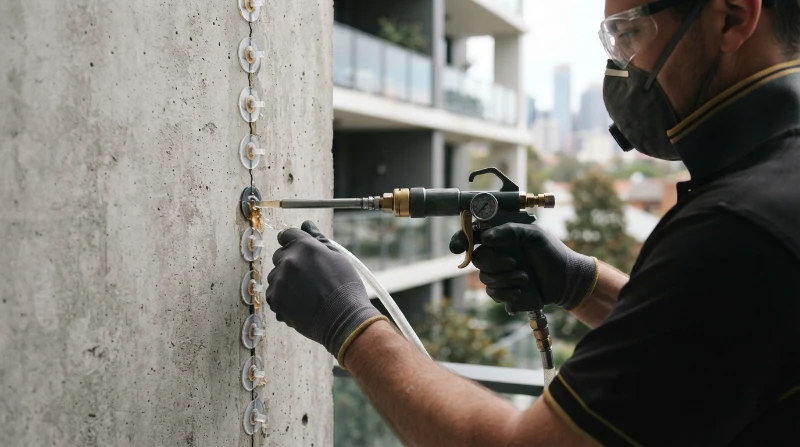
Use crack injection for cracks in concrete — slabs, columns, beams, basement and lift-pit walls — where you need to restore strength or stop water. Resin is pumped under pressure through a line of ports so it travels the full depth of the crack, not just the surface. The resin you choose, epoxy or polyurethane, depends entirely on whether the crack is still moving.
Cracking in concrete is also one of the first visible signs of reinforcement corrosion — concrete cancer, which can be repaired if it is caught early enough. Injection is often one part of that larger remediation rather than the whole fix.
Epoxy is a rigid, high-strength resin that effectively welds the concrete back together, restoring the element close to its original monolithic strength. It is the right choice for static (dormant) structural cracks — industry (ACI) guidance applies it to cracks from about 0.05 mm wide upward. The catch: epoxy is rigid, so if the crack is still moving, the repair can simply re-crack alongside the old line.
Polyurethane is flexible and reacts with water, foaming on contact to chase and stop an active leak quickly. It is the go-to for basement walls, planter boxes, lift pits and any crack where water is getting through or some ongoing movement is expected. It seals rather than structurally bonds — so the job is stopping water, not restoring load capacity. On many Sydney jobs the two are combined: polyurethane first to kill a live leak, then epoxy once the surface is dry to restore strength. This is core to how we remediate damaged concrete across Sydney strata buildings.
Use crack stitching for cracked brick and block masonry — the stepped cracks that track through mortar joints on older walk-up blocks and rendered facades. Stainless-steel helical bars are bonded into slots cut along the horizontal mortar beds, typically every 4–6 courses (300–450 mm apart) and extending at least 500 mm each side of the crack. The bars tie the wall back together across the crack.
Stitching is used where masonry has cracked from differential movement, thermal expansion, failed wall ties or minor settlement. It is minimally invasive — once the mortar is repointed, the repair is invisible — which is why it suits heritage and rendered facades where rebuilding a section would be disruptive and costly. The important caveat: stitching stabilises the wall but does not cure the cause. If the ground is still settling or a lintel has failed, that has to be addressed as well. Where the cracking is driven by a load-path or footing problem, the fix belongs with proper structural crack repair, not a cosmetic patch.
| Crack injection | Crack stitching | |
| Best for | Concrete: slabs, columns, beams, basement walls | Brick & block masonry walls |
| What it does | Fills and bonds (epoxy) or seals (polyurethane) the crack | Reinforces across the crack with steel |
| Material installed | Epoxy or polyurethane resin | Stainless-steel helical bars + grout |
| Restores structural strength? | Yes (epoxy); no, seals only (polyurethane) | Yes — redistributes load across the crack |
| Typical spacing / extent | Full depth via injection ports along the crack | Bars every 300–450 mm, min. 500 mm each side |
| Handles ongoing movement? | Polyurethane yes; epoxy no | Stabilises, but the cause must be fixed too |
| Stops water? | Yes — polyurethane is purpose-built for it | No — it is a structural repair |
You often cannot tell by looking — the most common and costly mistake. As a rule of thumb, cracks wider than about 5 mm, cracks running diagonally from window and door corners, stepped cracks through brickwork, and any crack that is visibly widening all warrant an engineer's assessment before a repair is chosen. Width, direction, pattern and movement point to the cause — and the cause decides the method.
This is the same logic that governs concrete repair generally: the type of deterioration you are dealing with changes the repair entirely. A hairline crack in render can be purely cosmetic, or it can be the surface sign of a moving slab. Only a diagnosis tells you which.
Yes — and on larger remedial jobs they frequently are. A concrete frame with a cracked masonry infill wall might need epoxy injection to the structural slab and helical stitching to the brickwork above it. The two repairs solve different problems in the same building, so a good specification names which crack gets which treatment rather than applying one method everywhere.
Across the walk-up blocks and concrete towers we remediate in Sydney — from the North Shore to the inner city — it is normal for a single scope to carry both techniques alongside waterproofing and concrete repair. The skill is in the sequencing, not the individual product.
The crack itself is rarely the biggest cost — access is. Height, scaffolding or EWP hire, whether work is over-head or at ground level, the length and depth of cracking, and whether the underlying cause needs separate structural work all move the price far more than the resin or the bars. A short accessible crack is minor; the same crack four storeys up behind a balcony is not.
Because the drivers are so site-specific, any honest number comes from an inspection, not a web page. For indicative concrete repair bands and how strata jobs are usually priced, see our 2026 concrete cancer repair cost guide.
On Class 2 (apartment) buildings in NSW, structural remediation must be designed and carried out by registered practitioners under the Design and Building Practitioners Act. That means the diagnosis, the specified method and the installer all need to stand behind the work. Atomic Projects is a Class 2 DBP Registered Building Practitioner and has delivered $20M+ across 100+ Sydney strata buildings, from $50k balcony repairs to $5M+ facade programs.
For a strata committee, the practical takeaway is simple: do not approve a repair method before the crack has been properly diagnosed. The method is only ever as good as the diagnosis behind it.
If there is a crack in your building and you are not sure whether it is cosmetic, structural, or a sign of something bigger, the right first step is an assessment — not a product. Atomic Projects carries out crack and structural assessments across Sydney strata buildings and tells you plainly what you are dealing with and what it will take to fix. Get a free assessment and we will give you a straight answer before anyone talks about epoxy or helical bars.

Send photos, the engineer's report, or just the symptoms — whatever you've got. A registered builder reads it and calls you back. No call centre, no obligation.