


Concrete cancer repair in Sydney costs $250–$2,500+/m². Here are the 2026 cost bands, what drives the price, who pays in a strata scheme, and how an owners corporation should budget.
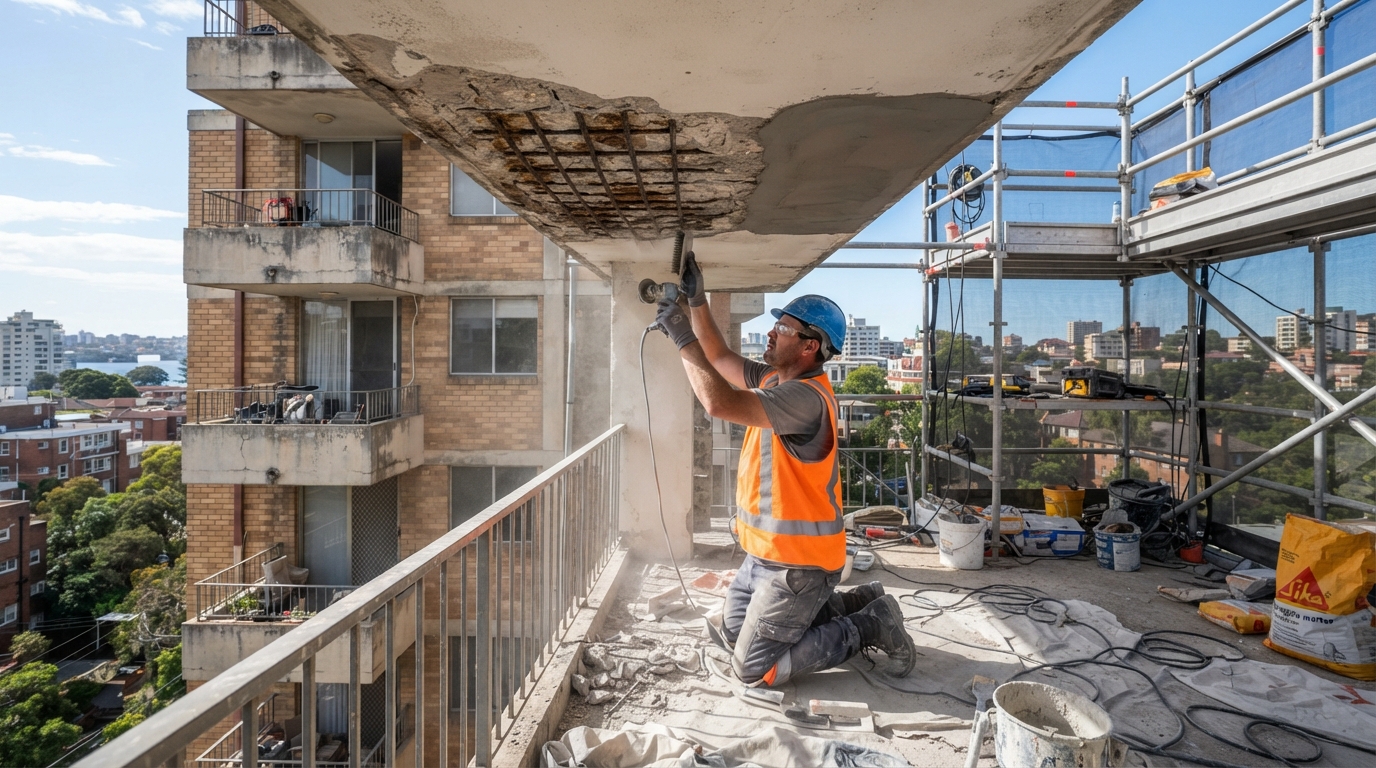
Concrete cancer is one of the most expensive line items a Sydney strata building will ever face — and one of the easiest to get wrong at budgeting time. Two committees with buildings the same age can end up with wildly different bills: one pays $8,000 to patch a single balcony soffit, the next pays $450,000 to remediate a whole facade. The difference is rarely luck. It comes down to how early the damage was caught, how bad the corrosion is behind the surface, and how hard the affected concrete is to reach.
This guide gives strata managers and owners corporations honest 2026 numbers, the drivers that move the price, and a practical way to budget — from your capital works fund to a special levy — before the engineer's report lands on the agenda.
Concrete cancer is the corrosion of the steel reinforcement inside concrete. As the embedded steel rusts it expands up to seven times its original volume, cracking and pushing off the surrounding concrete — the flaking and drummy patches you see on balconies, soffits and carpark ceilings. It costs so much because a proper repair treats the rusting steel, not just the surface, and often needs access equipment and waterproofing.
The reason a $2,000 patch turns into a $200,000 program is that the visible damage is usually the smallest part of the problem. By the time concrete is spalling, chloride or carbonation has often reached reinforcement across a much wider area that still looks intact. Cutting a repair short — patching the hole and painting over it — traps the corrosion and it reappears within a year or two. Under AS 3600 (Concrete Structures), a durable repair means exposing the corroded bar back to clean steel, treating it, and reinstating cover with the right repair mortar. That sequence — expose, treat, reinstate — is the basis of every concrete remediation program we scope.
In Sydney in 2026, concrete cancer repair typically runs $250–$600 per m² for minor localised patching and $1,200–$2,500+ per m² for severe structural work. In whole-job terms, expect $2,000–$5,000 for a small isolated repair, $5,000–$15,000 for one balcony or wall section, and $40,000 to $500,000+ for a building-wide program once access and waterproofing are included.
The table below is the budgeting starting point we give strata committees. Treat it as a planning range, not a quote — an on-site assessment is the only way to price your building.
| Severity | Typical scope | Access | Indicative cost |
| Level 1 — cosmetic spalling | Isolated patch, polymer-modified mortar | Ladder / low balcony | $1,500 – $5,000 |
| Level 2 — localised structural | One balcony or wall section, rebar treatment + anti-carbonation coating | Scaffold or EWP | $5,000 – $15,000 |
| Level 3 — advanced single location | Multiple spalls, scaffolded elevation | Scaffold | $15,000 – $40,000 |
| Level 4 — building-wide program | Facade / multiple balconies / carpark soffit, staged over months | Full scaffold or rope access | $40,000 – $500,000+ |
For context, scaffolding a single facade elevation alone can exceed $15,000 before a single repair is made — which is why access, not the concrete work itself, is often the biggest number on the page. For a wider view of what concrete repair costs across Sydney strata, our companion cost guide breaks down the full picture.
Four things move a concrete cancer price more than anything else: how much reinforcement is affected, how hard it is to reach, whether waterproofing has failed alongside it, and how far the corrosion has spread beyond what you can see. Get these four assessed properly and your budget will hold; guess at them and it won't.
Access is usually the first shock. A ground-floor patch is cheap; the same defect eight storeys up needs scaffold, a rope-access crew or an elevated work platform, plus safety systems and often council approval for hoarding. On the buildings we deliver across Sydney, access and preliminaries routinely account for 30–50% of the total.
The second driver is the true extent of corrosion. This is why the diagnosis stage matters. Invasive investigation — breaking out sample areas, using a covermeter and half-cell potential testing to map where the steel is actively corroding — turns a guess into a scope. It costs a few thousand dollars up front and routinely saves tens of thousands by stopping you from either under-scoping (repairs that fail) or over-scoping (remediating sound concrete). Telling the two mechanisms apart matters here too: our guide to whether the cause is carbonation or chloride attack explains why the same-looking damage carries different scopes.
The third is waterproofing. Concrete cancer on a balcony is almost always a symptom of water getting in. If you repair the concrete without addressing the failed membrane, you have bought yourself the same repair again in a few years. A durable balcony job usually means the concrete repair plus a new membrane to AS 4654.2 — budget for both.
In a NSW strata scheme, the owners corporation almost always pays for concrete cancer repairs to common property — which includes external walls, balcony slabs, soffits and structural elements. Individual lot owners are generally not liable for structural concrete on common property, even when the affected balcony belongs to their apartment. The cost is shared by all owners through levies.
There are two exceptions worth flagging to your committee. If the building is still within its statutory warranty period, or the defect stems from original construction, there may be a claim against the builder or developer under NSW's Design and Building Practitioners Act — and any remediation should be documented accordingly. And where a special by-law has shifted maintenance of a specific area to a lot owner, responsibility can differ. When in doubt, get the scheme's strata lawyer to confirm before the works go to tender.
Start with your capital works fund, commission an engineer's assessment to get a scoped figure, then cover any shortfall with a special levy raised at a general meeting. For a building-wide program, expect to stage the works and the levy over one to three years so owners aren't hit with the full amount at once. A properly scoped program lets you phase spending against cash flow.
The sequence that works: get a structural engineer's report and an invasive investigation so you have a real number, not a fear; take that scope to two or three DBP-registered remedial contractors for comparable quotes; then decide funding. A ten-year capital works fund plan should already anticipate concrete durability works on buildings over 15–20 years old — if yours doesn't, this is the year to add it. Staging matters because it lets you treat the worst elevations first (the ones failing safety inspections) while spreading the levy.
Yes — the single biggest saving is catching it early. A defect treated at Level 1 for a few thousand dollars becomes a Level 3 or 4 program costing tens or hundreds of thousands once corrosion spreads and concrete starts falling. Early diagnosis, routine facade inspections, and maintaining balcony waterproofing are the cheapest money an owners corporation can spend.
The other saving is scoping discipline. Insist on invasive investigation before pricing so you pay to repair what is actually corroding — not a blanket over-treatment, and not an under-treatment that fails. Bundling works while access is already erected also helps: if you're paying $15,000 for scaffold, treat every defect on that elevation in one visit rather than returning next year. Cheap repairs that skip the steel treatment or the waterproofing aren't savings; they're the same job bought twice.
Every number in this guide is a planning range. The only way to know what your building will actually cost for concrete cancer repair in Sydney is an on-site assessment that maps the corrosion and prices the access. Atomic Projects is a Class 2 DBP Registered Building Practitioner and has delivered $20M+ of remedial works across 100+ Sydney strata buildings, from $50k balcony repairs to $5M+ facade programs.
Get a free assessment — we'll inspect the affected areas, explain what's driving the cost, and give your committee a scoped figure it can budget against.

Send photos, the engineer's report, or just the symptoms — whatever you've got. A registered builder reads it and calls you back. No call centre, no obligation.