


Not all concrete cracks are serious. Learn how to identify structural vs cosmetic cracks in your strata building, what each type means, and when to call a specialist in Sydney.
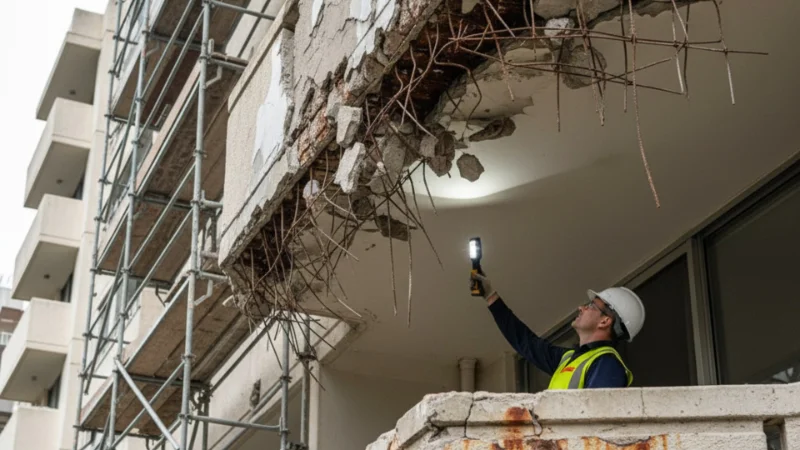
You've noticed cracks in your building's concrete — maybe in the basement carpark, along a balcony soffit, or running down a column in the common area. The question every strata committee asks at this point is the same: is this serious?
The answer depends entirely on what kind of crack you're looking at. Some concrete cracks are cosmetic. They've been there since the building was poured and they'll be there in fifty years. Others are the first visible sign of structural deterioration that, left unaddressed, will cost your owners corporation hundreds of thousands of dollars to repair.
This guide explains how to tell the difference. It covers the three categories of concrete cracks you'll find in Sydney strata buildings, what each one means, and when to call a specialist versus when to simply monitor and record.
We're not suggesting you diagnose structural issues from a blog post. What we're giving you is enough knowledge to have an informed conversation with your structural engineer — and to recognise when a crack needs urgent attention before your next committee meeting.
Every concrete crack in your building falls into one of three risk categories. Understanding which category you're looking at determines whether you need immediate action, planned remediation, or just a note in your maintenance records.
These are the cracks that have been there since the building was young. They're caused by the concrete itself — not by anything wrong with the structure.
Plastic shrinkage cracks appear within hours of the concrete being poured. As the surface dries faster than the interior, shallow cracks form in a random pattern. They're typically less than 0.1mm wide and don't extend through the full depth of the slab or element. You'll see them on exposed slabs, driveways, and podium decks.
Drying shrinkage cracks develop over the first weeks and months as concrete cures. As water evaporates from the mix, the concrete contracts. If the contraction is restrained — by reinforcement, formwork, or adjacent elements — cracks form. These are usually straight, evenly spaced, and run perpendicular to the restraining force. In a slab, you'll see them running parallel to walls or columns.
Thermal cracks result from temperature changes causing expansion and contraction. In Sydney, where summer surface temperatures on a north-facing facade can exceed 60°C, the daily thermal cycle stresses concrete at joints and connections. These cracks follow a regular pattern and rarely change width over time.
What to do: Record them. Photograph them with a scale reference (a coin or ruler held beside the crack). Note the location, date, and approximate width. If they haven't changed at your next six-monthly inspection, they're stable. Non-structural cracks that are wider than 0.3mm should still be sealed to prevent water ingress — even though they're not structural, water penetration through cracks accelerates reinforcement corrosion and creates problems in Category 3.
Structural cracks indicate a problem with the building's load-bearing capacity. They're caused by forces the concrete can't resist — overloading, settlement, inadequate design, or deterioration of the reinforcement.
Diagonal shear cracks typically appear at approximately 45 degrees on beams, near supports. They indicate the element is experiencing shear forces beyond its capacity. In a strata building, you might see these on transfer beams in the basement or on beams supporting the podium level. These are serious — they indicate the element is working harder than it was designed to.
Flexural cracks appear on the tension face of a concrete element — the bottom of a beam, the top of a cantilever. They run vertically (perpendicular to the beam's length) and are wider at the tension face, tapering to nothing at the compression face. Some flexural cracking is normal and expected in reinforced concrete design — the reinforcement carries the tension. But if the cracks are widening over time or exceed the limits in Australian Standard AS 3600 (0.3mm for most exposure conditions, less for aggressive environments), the element needs assessment.
Settlement cracks occur when the building's foundations move. These often appear as diagonal cracks running from the corners of openings (doors, windows) or as horizontal cracks at floor-wall junctions. In Sydney, where reactive clay soils are common in the western suburbs and seasonal moisture changes cause ground movement, settlement cracking can develop years after construction.
What to do: If you identify a crack that matches any of these patterns — diagonal on a beam, widening flexural cracks, or cracks radiating from foundation level — commission a building investigation from a registered structural engineer. Don't wait for the next AGM. Structural cracks can indicate load paths that are overstressed, and the consequences of failure in a multi-storey occupied building are severe.
Under Australian Standard AS 3600:2018, the maximum allowable surface crack width depends on the element's exposure classification. For most external elements on Sydney strata buildings (B1 or B2 exposure — near-coastal or coastal), the limit is 0.2–0.3mm. Cracks exceeding this threshold may indicate non-compliance and should be assessed by an engineer regardless of their apparent cause.
This is the category that costs strata schemes the most money — because it starts invisible and is often ignored until it becomes expensive.
Concrete cancer (technically: reinforcement corrosion) happens when steel reinforcement inside the concrete begins to rust. The rust occupies several times the volume of the original steel, creating internal pressure that cracks and spalls the concrete from the inside out.
What causes it:
What it looks like:
The first sign is typically rust staining on the concrete surface — brown or orange marks where moisture is carrying dissolved rust through the cover. This is followed by hairline cracks running along the line of the reinforcement (parallel to bars, not random). Eventually, the concrete cover delaminates and spalls — chunks fall away, exposing corroded reinforcement.
If you tap the concrete around a rust stain with a hammer and hear a hollow sound, the concrete has already delaminated beneath the surface. The visible damage is a fraction of the total — for every square metre of spalled concrete you can see, there's typically two to three times that area with subsurface delamination waiting to follow.
What to do: This doesn't wait. Commission a concrete condition assessment that includes delamination mapping (hammer tap or chain drag survey) and, where appropriate, carbonation depth testing and chloride profiling. The assessment determines how far the corrosion has progressed, how much of the building is affected, and what repair methodology is required.
The NSW Building Commission's 2023 research found that 53% of surveyed strata buildings have serious defects in common property. Concrete deterioration and waterproofing failures account for the majority of those defects. If your building was constructed in the 1990s or 2000s and you haven't had a concrete condition assessment, the probability of active corrosion somewhere in the structure is high.
Where you find cracks matters as much as what they look like:
Balcony soffits (the underside of the balcony above). Cracks and rust stains here typically indicate waterproofing failure on the balcony above. Water penetrating through a failed membrane reaches the reinforcement and starts corrosion. This is the most common concrete cancer presentation in Sydney strata buildings.
Basement carpark ceilings. Cracks in the carpark ceiling often indicate loading issues from the podium or ground-level slab above, or water ingress from the ground level. Structural carpark elements carry significant load and any cracking should be assessed.
Columns. Vertical cracks in columns can indicate overloading or inadequate confinement reinforcement. Horizontal cracks in columns are more concerning — they can indicate shear failure, which is a safety-critical condition. Any cracking in columns should be assessed by a structural engineer.
Common area walls. Cracks at junctions between walls and floors, or diagonal cracks running from window corners, usually indicate settlement or differential movement. In newer buildings, these can also indicate inadequate movement joints.
Facade and external walls. Cracks in rendered facades often follow the block or brick pattern beneath the render. These can indicate substrate cracking (the wall itself), or they can be render-only cracking from thermal movement or insufficient expansion joints.
Not every crack needs immediate repair. Here's the decision framework:
Monitor and record if the crack is:
Investigate within 3 months if the crack is:
Investigate immediately if the crack is:
The repair method depends on the crack type, cause, and severity. Here's what each approach involves:
Crack injection (epoxy or polyurethane). For structural cracks that need to be bonded back together, low-pressure injection fills the crack with structural adhesive. Epoxy restores full structural capacity. Polyurethane is flexible and better suited to cracks that are still moving. This is precise work — the injection must fill the full depth of the crack without leaving voids.
Patch repair. For concrete cancer where the cover has spalled or delaminated, the damaged concrete is removed to expose the reinforcement. Corroded steel is cleaned, treated with a protective primer, and the void is filled with polymer-modified repair mortar. The repaired area is then coated with a protective system to prevent recurrence.
Protective coatings and sealers. For buildings with early-stage corrosion risk (carbonation approaching the reinforcement, but not yet causing visible damage), anti-carbonation coatings can slow the progression. Crack sealers prevent water ingress through non-structural cracks. These are preventive measures — they buy time, they don't fix existing damage.
Structural strengthening. For elements where cracking indicates inadequate load capacity, external strengthening may be required. Carbon fibre reinforcement polymer (CFRP) wraps or plates bonded to the concrete surface increase the element's capacity without adding significant weight or volume. This is engineering-designed work requiring a registered design practitioner's specification.
For a detailed breakdown of costs for each approach, see our remedial works cost guide and concrete repair costs page.
WSRG recently published data showing that remedial costs can increase twentyfold when concrete cracks are ignored versus treated at first discovery. That's not an exaggeration — it reflects the compounding nature of concrete deterioration.
A 0.3mm crack sealed for $500 today prevents water ingress. Left unsealed for two years, that water reaches the reinforcement, initiates corrosion, and now you're looking at a $15,000–$50,000 patch repair program. Leave the corrosion for another three years, and the spalling spreads to adjacent areas through interconnected moisture paths. Now it's a $200,000+ structural remediation project with scaffold, resident disruption, and a 6-month program.
The decision to "monitor and reassess next year" is sometimes appropriate. But it should be a deliberate decision based on professional assessment — not a committee hoping the cracks will stop growing on their own. They won't.
If your building is showing signs it needs remedial work, acting early is the single most effective way to control costs.
A professional concrete crack assessment typically involves a visual survey of all accessible concrete elements, delamination testing (hammer tap or chain drag), crack width measurement and mapping, and — where corrosion is suspected — carbonation depth testing and chloride sampling.
For a standard strata building (4–8 storeys), expect the assessment to take one to two days on site and cost $5,000–$15,000 depending on building size and access requirements. The deliverable is a condition report that categorises every defect, assigns a priority rating, and provides indicative repair costs.
This is the document your committee needs to make informed decisions about remedial works — and it's the foundation of your capital works plan budgeting.
At Atomic Projects, we provide concrete and structural repair services informed by thorough investigation. If your building has concrete cracks you're unsure about, book a concrete crack assessment or call our team to discuss what you're seeing.
How do I measure crack width?
Use a crack width gauge (also called a crack comparator card) — a clear plastic card with graduated line widths printed on it. Hold it against the crack and match the line that best fits the crack opening. These cost under $20 from engineering or hardware suppliers. For monitoring, photograph the crack with the gauge visible for a dated record.
Are hairline cracks in concrete normal?
Yes — hairline cracks (less than 0.1mm) are common in reinforced concrete and generally don't indicate structural problems. They result from normal shrinkage during curing. However, hairline cracks accompanied by rust staining should be investigated, as they may indicate early-stage reinforcement corrosion.
How quickly does concrete cancer spread?
Once corrosion initiates, the rate depends on moisture, chloride concentration, and oxygen availability. In Sydney's coastal climate, active corrosion can cause visible spalling within 2–5 years of initiation. In drier inland areas, the progression may be slower. The key factor is moisture — concrete cancer accelerates dramatically in areas with consistent water exposure (balconies, planter boxes, below-grade elements).
Can concrete cracks be repaired permanently?
Structural epoxy injection restores the original load capacity and is considered a permanent repair for static cracks. For cracks caused by ongoing movement (settlement, thermal cycling), flexible sealants accommodate continued movement but need periodic replacement. Concrete cancer repairs are durable if the root cause (carbonation, chloride ingress, water penetration) is addressed — if you only patch the concrete without fixing the waterproofing above, the corrosion will return.
Does my strata scheme need a registered practitioner for crack repairs?
Under the NSW Design and Building Practitioners Act, regulated building work (structural repair, waterproofing, fire safety) on Class 2 buildings must be carried out by a registered building practitioner. From 1 July 2026, this extends to Class 3 and 9c buildings. Cosmetic crack sealing on non-structural elements is generally exempt, but any repair to a structural element or the building envelope requires a registered practitioner and design lodgement on the NSW Planning Portal.

Send photos, the engineer's report, or just the symptoms — whatever you've got. A registered builder reads it and calls you back. No call centre, no obligation.