Atomic Projects white logo

Get Your Free E Book

23 Pages of Exclusive Trade Secrets
Thank you! Your submission has been received!
Oops! Something went wrong while submitting the form.
Limited Time Only
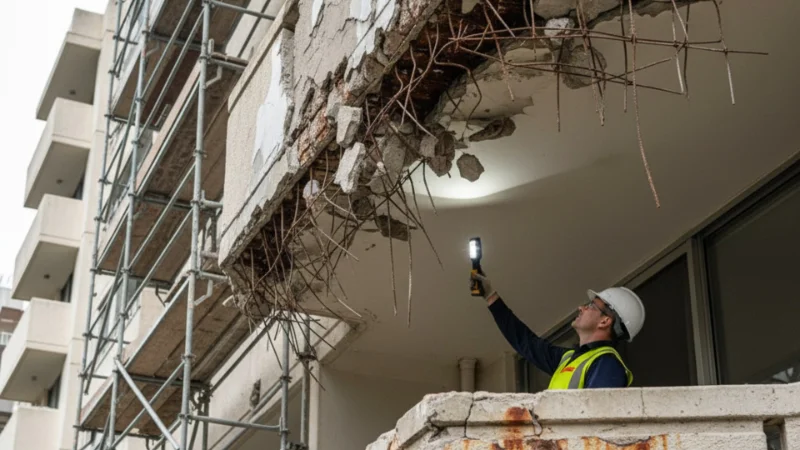
Concrete restoration on a Sydney strata building — corroded reinforcement treatment and fresh repair mortar on a balcony soffit

Concrete Restoration in Sydney: What Strata Buildings Need to Know in 2026

Your strata building is 20 years old. The balcony soffits are spalling. The carpark ceiling has rust stains tracking along the rebar lines. The facade has hairline cracks that were not there five years ago.

Your engineer has used the word "restoration" in their report. Not just "repair" — restoration. And your committee is wondering what that actually means, what it involves, and why it matters.

This guide explains concrete restoration for Sydney strata buildings: what it is, how it differs from a simple patch repair, what the process looks like end to end, and why it is the difference between a building that lasts another 50 years and one that needs the same work again in 10.

What Is Concrete Restoration (And How Is It Different from Repair?)

Concrete repair fixes a specific defect. You break out the spalled concrete, treat the corroded rebar, apply repair mortar, and move on. The patch is fixed. The structural element is functional again.

Concrete restoration is broader. It addresses the underlying condition of the concrete — not just the visible damage. A restoration program includes diagnosis, repair of active defects, treatment of areas where deterioration has started but is not yet visible, and application of protective systems to slow future deterioration across the entire structure.

Think of it this way: repair is reactive (fix what is broken). Restoration is strategic (fix what is broken, treat what is deteriorating, protect what is still sound).

For a strata building, the distinction matters because reactive repairs tend to cascade. You repair the worst balcony this year, then two more next year, then four the year after. Each mobilisation costs $8,000–$15,000 in access and preliminaries before any repair work begins. A restoration program identifies all the damage upfront and addresses it in a single coordinated project — one mobilisation, one scaffolding erection, one access plan.

The total repair cost for a restoration program is typically 20–35% lower than the cumulative cost of addressing the same defects individually over 5–10 years.

The Five Stages of Concrete Restoration

Every concrete restoration project in a Sydney strata building follows the same five-stage sequence. Shortcuts at any stage compromise the outcome.

Stage 1: Diagnostic Investigation

Before any concrete is broken out, the building needs a structural condition assessment. This is not a visual inspection — it is an invasive investigation that answers three questions: where is the damage (delamination survey using hammer sounding or ground-penetrating radar), how deep does it go (core sampling and carbonation depth testing), and why is it happening (chloride profiling, half-cell potential mapping, cover meter surveys).

The investigation produces a condition report with defect maps that show exactly where the concrete is compromised, how far the deterioration has progressed, and what is causing it. This is the foundation of every decision that follows. Cost: $8,000–$30,000 depending on building size and complexity.

Stage 2: Scope Definition and Specification

The investigation data drives the scope. A restoration specification defines which areas need full breakout and structural repair, which areas need preventive treatment, which areas need protective coating only, the repair methodology for each category, and hold points and third-party verification stages.

This stage is where the engineer and the contractor align on what "done" looks like. Without a detailed specification, the contractor decides what to repair and what to leave — and their commercial incentive is to repair as little as possible.

Stage 3: Access and Preparation

For multi-storey strata buildings, access planning is a project in itself. Scaffolding ($10,000–$15,000 per elevation) is best for large-area restoration where multiple elements on the same elevation need attention. Rope access ($2,000–$5,000 per drop) is best for targeted repairs on facades and soffits. Elevated work platforms ($800–$2,500 per day) are best for low-to-mid-rise buildings with ground-level access.

The preparation phase also includes resident notification, noise management planning, traffic management, and protection of common areas below the work zone.

Stage 4: Repair and Treatment

This is the hands-on work. In a restoration program, repair and treatment happen in parallel across the building rather than one defect at a time.

For active defects (spalling, exposed rebar, cracking): break out deteriorated concrete to 25mm behind the furthest extent of corrosion; clean reinforcement to bright metal; apply zinc-rich primer to treated reinforcement; build up repair mortar in layers; and final profile to match existing concrete surface.

For early-stage deterioration (carbonation approaching rebar, no active corrosion): apply migrating corrosion inhibitor (MCI) to the concrete surface, which penetrates through the cover and forms a protective molecular layer on the reinforcement, extending service life by 10–20 years without breakout.

For sound concrete: apply anti-carbonation coating or penetrating silane sealer to prevent carbon dioxide and moisture from entering the concrete. Service life of protection is 10–15 years before reapplication.

Stage 5: Verification and Handover

A restoration project is not complete when the last mortar patch is finished. Verification includes pull-off adhesion testing on repair patches (minimum 1.5 MPa bond strength), coating thickness measurement, photographic documentation of every repair location, an updated condition report, and a maintenance schedule for protective coating reapplication.

The handover documentation becomes your building's concrete health record. It tells your next engineer exactly what was done, where, and when — so the next condition assessment can track whether the restoration is performing as designed.

Why Strata Buildings Need Restoration, Not Just Repair

Strata committees often approve repairs one at a time because each individual repair seems manageable. But this approach has three hidden costs.

Repeated mobilisation. Every time a contractor comes back, you pay mobilisation, access, and preliminary costs again. On a 6-storey building, scaffolding for a single elevation costs $10,000–$15,000. If you scaffold the same elevation three times over five years for separate repairs, that is $30,000–$45,000 in access costs alone.

Accelerating deterioration. Concrete damage is not linear. Once carbonation reaches the reinforcement and corrosion begins, the damage accelerates. A defect that was too minor to repair today becomes a structural concern in 2–3 years.

Non-compliant capital works planning. Since 1 April 2026, any new or revised 10-year capital works fund plan in NSW must use the mandatory standard form, which requires detailed provisions for anticipated remedial expenditure. A building that has been addressing concrete damage ad hoc will struggle to produce the cost projections the new form demands.

What Concrete Restoration Costs in a Sydney Strata Building

Restoration costs more upfront than patching the worst three spots. But the lifetime cost is lower because you are doing the work once, comprehensively, instead of returning to the same building every 2–3 years.

Indicative ranges for a mid-rise (4–8 storey) strata building in Greater Sydney:

Scope Typical Range What It Covers
Investigation + specification $15,000–$40,000 Invasive investigation, condition report, restoration specification
Localised restoration (10–20% of concrete affected) $100,000–$300,000 Breakout + repair of active defects, preventive treatment of surrounding areas, protective coatings
Moderate restoration (20–40% of concrete affected) $300,000–$700,000 Systematic repair across multiple elements, building-wide protection
Major restoration (40%+ of concrete affected) $700,000–$1.5M+ Full structural remediation, potential recasting, complete waterproofing system, facade protection

These ranges include access, repair, treatment, protection, and project management. They exclude interior make-good, which varies by unit fit-out.

For detailed cost breakdowns by repair type, see our concrete repair cost guide.

How to Know If Your Building Needs Restoration

Not every building with a few spalling patches needs a full restoration program.

Patch repair is sufficient when: damage is isolated to 1–3 locations; the cause is localised (construction defect, impact damage, isolated waterproofing failure); the surrounding concrete is sound; and there is no pattern of recurrence.

Restoration is necessary when: damage appears across multiple elements; the cause is systemic (carbonation advancing building-wide, insufficient concrete cover, chloride exposure); previous repairs have failed or adjacent areas are now showing the same damage; the engineer's report identifies "widespread" or "progressive" deterioration; or your building is 20+ years old and has never had a comprehensive concrete condition assessment. If your building is showing signs of progressive concrete deterioration, our guide on when strata buildings need remedial works covers the warning signs in detail.

Choosing a Contractor for Concrete Restoration

Concrete restoration is specialist work. Not every builder who can patch a spalling soffit has the diagnostic capability or product knowledge to deliver a full restoration program.

What to look for: DBP registration (from 1 July 2026, the Design and Building Practitioners Act covers Class 3 and 9c buildings in addition to Class 2 — verify the registration number on the NSW Fair Trading register); a diagnostic-first approach (the investigation should drive the specification, not the other way around); specified product systems (the repair mortar, corrosion inhibitor, and protective coating should all be named in the specification); hold points and verification (defined points where the engineer or a third party inspects the work before it is covered up); and a maintenance schedule (protective coatings need reapplication every 10–15 years).

What Happens If You Do Nothing

Concrete deterioration follows a predictable curve. The initiation phase can take 15–25 years with no visible sign. Once corrosion begins, the propagation phase produces visible damage within 3–5 years and accelerates from there.

The engineering rule of thumb: every year of deferral on active concrete corrosion increases the eventual restoration cost by 8–12%. A $300,000 restoration need today becomes $420,000–$500,000 if deferred for five years. And that assumes no safety incident triggers emergency works at premium rates.

For buildings with corroding reinforcement in overhead elements (balcony soffits, carpark ceilings), deferral also carries a safety risk. Spalling concrete falling from height is a WorkSafe notifiable incident.

Next Steps

If your strata building has concrete damage in multiple locations, or if your engineer's report mentions progressive deterioration, the path forward starts with diagnosis:

  1. Commission a structural condition assessment — ideally invasive, not just visual.

  2. Get a restoration specification — the investigation data should drive a defined scope, not a generic quote.

  3. Obtain quotes from DBP-registered remedial contractors — compare on methodology and scope, not just price.

  4. Update your 10-year capital works fund plan under the new April 2026 standard form with accurate restoration cost provisions.

Atomic Projects is a DBP-registered remedial building contractor. We diagnose before we quote, specify before we build, and verify before we hand over. Our concrete and structural repair service is informed by thorough building investigation. Get a concrete restoration assessment for your strata building.

Frequently Asked Questions

What is the difference between concrete repair and concrete restoration? Concrete repair fixes specific visible defects (spalling, cracks). Concrete restoration is a comprehensive program that repairs active damage, treats early-stage deterioration before it becomes visible, and applies protective systems to the entire structure. Restoration addresses the underlying cause, not just the symptoms.

How much does concrete restoration cost for a Sydney strata building? For a mid-rise (4-8 storey) strata building in Sydney, concrete restoration costs range from $100,000-$300,000 for localised programs (10-20% of concrete affected) to $700,000-$1.5M+ for major restoration (40%+ affected). Costs include investigation, repair, preventive treatment, protective coatings, and project management.

How long does concrete restoration take on a strata building? A typical mid-rise strata concrete restoration program takes 3-6 months from investigation to handover. The investigation phase takes 2-4 weeks, specification and quoting takes 4-6 weeks, and the on-site repair program takes 8-16 weeks depending on scope and access requirements.

Does concrete damage get worse if you delay restoration? Yes. Every year of deferral on active concrete corrosion increases eventual restoration cost by 8-12%. Concrete deterioration accelerates once it begins: the initiation phase (15-25 years, no visible signs) is followed by a propagation phase where damage compounds. A $300,000 restoration need today becomes $420,000-$500,000 if deferred five years.

When does a strata building need restoration instead of patch repair? Restoration is needed when damage appears across multiple structural elements, the cause is systemic (building-wide carbonation, insufficient concrete cover), previous repairs have failed or adjacent areas are now showing the same damage, or the building is 20+ years old and has never had a comprehensive concrete condition assessment.

Concrete Restoration in Sydney: What Strata Buildings Need to Know in 2026

Concrete restoration on a Sydney strata building — corroded reinforcement treatment and fresh repair mortar on a balcony soffit

Your strata building is 20 years old. The balcony soffits are spalling. The carpark ceiling has rust stains tracking along the rebar lines. The facade has hairline cracks that were not there five years ago.

Your engineer has used the word "restoration" in their report. Not just "repair" — restoration. And your committee is wondering what that actually means, what it involves, and why it matters.

This guide explains concrete restoration for Sydney strata buildings: what it is, how it differs from a simple patch repair, what the process looks like end to end, and why it is the difference between a building that lasts another 50 years and one that needs the same work again in 10.

What Is Concrete Restoration (And How Is It Different from Repair?)

Concrete repair fixes a specific defect. You break out the spalled concrete, treat the corroded rebar, apply repair mortar, and move on. The patch is fixed. The structural element is functional again.

Concrete restoration is broader. It addresses the underlying condition of the concrete — not just the visible damage. A restoration program includes diagnosis, repair of active defects, treatment of areas where deterioration has started but is not yet visible, and application of protective systems to slow future deterioration across the entire structure.

Think of it this way: repair is reactive (fix what is broken). Restoration is strategic (fix what is broken, treat what is deteriorating, protect what is still sound).

For a strata building, the distinction matters because reactive repairs tend to cascade. You repair the worst balcony this year, then two more next year, then four the year after. Each mobilisation costs $8,000–$15,000 in access and preliminaries before any repair work begins. A restoration program identifies all the damage upfront and addresses it in a single coordinated project — one mobilisation, one scaffolding erection, one access plan.

The total repair cost for a restoration program is typically 20–35% lower than the cumulative cost of addressing the same defects individually over 5–10 years.

The Five Stages of Concrete Restoration

Every concrete restoration project in a Sydney strata building follows the same five-stage sequence. Shortcuts at any stage compromise the outcome.

Stage 1: Diagnostic Investigation

Before any concrete is broken out, the building needs a structural condition assessment. This is not a visual inspection — it is an invasive investigation that answers three questions: where is the damage (delamination survey using hammer sounding or ground-penetrating radar), how deep does it go (core sampling and carbonation depth testing), and why is it happening (chloride profiling, half-cell potential mapping, cover meter surveys).

The investigation produces a condition report with defect maps that show exactly where the concrete is compromised, how far the deterioration has progressed, and what is causing it. This is the foundation of every decision that follows. Cost: $8,000–$30,000 depending on building size and complexity.

Stage 2: Scope Definition and Specification

The investigation data drives the scope. A restoration specification defines which areas need full breakout and structural repair, which areas need preventive treatment, which areas need protective coating only, the repair methodology for each category, and hold points and third-party verification stages.

This stage is where the engineer and the contractor align on what "done" looks like. Without a detailed specification, the contractor decides what to repair and what to leave — and their commercial incentive is to repair as little as possible.

Stage 3: Access and Preparation

For multi-storey strata buildings, access planning is a project in itself. Scaffolding ($10,000–$15,000 per elevation) is best for large-area restoration where multiple elements on the same elevation need attention. Rope access ($2,000–$5,000 per drop) is best for targeted repairs on facades and soffits. Elevated work platforms ($800–$2,500 per day) are best for low-to-mid-rise buildings with ground-level access.

The preparation phase also includes resident notification, noise management planning, traffic management, and protection of common areas below the work zone.

Stage 4: Repair and Treatment

This is the hands-on work. In a restoration program, repair and treatment happen in parallel across the building rather than one defect at a time.

For active defects (spalling, exposed rebar, cracking): break out deteriorated concrete to 25mm behind the furthest extent of corrosion; clean reinforcement to bright metal; apply zinc-rich primer to treated reinforcement; build up repair mortar in layers; and final profile to match existing concrete surface.

For early-stage deterioration (carbonation approaching rebar, no active corrosion): apply migrating corrosion inhibitor (MCI) to the concrete surface, which penetrates through the cover and forms a protective molecular layer on the reinforcement, extending service life by 10–20 years without breakout.

For sound concrete: apply anti-carbonation coating or penetrating silane sealer to prevent carbon dioxide and moisture from entering the concrete. Service life of protection is 10–15 years before reapplication.

Stage 5: Verification and Handover

A restoration project is not complete when the last mortar patch is finished. Verification includes pull-off adhesion testing on repair patches (minimum 1.5 MPa bond strength), coating thickness measurement, photographic documentation of every repair location, an updated condition report, and a maintenance schedule for protective coating reapplication.

The handover documentation becomes your building's concrete health record. It tells your next engineer exactly what was done, where, and when — so the next condition assessment can track whether the restoration is performing as designed.

Why Strata Buildings Need Restoration, Not Just Repair

Strata committees often approve repairs one at a time because each individual repair seems manageable. But this approach has three hidden costs.

Repeated mobilisation. Every time a contractor comes back, you pay mobilisation, access, and preliminary costs again. On a 6-storey building, scaffolding for a single elevation costs $10,000–$15,000. If you scaffold the same elevation three times over five years for separate repairs, that is $30,000–$45,000 in access costs alone.

Accelerating deterioration. Concrete damage is not linear. Once carbonation reaches the reinforcement and corrosion begins, the damage accelerates. A defect that was too minor to repair today becomes a structural concern in 2–3 years.

Non-compliant capital works planning. Since 1 April 2026, any new or revised 10-year capital works fund plan in NSW must use the mandatory standard form, which requires detailed provisions for anticipated remedial expenditure. A building that has been addressing concrete damage ad hoc will struggle to produce the cost projections the new form demands.

What Concrete Restoration Costs in a Sydney Strata Building

Restoration costs more upfront than patching the worst three spots. But the lifetime cost is lower because you are doing the work once, comprehensively, instead of returning to the same building every 2–3 years.

Indicative ranges for a mid-rise (4–8 storey) strata building in Greater Sydney:

Scope Typical Range What It Covers
Investigation + specification $15,000–$40,000 Invasive investigation, condition report, restoration specification
Localised restoration (10–20% of concrete affected) $100,000–$300,000 Breakout + repair of active defects, preventive treatment of surrounding areas, protective coatings
Moderate restoration (20–40% of concrete affected) $300,000–$700,000 Systematic repair across multiple elements, building-wide protection
Major restoration (40%+ of concrete affected) $700,000–$1.5M+ Full structural remediation, potential recasting, complete waterproofing system, facade protection

These ranges include access, repair, treatment, protection, and project management. They exclude interior make-good, which varies by unit fit-out.

For detailed cost breakdowns by repair type, see our concrete repair cost guide.

How to Know If Your Building Needs Restoration

Not every building with a few spalling patches needs a full restoration program.

Patch repair is sufficient when: damage is isolated to 1–3 locations; the cause is localised (construction defect, impact damage, isolated waterproofing failure); the surrounding concrete is sound; and there is no pattern of recurrence.

Restoration is necessary when: damage appears across multiple elements; the cause is systemic (carbonation advancing building-wide, insufficient concrete cover, chloride exposure); previous repairs have failed or adjacent areas are now showing the same damage; the engineer's report identifies "widespread" or "progressive" deterioration; or your building is 20+ years old and has never had a comprehensive concrete condition assessment. If your building is showing signs of progressive concrete deterioration, our guide on when strata buildings need remedial works covers the warning signs in detail.

Choosing a Contractor for Concrete Restoration

Concrete restoration is specialist work. Not every builder who can patch a spalling soffit has the diagnostic capability or product knowledge to deliver a full restoration program.

What to look for: DBP registration (from 1 July 2026, the Design and Building Practitioners Act covers Class 3 and 9c buildings in addition to Class 2 — verify the registration number on the NSW Fair Trading register); a diagnostic-first approach (the investigation should drive the specification, not the other way around); specified product systems (the repair mortar, corrosion inhibitor, and protective coating should all be named in the specification); hold points and verification (defined points where the engineer or a third party inspects the work before it is covered up); and a maintenance schedule (protective coatings need reapplication every 10–15 years).

What Happens If You Do Nothing

Concrete deterioration follows a predictable curve. The initiation phase can take 15–25 years with no visible sign. Once corrosion begins, the propagation phase produces visible damage within 3–5 years and accelerates from there.

The engineering rule of thumb: every year of deferral on active concrete corrosion increases the eventual restoration cost by 8–12%. A $300,000 restoration need today becomes $420,000–$500,000 if deferred for five years. And that assumes no safety incident triggers emergency works at premium rates.

For buildings with corroding reinforcement in overhead elements (balcony soffits, carpark ceilings), deferral also carries a safety risk. Spalling concrete falling from height is a WorkSafe notifiable incident.

Next Steps

If your strata building has concrete damage in multiple locations, or if your engineer's report mentions progressive deterioration, the path forward starts with diagnosis:

  1. Commission a structural condition assessment — ideally invasive, not just visual.

  2. Get a restoration specification — the investigation data should drive a defined scope, not a generic quote.

  3. Obtain quotes from DBP-registered remedial contractors — compare on methodology and scope, not just price.

  4. Update your 10-year capital works fund plan under the new April 2026 standard form with accurate restoration cost provisions.

Atomic Projects is a DBP-registered remedial building contractor. We diagnose before we quote, specify before we build, and verify before we hand over. Our concrete and structural repair service is informed by thorough building investigation. Get a concrete restoration assessment for your strata building.

Frequently Asked Questions

What is the difference between concrete repair and concrete restoration? Concrete repair fixes specific visible defects (spalling, cracks). Concrete restoration is a comprehensive program that repairs active damage, treats early-stage deterioration before it becomes visible, and applies protective systems to the entire structure. Restoration addresses the underlying cause, not just the symptoms.

How much does concrete restoration cost for a Sydney strata building? For a mid-rise (4-8 storey) strata building in Sydney, concrete restoration costs range from $100,000-$300,000 for localised programs (10-20% of concrete affected) to $700,000-$1.5M+ for major restoration (40%+ affected). Costs include investigation, repair, preventive treatment, protective coatings, and project management.

How long does concrete restoration take on a strata building? A typical mid-rise strata concrete restoration program takes 3-6 months from investigation to handover. The investigation phase takes 2-4 weeks, specification and quoting takes 4-6 weeks, and the on-site repair program takes 8-16 weeks depending on scope and access requirements.

Does concrete damage get worse if you delay restoration? Yes. Every year of deferral on active concrete corrosion increases eventual restoration cost by 8-12%. Concrete deterioration accelerates once it begins: the initiation phase (15-25 years, no visible signs) is followed by a propagation phase where damage compounds. A $300,000 restoration need today becomes $420,000-$500,000 if deferred five years.

When does a strata building need restoration instead of patch repair? Restoration is needed when damage appears across multiple structural elements, the cause is systemic (building-wide carbonation, insufficient concrete cover), previous repairs have failed or adjacent areas are now showing the same damage, or the building is 20+ years old and has never had a comprehensive concrete condition assessment.

Take the next step.

Fill out the form below and let's build something that lasts.

Phone: Call us at 0410 515 509

Email: Send us a message at hello@atomicprojects.com.au

Form: Fill out the form — we usually respond within 1 business day.

Max file size 10MB.
Uploading...
fileuploaded.jpg
Upload failed. Max size for files is 10 MB.
Thank you! Your submission has been received!
Oops! Something went wrong while submitting the form.