Atomic Projects white logo

Get Your Free E Book

23 Pages of Exclusive Trade Secrets
Thank you! Your submission has been received!
Oops! Something went wrong while submitting the form.
Limited Time Only
Strata committee member assessing a mid-rise Sydney apartment building facade for remedial works triggers

When Does Your Strata Building Need Remedial Works? 7 Triggers Every Sydney Committee Should Know

Every strata committee has had this conversation.

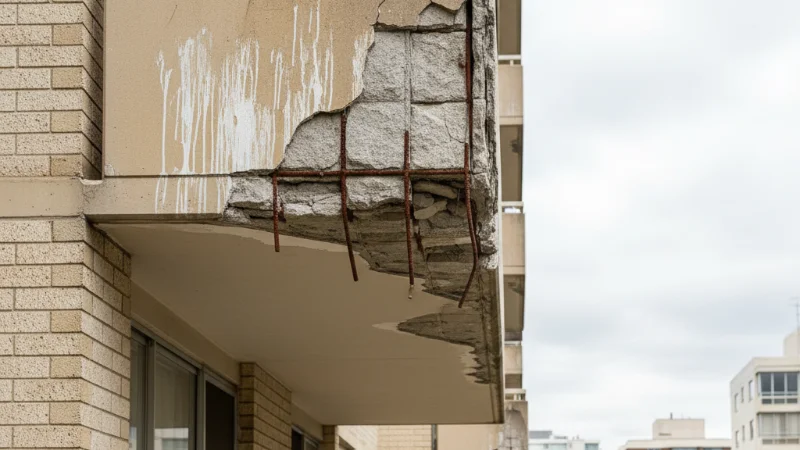
Someone points out the cracks in the carpark ceiling. The water stain on the podium soffit. The spalling concrete on the balcony edge. The committee chair says: "We'll monitor it."

Monitoring is the right response — sometimes. Hairline cracks in render are cosmetic. Surface efflorescence can be benign. Not every visible mark on a building means you need a $300,000 remedial project.

But here's the problem: "monitoring" becomes the default response for everything. The committee monitors for a year. Then two. Then five. By the time they decide to act, the repair scope has tripled, the cost has doubled, and the building's structural integrity is genuinely at risk.

The question isn't whether your building will need remedial works. If it's concrete construction and more than 15 years old, the answer is almost certainly yes. The question is when to stop monitoring and start acting.

These are the seven triggers. If any one of them applies to your building, the monitoring phase is over.

Trigger 1: Your Building Has Crossed the 15–25 Year Threshold

Concrete doesn't last forever. It deteriorates — slowly at first, then faster.

In Sydney's coastal and humid climate, the typical deterioration timeline for a multi-storey concrete building runs roughly like this. In years 0–10, waterproofing membranes reach end-of-life and early carbonation begins in exposed concrete. Between years 10–20, carbonation reaches the reinforcement depth, triggering steel corrosion; joints and sealants fail; and water ingress pathways establish. From years 20–30, corrosion-driven spalling becomes visible, facade systems degrade, and structural repairs become necessary rather than optional. After 30 years, deferred maintenance compounds and repair costs escalate exponentially.

The 15–25 year window is critical because it's when most buildings transition from cosmetic maintenance to structural remediation. The earlier you act within this window, the less it costs.

A building that addresses waterproofing failure at year 15 might spend $80,000 on membrane replacement. The same building at year 25 — after a decade of water ingress through the failed membrane — might spend $400,000 on membrane replacement plus concrete repair plus steel treatment plus internal make-good.

If your building was built between 2001 and 2011, you're in this window now.

Trigger 2: Patch Repairs Are No Longer Holding

This is the most common trigger we see on site. The committee has been managing defects with patch repairs for years — sealing a crack here, patching spalled concrete there, recoating a balcony membrane.

Patch repairs are legitimate for isolated, stable defects. They stop being legitimate when the same defect recurs within 2–3 years of repair, multiple locations are showing the same symptom, the patch repair scope is growing each cycle, or the underlying cause hasn't been investigated or addressed.

Recurring patch repairs are a symptom of treating the visible damage without addressing the root cause. Water ingress is the most common example: a committee waterproofs one balcony, then the next one fails, then another. The root cause — a building-wide waterproofing system at end-of-life — requires a building-wide solution, not unit-by-unit patches.

The rule of thumb: if you've spent more than $20,000 on patch repairs to the same building element in the past three years, you need a systematic investigation and a remedial scope — not another patch.

Trigger 3: The Engineer's Report Says Priority 1 or Priority 2

If you've already commissioned a building condition assessment or engineer's report, the report's priority ratings tell you when to act.

Priority 1 (Urgent/Safety): Act immediately. The defect poses an immediate safety risk or is causing active damage that worsens daily. Under the April 2026 NSW strata law changes, the owners corporation must undertake urgent repairs to common property defects immediately if they pose a risk to safety or access — regardless of any ongoing legal proceedings.

Priority 2 (High): Act within 6–12 months. The defect will escalate to Priority 1 if left unaddressed. This is the window where remedial works are still manageable in scope and cost.

Priority 3 (Medium): Schedule within the next capital works cycle (1–3 years). Monitor annually.

Priority 4 (Low/Monitor): Cosmetic or stable. Monitor at annual inspections. The most dangerous pattern is when a committee receives a report with Priority 2 findings and treats them as Priority 3 — deferring action into the next capital works plan cycle. By the time the cycle arrives, those Priority 2 items have become Priority 1, and the scope has expanded.

If you haven't had an engineer's report, and your building is over 15 years old, that's a trigger in itself. Our building investigation and reporting service provides the baseline assessment.

Trigger 4: Your Capital Works Plan Flags Deferred Maintenance

From 1 April 2026, NSW strata law requires all capital works fund plans to use a standardised form that includes condition assessments and remaining lifespan estimates for every major building element.

This means your updated 10-year plan now tells you — in black and white — which building elements are approaching or past their expected lifespan. If the plan shows a waterproofing membrane with a 15-year lifespan that was installed 18 years ago, that's a remedial trigger.

What to look for in your updated plan: items rated "poor" or "end of life" condition, items that have been deferred from previous plan cycles, and cost estimates that have increased significantly from the prior plan.

If your capital works plan hasn't been updated to the new standard form yet, it should be — it's now a legislative requirement.

Trigger 5: NSW Law Now Requires You to Act

The April 2026 strata law amendments changed the rules for when an owners corporation must act on building defects.

Urgent repairs cannot be deferred. The legislation now explicitly states that urgent repairs to common property must be undertaken immediately if the defect poses a risk to safety or access. The committee cannot defer urgent repairs while pursuing a claim against the builder or developer.

The $30,000 independent quote threshold. Any remedial work valued at $30,000 or more now requires at least two independent quotes. For detailed guidance, see our guide on getting accurate quotes under the new $30K rule.

The DBP Act expansion (July 2026). From 1 July 2026, the Design and Building Practitioners Act extends to Class 3 and Class 9c buildings. If your building falls into these categories, remedial works now require registered practitioners and compliance documentation lodged on the NSW Planning Portal.

The statutory duty to maintain. Under the Strata Schemes Management Act 2015, the owners corporation has an ongoing, non-delegable duty to properly maintain and keep in a state of good and serviceable repair the common property. Individual lot owners can apply to NCAT for an order compelling repairs if the committee fails to act.

Trigger 6: Your Insurance Requires It (or Premiums Are Escalating)

Strata insurance is a leading indicator of building condition. Insurers assess risk based on building age, claims history, and known defects. When premiums start escalating sharply, or when the insurer adds exclusions for water damage or structural issues, they're telling you something about your building's condition.

Specific insurance triggers include your insurer requiring a building condition report before renewing the policy, water damage or structural claims being excluded or subject to increased excess, premiums increasing by more than 15–20% year-on-year without a corresponding claim, and the insurer requiring evidence of completed remedial works before providing full coverage.

In some cases, addressing the underlying defects can actually reduce premiums because the risk profile improves. The cost of remedial works may be partially offset by 3–5 years of reduced insurance costs.

If your insurer is asking questions about your building's condition, take it as a signal.

Trigger 7: Concrete Damage Has Reached the Reinforcement

This is the hard technical line. When concrete deterioration — whether from carbonation, chloride ingress, or physical damage — reaches the embedded steel reinforcement, the clock accelerates dramatically.

Steel reinforcement in concrete is protected by the alkaline environment of the surrounding concrete. When carbonation or chloride ions penetrate to the reinforcement depth, the pH drops, and the steel begins to corrode. Corroding steel expands to 6–10 times its original volume. This expansion cracks the concrete from within, creating spalling. The spalling exposes more steel, which accelerates corrosion, which causes more spalling.

This is an exponential curve, not a linear one. A building with early-stage carbonation at the reinforcement depth might need $100,000–$200,000 in preventive treatment. The same building five years later — with active corrosion and widespread spalling — might need $500,000–$1,000,000 in concrete break-out, steel treatment, and reinstatement.

For more detail on what different types of concrete cracking mean, see our guide on concrete cracks in strata buildings.

If you can see exposed reinforcement, rust staining on concrete surfaces, or hollow-sounding concrete when tapped, the deterioration has already passed this threshold. Remedial works aren't optional — they're overdue.

The Cost of Waiting: Why Every Year of Delay Costs More

The single most important concept in remedial building works is the deterioration multiplier. Building defects don't deteriorate at a constant rate — they accelerate.

A rough guide to the cost multiplier for deferred remedial works: if the base cost at the right time to act is 1x, then after 2 years of delay the cost rises to approximately 1.5–2x, after 5 years to 3–5x, and after 10 years to 5–10x. These are real numbers from projects we've delivered. A waterproofing replacement that would have cost $120,000 in 2020 became a $450,000 waterproofing-plus-concrete-repair project by 2025 because five years of water ingress destroyed the substrate.

The multiplier exists because water ingress compounds, corrosion is self-accelerating, scope creep is inevitable, and access costs increase. The cheapest remedial project is the one you do at the right time.

What to Do When a Trigger Applies

If one or more of these triggers applies to your building, here's the sequence:

  1. Commission a building condition assessment. If you don't already have an engineer's report, this is the first step. AP's building investigation and reporting service provides this.

  2. Understand the report. Make sure every committee member understands the priority ratings. Our guide on what happens after the engineer's report walks through this process.

  3. Get the specification developed. The engineer's report describes the problem. The remedial specification describes the solution. You need both before you can get meaningful quotes.

  4. Tender and compare quotes. Any work over $30,000 requires at least two independent quotes. Our guide on getting accurate quotes explains how.

  5. Fund and execute. Present the scope, quotes, and funding mechanism to a general meeting. Then deliver the works with proper defect rectification methodology and hold-point inspections.

The full process from trigger to completion typically takes 5–12 months. The sooner you start, the smaller the scope, the lower the cost, and the less disruption to residents.

How Atomic Projects Can Help

We work with strata committees from the first trigger point through to completed works. Our remedial building services cover every defect type — concrete, waterproofing, facades, structural, fire safety — and we hold current DBP registration for Class 2 and (from July 2026) Class 3/9c buildings.

If you've recognised one of these triggers in your building, talk to our team. For an understanding of how much remedial works cost, see our detailed cost guide.

Frequently Asked Questions

How do I know if my building needs remedial works or just maintenance? Maintenance is recurring, preventive work that keeps building elements functioning. Remedial works address defects — things that are broken, failing, or no longer performing their intended function. If your maintenance contractor is repeatedly fixing the same problem, it's likely a remedial issue, not a maintenance one.

What does a building condition assessment cost? For a typical mid-rise strata building (4–8 storeys), a comprehensive building condition assessment costs $8,000–$25,000 depending on building size, access requirements, and the scope of investigation. This is a fraction of the remedial works cost and is the foundation for every decision that follows.

Can the strata committee defer remedial works to keep levies low? The committee has a statutory duty to maintain common property. Deferring necessary remedial works to keep levies low exposes the committee to NCAT orders, increased repair costs, potential personal liability, insurance complications, and reduced property values. Short-term levy savings almost always cost more in the long run.

Is there a legal deadline for acting on an engineer's report? There's no specific statutory deadline. However, the duty to maintain common property is ongoing and non-delegable. Failing to act within a reasonable timeframe could constitute a breach of that duty. For Priority 1 (safety) items, the April 2026 law changes require immediate action.

What's the difference between this guide and the "8 Signs" post? Our guide on 8 visual signs of building defects helps you identify what problems look like. This guide helps you decide when to act on them. The "8 Signs" post is about recognition; this post is about timing and decision-making.

When Does Your Strata Building Need Remedial Works? 7 Triggers Every Sydney Committee Should Know

Strata committee member assessing a mid-rise Sydney apartment building facade for remedial works triggers

Every strata committee has had this conversation.

Someone points out the cracks in the carpark ceiling. The water stain on the podium soffit. The spalling concrete on the balcony edge. The committee chair says: "We'll monitor it."

Monitoring is the right response — sometimes. Hairline cracks in render are cosmetic. Surface efflorescence can be benign. Not every visible mark on a building means you need a $300,000 remedial project.

But here's the problem: "monitoring" becomes the default response for everything. The committee monitors for a year. Then two. Then five. By the time they decide to act, the repair scope has tripled, the cost has doubled, and the building's structural integrity is genuinely at risk.

The question isn't whether your building will need remedial works. If it's concrete construction and more than 15 years old, the answer is almost certainly yes. The question is when to stop monitoring and start acting.

These are the seven triggers. If any one of them applies to your building, the monitoring phase is over.

Trigger 1: Your Building Has Crossed the 15–25 Year Threshold

Concrete doesn't last forever. It deteriorates — slowly at first, then faster.

In Sydney's coastal and humid climate, the typical deterioration timeline for a multi-storey concrete building runs roughly like this. In years 0–10, waterproofing membranes reach end-of-life and early carbonation begins in exposed concrete. Between years 10–20, carbonation reaches the reinforcement depth, triggering steel corrosion; joints and sealants fail; and water ingress pathways establish. From years 20–30, corrosion-driven spalling becomes visible, facade systems degrade, and structural repairs become necessary rather than optional. After 30 years, deferred maintenance compounds and repair costs escalate exponentially.

The 15–25 year window is critical because it's when most buildings transition from cosmetic maintenance to structural remediation. The earlier you act within this window, the less it costs.

A building that addresses waterproofing failure at year 15 might spend $80,000 on membrane replacement. The same building at year 25 — after a decade of water ingress through the failed membrane — might spend $400,000 on membrane replacement plus concrete repair plus steel treatment plus internal make-good.

If your building was built between 2001 and 2011, you're in this window now.

Trigger 2: Patch Repairs Are No Longer Holding

This is the most common trigger we see on site. The committee has been managing defects with patch repairs for years — sealing a crack here, patching spalled concrete there, recoating a balcony membrane.

Patch repairs are legitimate for isolated, stable defects. They stop being legitimate when the same defect recurs within 2–3 years of repair, multiple locations are showing the same symptom, the patch repair scope is growing each cycle, or the underlying cause hasn't been investigated or addressed.

Recurring patch repairs are a symptom of treating the visible damage without addressing the root cause. Water ingress is the most common example: a committee waterproofs one balcony, then the next one fails, then another. The root cause — a building-wide waterproofing system at end-of-life — requires a building-wide solution, not unit-by-unit patches.

The rule of thumb: if you've spent more than $20,000 on patch repairs to the same building element in the past three years, you need a systematic investigation and a remedial scope — not another patch.

Trigger 3: The Engineer's Report Says Priority 1 or Priority 2

If you've already commissioned a building condition assessment or engineer's report, the report's priority ratings tell you when to act.

Priority 1 (Urgent/Safety): Act immediately. The defect poses an immediate safety risk or is causing active damage that worsens daily. Under the April 2026 NSW strata law changes, the owners corporation must undertake urgent repairs to common property defects immediately if they pose a risk to safety or access — regardless of any ongoing legal proceedings.

Priority 2 (High): Act within 6–12 months. The defect will escalate to Priority 1 if left unaddressed. This is the window where remedial works are still manageable in scope and cost.

Priority 3 (Medium): Schedule within the next capital works cycle (1–3 years). Monitor annually.

Priority 4 (Low/Monitor): Cosmetic or stable. Monitor at annual inspections. The most dangerous pattern is when a committee receives a report with Priority 2 findings and treats them as Priority 3 — deferring action into the next capital works plan cycle. By the time the cycle arrives, those Priority 2 items have become Priority 1, and the scope has expanded.

If you haven't had an engineer's report, and your building is over 15 years old, that's a trigger in itself. Our building investigation and reporting service provides the baseline assessment.

Trigger 4: Your Capital Works Plan Flags Deferred Maintenance

From 1 April 2026, NSW strata law requires all capital works fund plans to use a standardised form that includes condition assessments and remaining lifespan estimates for every major building element.

This means your updated 10-year plan now tells you — in black and white — which building elements are approaching or past their expected lifespan. If the plan shows a waterproofing membrane with a 15-year lifespan that was installed 18 years ago, that's a remedial trigger.

What to look for in your updated plan: items rated "poor" or "end of life" condition, items that have been deferred from previous plan cycles, and cost estimates that have increased significantly from the prior plan.

If your capital works plan hasn't been updated to the new standard form yet, it should be — it's now a legislative requirement.

Trigger 5: NSW Law Now Requires You to Act

The April 2026 strata law amendments changed the rules for when an owners corporation must act on building defects.

Urgent repairs cannot be deferred. The legislation now explicitly states that urgent repairs to common property must be undertaken immediately if the defect poses a risk to safety or access. The committee cannot defer urgent repairs while pursuing a claim against the builder or developer.

The $30,000 independent quote threshold. Any remedial work valued at $30,000 or more now requires at least two independent quotes. For detailed guidance, see our guide on getting accurate quotes under the new $30K rule.

The DBP Act expansion (July 2026). From 1 July 2026, the Design and Building Practitioners Act extends to Class 3 and Class 9c buildings. If your building falls into these categories, remedial works now require registered practitioners and compliance documentation lodged on the NSW Planning Portal.

The statutory duty to maintain. Under the Strata Schemes Management Act 2015, the owners corporation has an ongoing, non-delegable duty to properly maintain and keep in a state of good and serviceable repair the common property. Individual lot owners can apply to NCAT for an order compelling repairs if the committee fails to act.

Trigger 6: Your Insurance Requires It (or Premiums Are Escalating)

Strata insurance is a leading indicator of building condition. Insurers assess risk based on building age, claims history, and known defects. When premiums start escalating sharply, or when the insurer adds exclusions for water damage or structural issues, they're telling you something about your building's condition.

Specific insurance triggers include your insurer requiring a building condition report before renewing the policy, water damage or structural claims being excluded or subject to increased excess, premiums increasing by more than 15–20% year-on-year without a corresponding claim, and the insurer requiring evidence of completed remedial works before providing full coverage.

In some cases, addressing the underlying defects can actually reduce premiums because the risk profile improves. The cost of remedial works may be partially offset by 3–5 years of reduced insurance costs.

If your insurer is asking questions about your building's condition, take it as a signal.

Trigger 7: Concrete Damage Has Reached the Reinforcement

This is the hard technical line. When concrete deterioration — whether from carbonation, chloride ingress, or physical damage — reaches the embedded steel reinforcement, the clock accelerates dramatically.

Steel reinforcement in concrete is protected by the alkaline environment of the surrounding concrete. When carbonation or chloride ions penetrate to the reinforcement depth, the pH drops, and the steel begins to corrode. Corroding steel expands to 6–10 times its original volume. This expansion cracks the concrete from within, creating spalling. The spalling exposes more steel, which accelerates corrosion, which causes more spalling.

This is an exponential curve, not a linear one. A building with early-stage carbonation at the reinforcement depth might need $100,000–$200,000 in preventive treatment. The same building five years later — with active corrosion and widespread spalling — might need $500,000–$1,000,000 in concrete break-out, steel treatment, and reinstatement.

For more detail on what different types of concrete cracking mean, see our guide on concrete cracks in strata buildings.

If you can see exposed reinforcement, rust staining on concrete surfaces, or hollow-sounding concrete when tapped, the deterioration has already passed this threshold. Remedial works aren't optional — they're overdue.

The Cost of Waiting: Why Every Year of Delay Costs More

The single most important concept in remedial building works is the deterioration multiplier. Building defects don't deteriorate at a constant rate — they accelerate.

A rough guide to the cost multiplier for deferred remedial works: if the base cost at the right time to act is 1x, then after 2 years of delay the cost rises to approximately 1.5–2x, after 5 years to 3–5x, and after 10 years to 5–10x. These are real numbers from projects we've delivered. A waterproofing replacement that would have cost $120,000 in 2020 became a $450,000 waterproofing-plus-concrete-repair project by 2025 because five years of water ingress destroyed the substrate.

The multiplier exists because water ingress compounds, corrosion is self-accelerating, scope creep is inevitable, and access costs increase. The cheapest remedial project is the one you do at the right time.

What to Do When a Trigger Applies

If one or more of these triggers applies to your building, here's the sequence:

  1. Commission a building condition assessment. If you don't already have an engineer's report, this is the first step. AP's building investigation and reporting service provides this.

  2. Understand the report. Make sure every committee member understands the priority ratings. Our guide on what happens after the engineer's report walks through this process.

  3. Get the specification developed. The engineer's report describes the problem. The remedial specification describes the solution. You need both before you can get meaningful quotes.

  4. Tender and compare quotes. Any work over $30,000 requires at least two independent quotes. Our guide on getting accurate quotes explains how.

  5. Fund and execute. Present the scope, quotes, and funding mechanism to a general meeting. Then deliver the works with proper defect rectification methodology and hold-point inspections.

The full process from trigger to completion typically takes 5–12 months. The sooner you start, the smaller the scope, the lower the cost, and the less disruption to residents.

How Atomic Projects Can Help

We work with strata committees from the first trigger point through to completed works. Our remedial building services cover every defect type — concrete, waterproofing, facades, structural, fire safety — and we hold current DBP registration for Class 2 and (from July 2026) Class 3/9c buildings.

If you've recognised one of these triggers in your building, talk to our team. For an understanding of how much remedial works cost, see our detailed cost guide.

Frequently Asked Questions

How do I know if my building needs remedial works or just maintenance? Maintenance is recurring, preventive work that keeps building elements functioning. Remedial works address defects — things that are broken, failing, or no longer performing their intended function. If your maintenance contractor is repeatedly fixing the same problem, it's likely a remedial issue, not a maintenance one.

What does a building condition assessment cost? For a typical mid-rise strata building (4–8 storeys), a comprehensive building condition assessment costs $8,000–$25,000 depending on building size, access requirements, and the scope of investigation. This is a fraction of the remedial works cost and is the foundation for every decision that follows.

Can the strata committee defer remedial works to keep levies low? The committee has a statutory duty to maintain common property. Deferring necessary remedial works to keep levies low exposes the committee to NCAT orders, increased repair costs, potential personal liability, insurance complications, and reduced property values. Short-term levy savings almost always cost more in the long run.

Is there a legal deadline for acting on an engineer's report? There's no specific statutory deadline. However, the duty to maintain common property is ongoing and non-delegable. Failing to act within a reasonable timeframe could constitute a breach of that duty. For Priority 1 (safety) items, the April 2026 law changes require immediate action.

What's the difference between this guide and the "8 Signs" post? Our guide on 8 visual signs of building defects helps you identify what problems look like. This guide helps you decide when to act on them. The "8 Signs" post is about recognition; this post is about timing and decision-making.

Take the next step.

Fill out the form below and let's build something that lasts.

Phone: Call us at 0410 515 509

Email: Send us a message at hello@atomicprojects.com.au

Form: Fill out the form — we usually respond within 1 business day.

Max file size 10MB.
Uploading...
fileuploaded.jpg
Upload failed. Max size for files is 10 MB.
Thank you! Your submission has been received!
Oops! Something went wrong while submitting the form.