A stain on the ceiling, a wet carpet under the window, blistering paint on a reveal — the water is obvious, but the entry point rarely is. Window and facade leaks travel. Water can enter at a failed head flashing two floors up and only show itself in the unit below, which is why patching the nearest-looking joint so often fails. The leak comes back with the next southerly.
Our window leak investigation and sealing service is built to find the actual defect before anyone reaches for a sealant gun. We treat diagnosis as its own discipline: locate the source, prove it under test, then remediate the specific failure rather than smearing mastic over the symptom.
The outcome we're after is simple — the leak stops and stays stopped, and you have documented evidence of what was wrong and what we did about it, which matters when the works are funded from a strata budget and questions get asked later.
How We Investigate & Seal Window Leaks
- Site inspection and history review. We walk the affected units and the external elevation, review any prior reports, and map where water is presenting against wind and rain direction to form a shortlist of likely entry points.
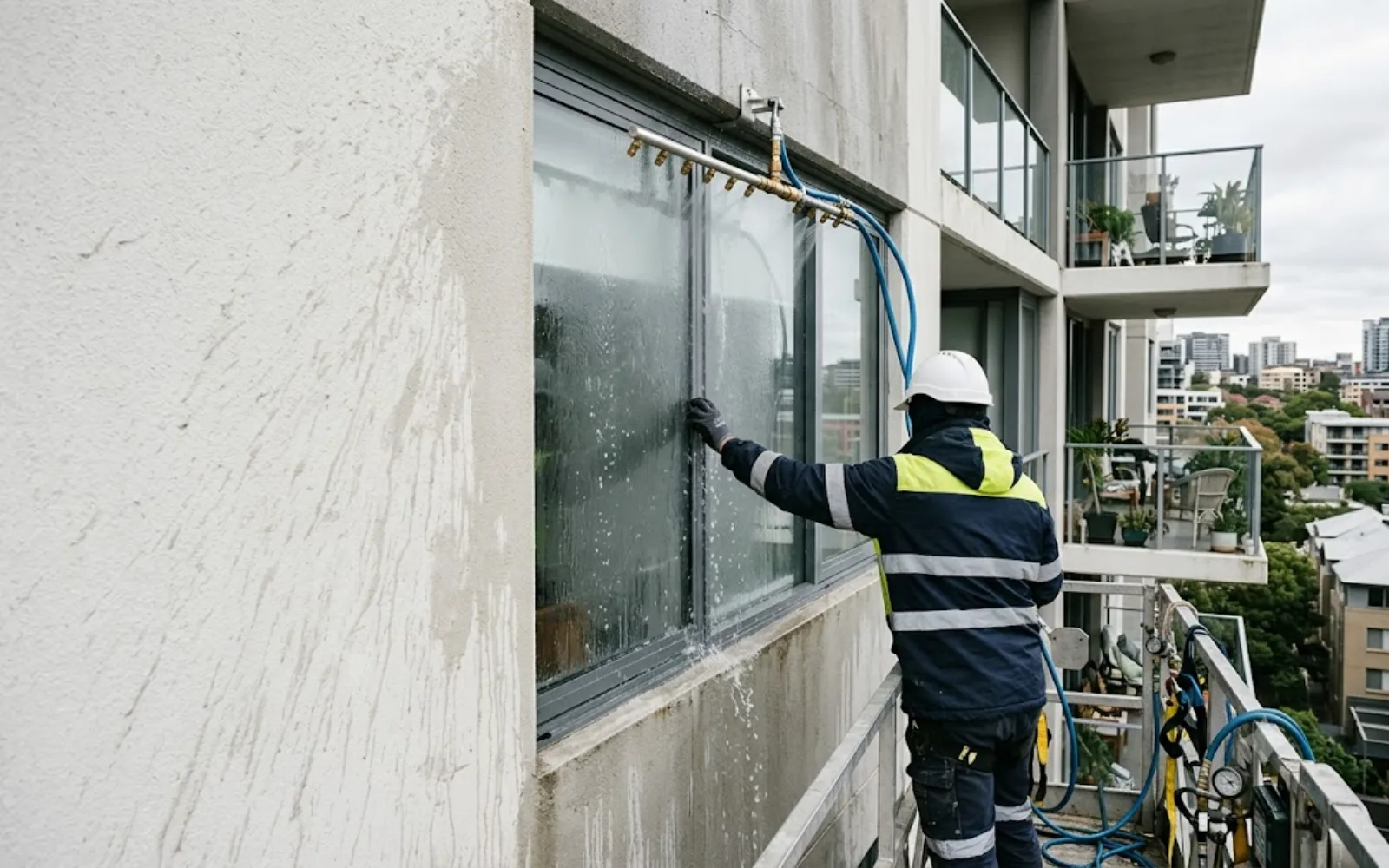
- Diagnostic water testing. We apply controlled water testing to window perimeters, sills and junctions in line with the principles of AS/NZS 4284, working from the bottom of a suspected zone upwards so we can isolate the exact joint that is letting water through.
- Confirm the failure mechanism. Perished perimeter sealant, a failed or missing flashing, a corroded frame, a blocked drainage path or a defective glazing seal each need a different fix. We identify which one is actually responsible.
- Joint preparation. Failed sealant is cut out, joints are cleaned back to sound substrate, and correctly sized backer rod is installed to set proper joint geometry so the new seal can move without tearing.
- Reseal and reinstate. We apply a high-performance elastomeric sealant matched to the substrate and exposure, and reinstate any flashing or drainage detail needed to shed water away from the opening.
- Verification retest. The repaired joint is retested under the same water conditions to confirm the leak is resolved, with results and photographs recorded in a completion report you can hold on file.
Frequently Asked Questions
Water is coming in around one window — why do you need to test the whole area rather than just seal that window?
Because the window you can see water near is often not where the water is getting in. Facade water tracks downward and sideways behind finishes before it appears, so sealing the visible joint frequently does nothing. Controlled water testing lets us start low and work up until the leak reappears, which isolates the true entry point. Sealing that — rather than the symptom — is the difference between a repair that lasts and one that fails by the next heavy rain.
Our building has had this leak 'fixed' twice already and it keeps coming back. What's different about your approach?
Repeat failures almost always trace back to the original repair treating the symptom instead of the cause — resealing the nearest joint without proving where water actually enters. Our process is diagnosis-led: we don't remediate until a water test has demonstrated the source. That evidence-first sequence is what breaks the patch-and-fail cycle, and the retest at the end confirms the fix before we leave site.
How disruptive is water testing for residents?
Minimal. Testing is done from outside at the affected elevation using controlled water volumes, and we coordinate access windows with the strata manager or building manager in advance. Residents in the test units may need to allow brief internal access so we can observe where water presents, but there is no demolition involved in the investigation stage itself.
Who is responsible for a window leak in a strata building — the owner or the owners corporation?
In most NSW schemes the window frames and the external building envelope are common property, which makes leak investigation and sealing an owners corporation responsibility under the Strata Schemes Management Act 2015, even where the water is damaging a single lot. We provide a documented diagnosis and scope that the committee can use to authorise and fund the works. Where responsibility is genuinely unclear, our report gives everyone an evidence base to work from.
Will I get documentation I can give the committee and owners?
Yes. Every investigation concludes with a report setting out the entry point we identified, the test results, the remediation carried out, and the verification retest, supported by photographs. This gives the owners corporation a clear record for its files and for any future capital works planning.
Related Services