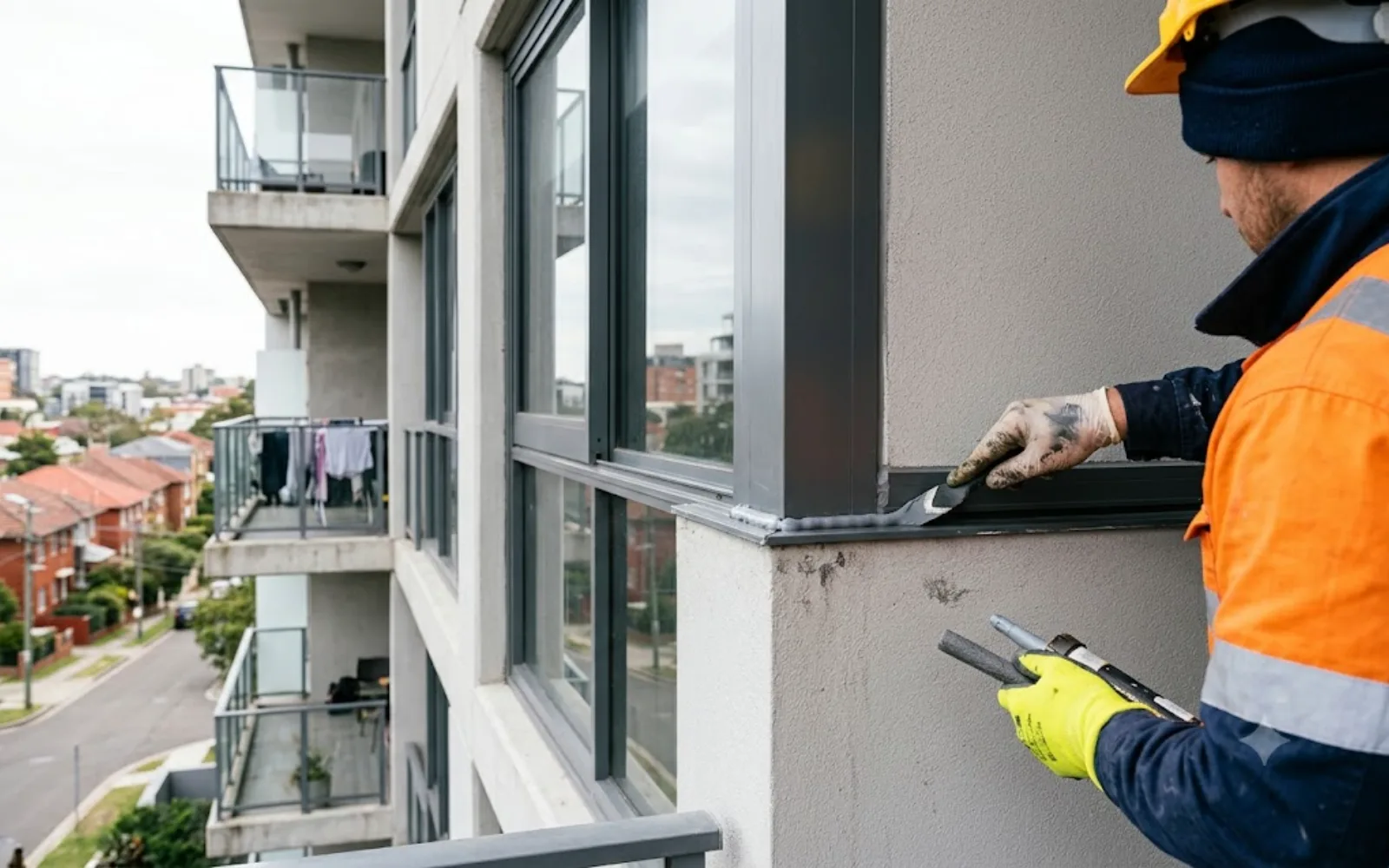
The sealant around a window frame and the rubber gaskets holding the glass are consumable. They shrink, harden, crack and pull away from the substrate under years of UV, heat cycling and building movement. Long before a window looks like it has a problem, its weather seal can be gone — and the first sign is usually water on a sill after a driving rain.
Our window sealant and gasket renewal service is the planned, envelope-wide answer to that ageing. Rather than waiting for individual leaks and chasing them one by one, we strip the perished perimeter sealant and failed glazing gaskets across an elevation or a building and reinstate them to a proper standard, restoring the continuous weather seal the facade relies on.
This is the most cost-effective point on the window-maintenance curve: renewing seals before they fail avoids the internal damage, the reactive callouts and the resident complaints that come once water is already getting in.
How We Renew Sealant & Gaskets
- Condition survey. We inspect perimeter sealant and glazing gaskets across the affected windows, identify which joints have failed or are near the end of their life, and prioritise by exposure and risk.
- Remove perished material. Old sealant is cut out in full and hardened or split gaskets are removed — renewal only works when the failed material is gone, not skinned over.
- Prepare the joints. Joints are cleaned back to sound substrate, primed where required, and fitted with correctly sized backer rod to set the right joint depth and profile.
- Select the right sealant. We match sealant chemistry — polyurethane, hybrid or silicone — to the substrate, joint movement and exposure, avoiding the compatibility failures that cause staining or debonding.
- Reseal and re-gasket. New sealant is gunned and tooled to a consistent profile, and replacement glazing gaskets are fitted to reseat the glass and restore its seal.
- Check and document. Renewed joints are checked, spot water-tested where warranted, and the scope of what was renewed is documented for the building's maintenance record.
Frequently Asked Questions
How long does window sealant last before it needs renewing?
Quality polyurethane or hybrid sealant in a well-detailed joint typically lasts 10 to 20 years depending on UV exposure, joint movement and substrate compatibility. West- and north-facing elevations and high-movement joints degrade fastest. Because failure is gradual and largely invisible, sealant is best inspected as part of a regular maintenance programme rather than left until leaks appear.
Do we need to renew every window's sealant, or just the ones that are leaking?
It depends on age. If the sealant across a building was installed at the same time and is now well into its service life, renewing only the joints that have leaked so far tends to be a false economy — the adjacent joints are the same age and fail soon after, leading to repeated callouts. Where sealant is genuinely of mixed age or only isolated joints have failed, targeted renewal is appropriate. Our survey tells you which situation you're in.
Why does the type of sealant matter so much?
Because sealants are not interchangeable. Some stain porous stone, some leach oils, and some fail to bond to particular metals or plastics. A sealant also has to accommodate the specific movement of its joint without tearing. Matching chemistry to substrate, movement and exposure is what separates a seal that lasts from one that debonds within a couple of years, and it is a routine part of how we specify the works.
Is sealant and gasket renewal a strata common-property cost?
Generally yes. Perimeter sealant and glazing gaskets on external windows form part of the common-property building envelope, so their renewal usually falls to the owners corporation under the NSW Strata Schemes Management Act 2015. Planned envelope-wide renewal is often best funded through the capital works fund, and we can provide scope and costings suitable for committee approval and 10-year plan reporting.
How disruptive is a building-wide sealant renewal for residents?
The work is carried out from outside via facade access, so internal disruption is limited. We coordinate access and any temporary weatherproofing with the building manager and give residents notice of when each elevation is being worked on. Windows remain usable throughout — the works are to the perimeter and glazing seals, not the operable sashes.
Related Services