


A builder's guide to Section 106 defect reports for NSW strata: what they are, who pays, what a good report must contain, and how long your owners corporation has to act under the SSMA 2015.
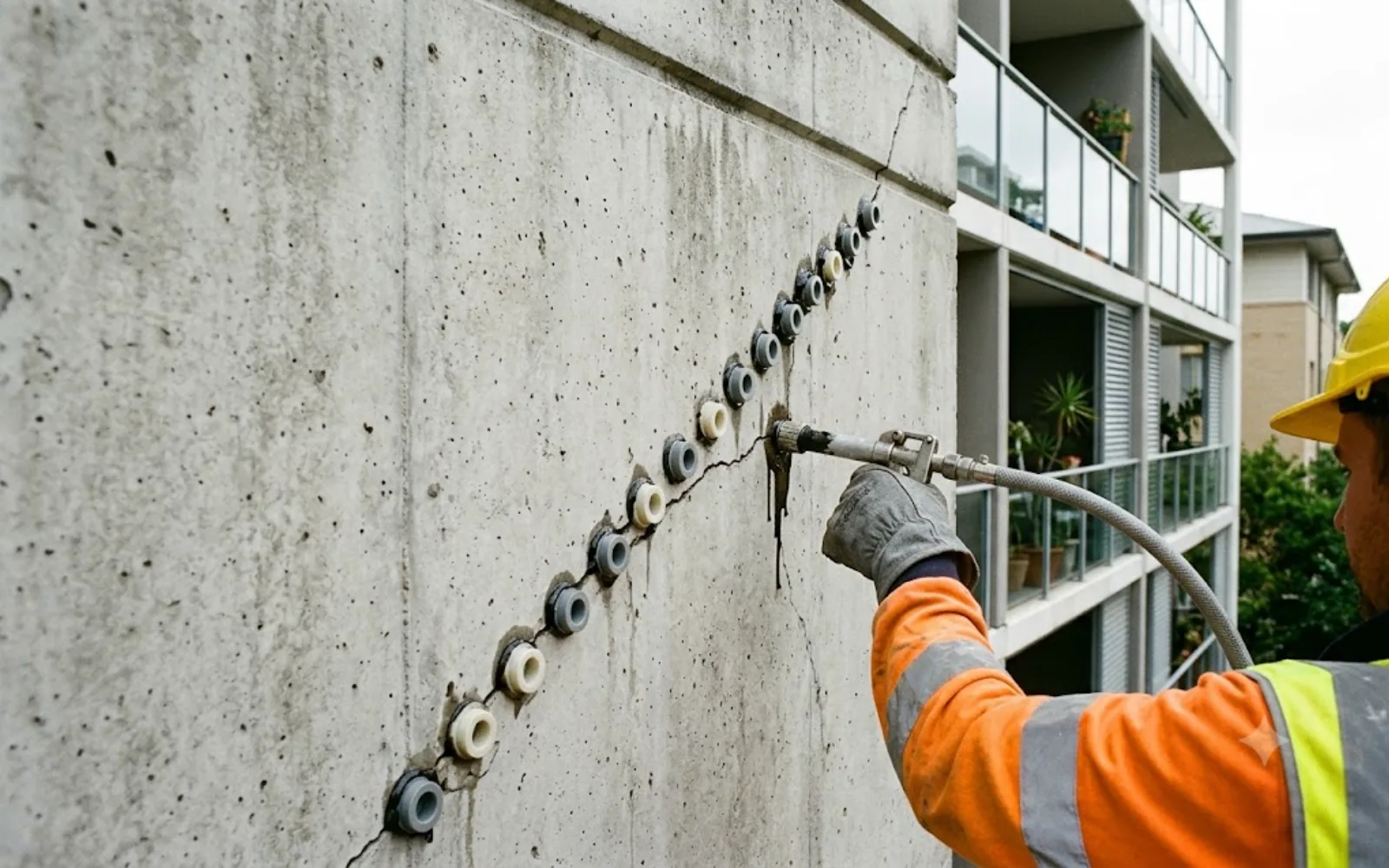
When a crack appears on a Sydney apartment facade or water starts tracking through a basement, the first useful document isn't a quote — it's a defect report. A good report turns a vague complaint into a costed, prioritised rectification scope. And once it lands, the owners corporation is on a strict statutory clock to act.
Strata managers and committees often hear the phrase "you'll need a Section 106 report" without a clear explanation of what that means, who pays for it, or what happens next. This guide sets it out from the builder's side of the table — the side that has to actually scope, price and fix what the report identifies. Atomic Projects is a Class 2 DBP Registered Building Practitioner that has delivered $20M+ of remedial work across 100+ Sydney strata buildings, and we read these reports every week.
If your building is sitting on an unresolved defect, the practical next step is usually a formal building investigation and condition report followed by a structured plan to rectify the building defects underneath it. The research is sobering: serious defects are widespread across NSW strata buildings, so most committees will deal with this at some point.
A "Section 106 defect report" is an industry term, not a statutory form. It's a building or engineering report that documents defects in a strata scheme's common property — their cause, extent and recommended fix — so the owners corporation can meet its duty under Section 106 of the Strata Schemes Management Act 2015 (NSW) to maintain and repair that property. It's prepared by a building consultant or engineer, not Fair Trading.
The name sticks because Section 106 is the legal reason the report exists. The duty to maintain common property is what forces an owners corporation to investigate, document and act on defects — and the report is the evidence that frames the decision.
Section 106(1) places a strict duty on the owners corporation to properly maintain and keep the common property in a state of good and serviceable repair. Section 106(2) extends this to renewing or replacing common-property fixtures and fittings. The duty is strict: a breach occurs the moment common property falls into disrepair, regardless of budget or how careful the committee has been.
Courts have read this duty broadly. It includes preventative maintenance — acting before a known problem becomes a failure — not just reacting after something breaks. There is a narrow exception in Section 106(3), covered below, but committees should treat the duty as non-negotiable until legal advice says otherwise.
This is why a credible report matters so much: it is the record that tells the committee what the common property condition is, and once they're on notice, inaction becomes a breach of a statutory duty — not just a maintenance backlog. Understanding how defect rectification is planned and staged early helps committees respond inside that duty rather than outside it.
It depends on the building's age and the defect source. For established buildings, the owners corporation usually commissions and pays for investigation of its own common-property defects. For newer buildings, the developer pays for the mandatory inspection reports under the Strata Building Bond and Inspection Scheme. An insurer or the original builder may ultimately bear rectification costs, but the upfront investigation is typically an owners-corporation expense.
Here's how the main scenarios break down:
| Scenario | Who commissions the report | Who typically pays | Governing instrument |
| Established building, common-property defect | Owners corporation (via strata manager/committee) | Owners corporation (admin or capital works fund) | Section 106, SSMA 2015 |
| New Class 2 building (within ~2 years of completion) | Developer appoints inspector from the panel | Developer | Strata Building Bond and Inspection Scheme (SBBIS) |
| Cost of rectification in dispute (new building) | Secretary / Fair Trading may arrange | Shared equally, developer and owners corporation | 209A report, SBBIS |
| Defect covered by statutory warranty | Owners corporation documents; pursues builder | Builder liable to rectify; OC funds report | Home Building Act 1989 (NSW) |
| Latent/insured damage | Owners corporation | Insurer may reimburse once liability established | Strata insurance / policy terms |
For new buildings under the SBBIS, the developer must have an interim defects report prepared early and a final defects report between roughly 21 and 24 months after completion. If the developer and owners corporation can't agree on the cost to rectify, a 209A report can be arranged and the cost shared. For everything outside that scheme, the owners corporation generally funds the investigation itself.
A report a builder can actually price identifies the areas inspected, each defect's cause (not just its symptom), the relevant standard it breaches, a severity or risk rating, a recommended rectification methodology, and an indicative cost and priority. Photographs and a clear scope are essential. A report that only lists symptoms — "water ingress to Unit 4" — without a diagnosed cause can't be scoped or tendered.
The difference between a cheap inspection and a useful report is diagnosis. Concrete spalling, for example, is usually a symptom; the cause might be carbonation or chloride attack, and the fix for each differs in method, cost and lifespan. A report that references the right standard — AS 3600 for concrete, AS 4654.2 for waterproofing — and ties each defect to a cause gives the committee something it can put to tender and the builder something it can stand behind.
When an engineer's report establishes the source of damage, it usually also determines who is liable for it — which is why that diagnostic step is worth paying for properly.
The Section 106 duty to maintain common property is immediate and ongoing — there's no grace period once the owners corporation is on notice. Separately, a lot owner who suffers loss from a breach can recover damages under Section 106(5), but must bring that action within two years of first becoming aware of the loss (Section 106(6)). Delay therefore creates both a safety exposure and a liability exposure.
In practice, this two-year window is why sitting on a defect report is risky. The clock for an owner's damages claim starts when they become aware of their loss, and the owners corporation's own duty is continuously live in the meantime. The report is often the moment "awareness" is documented for everyone involved.
This is general information, not legal advice — committees should get their own legal advice on limitation periods and any claim.
Once the report is in, the typical path is: confirm the scope, obtain tenders from qualified remedial builders, engage a Class 2 Registered Building Practitioner, carry out the rectification in stages where needed, and formally close out with evidence the defect is resolved. For common property, the owners corporation organises and funds this work through its funds and levies.
On Sydney strata buildings we've taken this from investigation through to completion many times — from a $50k balcony repair to a $5M+ facade and remediation program. The report defines the scope; a competent builder turns it into a staged plan that keeps residents safe and the building occupied while work proceeds.
Defects noted but not rectified can push up strata insurance premiums and excesses, and often trigger a special levy to fund the works. Insurers increasingly price the condition of a building into renewals, so an open defect report that sits unactioned can cost the owners corporation twice — once in premium, once in the eventual repair.
The link between unrepaired defects and rising premiums is now well established, which is one more reason to act on a report rather than file it. Acting early typically costs less than waiting for a defect to worsen and the insurance consequences to compound.
Only in a narrow case. Section 106(3) lets an owners corporation resolve by special resolution not to carry out a specified repair where it determines that maintaining or repairing it is inappropriate — but only if that decision won't affect the safety of the building or detract from its appearance. This is rare, must be properly resolved, and should not be used to defer genuine safety or structural defects. Get legal advice before relying on it.
For the vast majority of structural, waterproofing and facade defects, the exception won't apply, because those defects affect safety. The safer assumption for a committee is that the duty to repair stands.
A Section 106 defect report isn't red tape — it's the document that protects the owners corporation. It tells the committee what it's dealing with, starts the clock honestly, and gives a builder what's needed to price a real fix. The buildings that manage defects well are the ones that commission a proper diagnostic report early and act on it, rather than discovering the problem through a failed waterproofing membrane or a six-figure insurance renewal.
Atomic Projects works alongside strata managers and consultants across Sydney on exactly this — reading the report, scoping the work and delivering remedial building programs that close the defect out. If your building has a report you're not sure how to action, or a defect you haven't yet investigated, we offer a free, no-obligation assessment to help you understand your options.
Get a free assessment → talk to our team about your building's common-property defects.

Send photos, the engineer's report, or just the symptoms — whatever you've got. A registered builder reads it and calls you back. No call centre, no obligation.